Text to imageIllustrationStyle guide
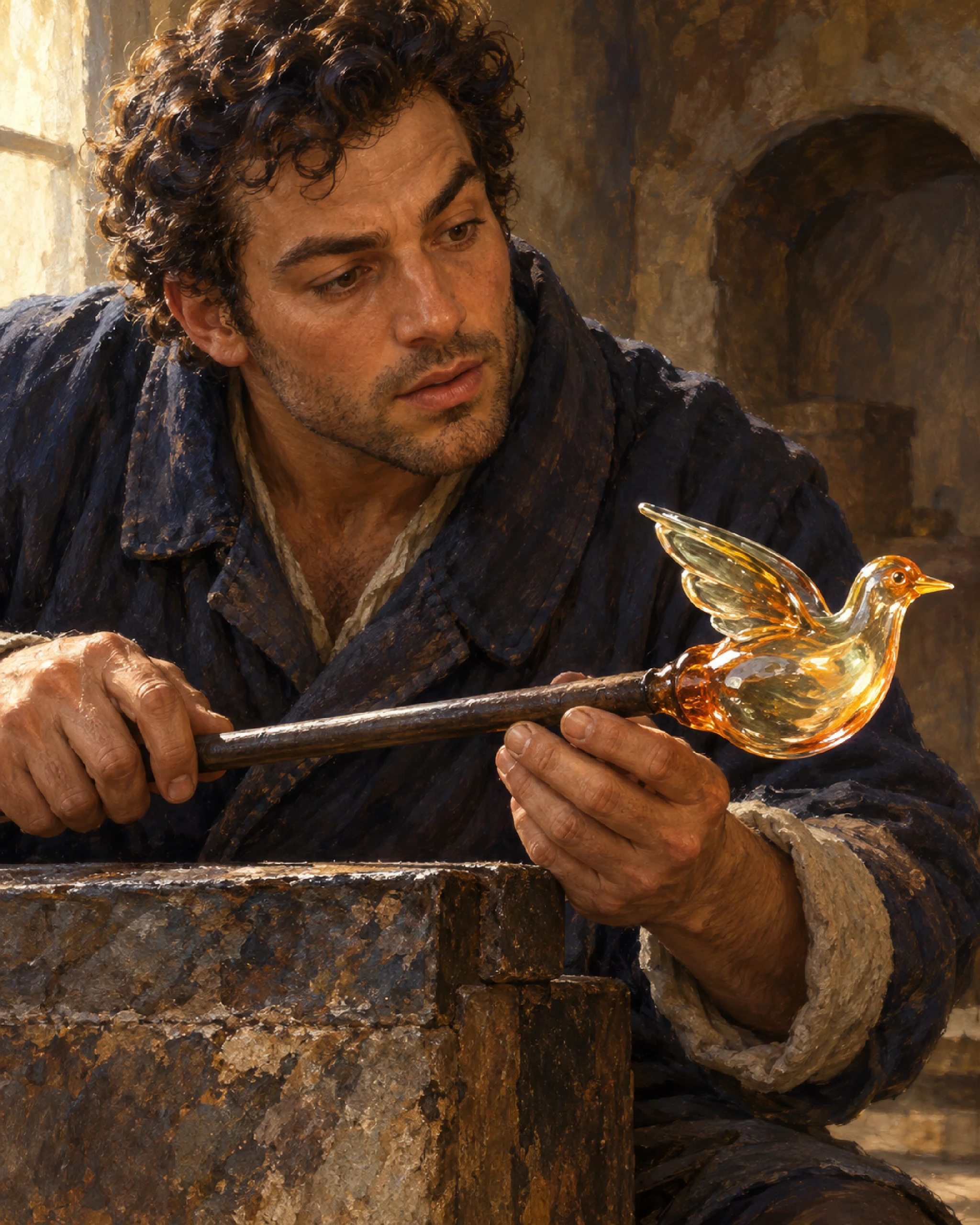
Glassworker Studying a Glass Bird
A glassworker gently turns a pipe to inspect the wing of a small, still-glowing glass bird. Expressive cropping brings face and fingers close, while flowing tonal transitions and layered brushwork illuminate a quiet workshop pause.
Remix this referenceGlassworker Studying a Glass Bird
- Form language
- Build forms from broad, rounded masses with selectively articulated small planes; allow minor shape variation within a coherent painted vocabulary.
- Contour
- Let contours emerge from adjacent value fields, alternating gently dissolved edges with a few fine, tapered accents.
- Mark-making
- Use flowing, overlapping brush passes with naturally varied lengths; let occasional dragged strokes remain visible in quieter passages.
- Surface rendering
- Layer translucent glazes over opaque foundations, merging midtones continuously while reserving a few concentrated bright notes.
Priority
Luminous continuous-tone painterly illustration, with brush variation surviving the soft tonal transitions.
What to avoid & what to check
Exact prompt for this example
MODULE OWNERSHIP
subject: Subject count, type, stable proportions and landmarks, resting face geometry, hair shape, physical materials, garment construction and permanent marks. No emotion, movement, color assignment or rendering recipe.
expression: Facial soft-tissue displacement and pupil direction, muscle coordination, regional intensity, asymmetry and onset/peak/release. No head/body pose, stable appearance, skin color or rendering.
gesture: Head/neck/body/limb orientation, joint movement, support, contact and pose-caused occlusion using existing anatomy. No eye/pupil movement, emotion, identity, props inventory or camera.
props: Prop count, type, construction, physical material and scale relative to the subject. Holding/contact belongs to gesture, position to composition, color to palette.
scene: Environment elements, terrain, backdrop/floor presence and structural detail. No canvas positions, camera, lighting, assigned colors or render texture.
camera: Projection, focal-length impression, camera elevation/yaw/roll, viewing distance and crop. No actor pose, world placement, lighting or canvas aspect ratio.
composition: Normalized 0-100% canvas positions, scale in frame, depth/overlap, focal hierarchy and margins. No joint pose, camera projection, rendering, subject/prop inventory or emotion.
palette: Color anchors, hue/saturation/value ranges, colors assigned to parts and approximate color coverage. No illumination direction, shading algorithm, physical material or layout.
lighting: Light-source direction/softness/intensity, ambient illumination, physical shadow direction/length and highlight position. Absence of directional illumination is allowed. No shading technique, palette or material changes.
style: Reusable form abstraction, contour weight/taper/edge quality, medium and mark scale/density/direction, surface rendering and tonal transition technique. No fixed subject proportions, anatomy, identity, expression, pose, palette, light-source direction, camera or layout.
output: Image count, aspect ratio, size, file/alpha requirements and global lettering/logo/watermark restrictions. No background scenery, crop, style, identity or pose.

SUBJECT
inventory: One adult glassworker, actor A; no other living subjects.
geometry: Broad cheekbones, a compact head above substantial shoulders, and sturdy hands with broad fingertips.
resting-face: Wide-set eyes, a softly angular nose bridge, and a full lower lip define the resting facial structure.
appearance: Short loose curls and a heavy cotton wrap jacket with a broad collar and turned cuffs; minor details may vary.

PRIORITY


AVOID


CHECK


EXPRESSION — ACTOR A
brows: One brow lifts slightly higher than the other.
lids: Upper lids open a little; lower lids remain soft.
cheeks: Cheeks stay loose, without a smile-driven lift.
nose: Nostrils remain relaxed, without flaring or wrinkling.
mouth: Lips begin to part narrowly, with level corners.
jaw: The jaw releases only enough to support the small lip opening.
gaze: Both pupils settle on the unfinished glass wing.
coordination: The uneven brow lift leads; the lower face remains quiet.
timing: Capture the onset, as the brow rises before the lips fully part.

PRIORITY


AVOID


CHECK


GESTURE
head: A tips the head slightly forward and turns it toward the glass form.
torso: The upper body inclines over the bench, with one shoulder gently advanced.
limbs: Both elbows bend; one hand steadies the shaft while the other lightly rolls it between fingertips.
contact: Fingers contact the pipe only; the shaft rests across the bench edge while the glass remains untouched.

PRIORITY


AVOID


CHECK


PROPS
inventory: One blowpipe with an attached unfinished bird-shaped glass form, approximately the size of A's palm.
construction: A hollow steel shaft carries a rounded glass body with a short beak and swept wings; handmade irregularity is welcome.

PRIORITY


AVOID


CHECK


SCENE
inventory: A small glass workshop with a stone workbench and a shallow wall alcove; the floor is outside the image.
structure: A heavy slab forms the work surface; the alcove has plain, slightly uneven walls and no shelving.

PRIORITY


AVOID


CHECK


CAMERA
projection: Gentle telephoto perspective compresses the distance between face and glass without flattening their volume.
viewpoint: View at eye height from a shallow three-quarter angle, with no camera roll.
crop: Crop part of the crown and lower forearms; retain the whole face, working fingers, and glass bird.

PRIORITY


AVOID


CHECK


COMPOSITION
placement: The face fills the left half; the bird sits near the right third, and the hands enter through the lower edge.
depth: The pipe crosses the foreground diagonally; the face sits behind it, with the alcove receding beyond both.
spacing: The face and glass wing form the focal pair; preserve a narrow open gap between their silhouettes and more air beyond the bird.

PRIORITY


AVOID


CHECK


PALETTE
colors: Anchor the image in smoky indigo, warm umber, muted terracotta, honey gold, and pale citron.
assignment: Use indigo for the jacket, umber for the workshop, terracotta for skin, and gold with citron accents for the glass.
balance: Dark, subdued hues occupy most of the image; smaller warm passages culminate in the pale glass accents.

PRIORITY


AVOID


CHECK


LIGHTING
sources: Broad soft window light arrives from upper left, accompanied by a weaker local glow from the still-hot glass.
shadows: Soft shadows fall rightward; diffuse ambient light keeps the recessed facial shadows readable.
highlights: Broad highlights touch the left forehead and fingers; a smaller bright reflection catches the upper glass wing.

PRIORITY


AVOID


CHECK


STYLE GUIDE
form-language: Build forms from broad, rounded masses with selectively articulated small planes; allow minor shape variation within a coherent painted vocabulary.
contour: Let contours emerge from adjacent value fields, alternating gently dissolved edges with a few fine, tapered accents.
mark-making: Use flowing, overlapping brush passes with naturally varied lengths; let occasional dragged strokes remain visible in quieter passages.
surface-rendering: Layer translucent glazes over opaque foundations, merging midtones continuously while reserving a few concentrated bright notes.

PRIORITY
Luminous continuous-tone painterly illustration, with brush variation surviving the soft tonal transitions.

AVOID


CHECK


OUTPUT
format: Deliver one 4:5 portrait image at 2048 × 2560 pixels as an opaque PNG.
restrictions: No lettering, logos, signatures, or watermarks.

PRIORITY


AVOID


CHECK


FINAL INTEGRATION
gesture + props: Resolve the hand contact against the defined prop construction.
Model information comes from image provenance. The same prompt may produce a different result.