Text to imageProductStyle guide
Glass Pitcher with a Crescent Handle
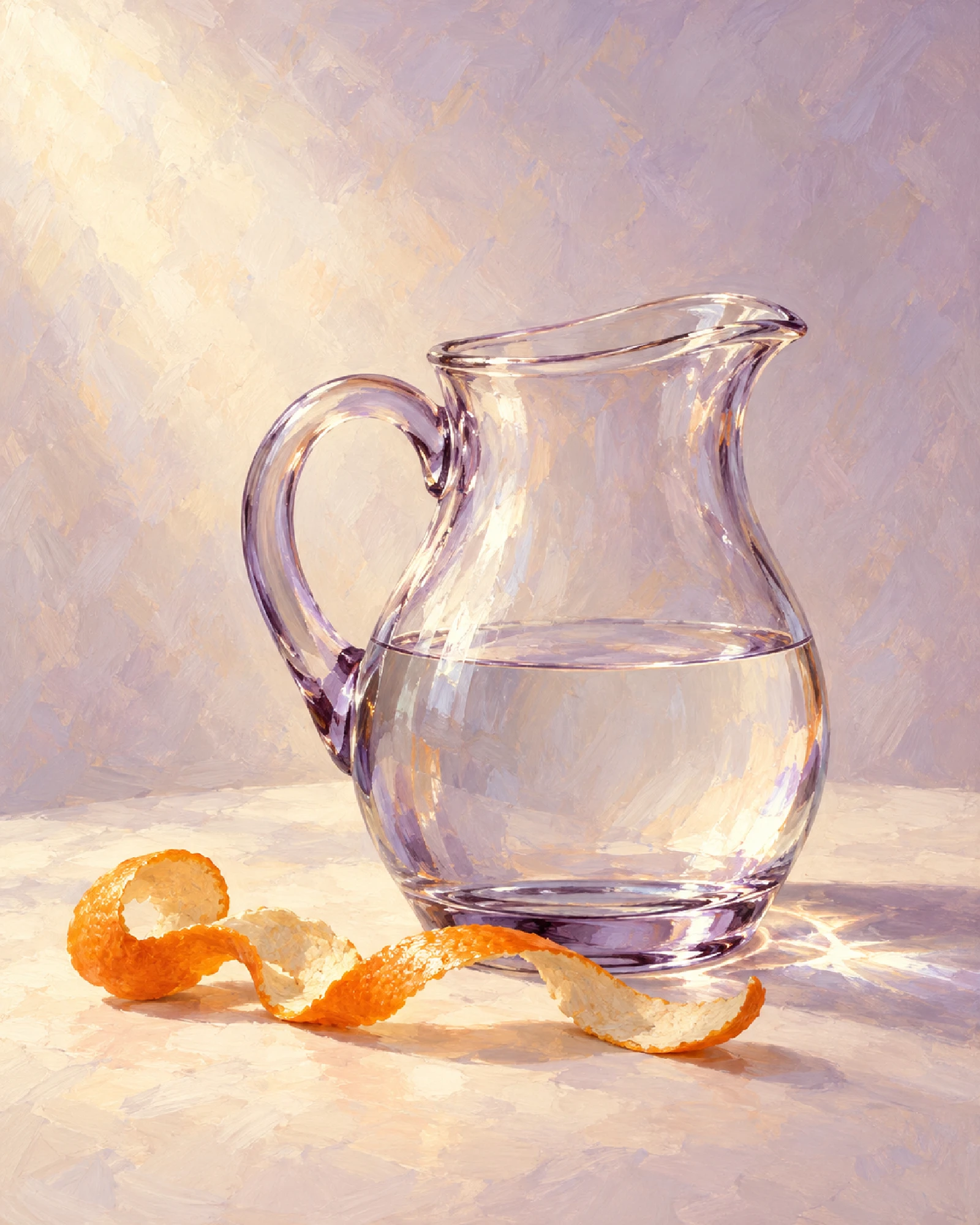
A crescent-handled glass pitcher and an unfurled citrus peel form a spacious product arrangement, painted with luminous continuous tones.
Remix this referenceGlass Pitcher with a Crescent Handle
- Form language
- Simplify objects into flowing volumetric masses while preserving the openings and broad structural changes.
- Contour
- Let edges dissolve and return through tonal contrast; reserve a few crisp painted accents for structural turns.
- Mark-making
- Interweave broad soft brush passes with occasional dragged strokes; allow natural variations in pressure and opacity.
- Surface rendering
- Build luminous continuous tones through translucent paint veils and softly blended turns, retaining visible painterly variation.
Priority
Use luminous continuous-tone painterly illustration, with light carried through layered paint.
What to avoid & what to check
Exact prompt for this example
MODULE OWNERSHIP
subject: Subject count, type, stable proportions and landmarks, resting face geometry, hair shape, physical materials, garment construction and permanent marks. No emotion, movement, color assignment or rendering recipe.
expression: Facial soft-tissue displacement and pupil direction, muscle coordination, regional intensity, asymmetry and onset/peak/release. No head/body pose, stable appearance, skin color or rendering.
gesture: Head/neck/body/limb orientation, joint movement, support, contact and pose-caused occlusion using existing anatomy. No eye/pupil movement, emotion, identity, props inventory or camera.
props: Prop count, type, construction, physical material and scale relative to the subject. Holding/contact belongs to gesture, position to composition, color to palette.
scene: Environment elements, terrain, backdrop/floor presence and structural detail. No canvas positions, camera, lighting, assigned colors or render texture.
camera: Projection, focal-length impression, camera elevation/yaw/roll, viewing distance and crop. No actor pose, world placement, lighting or canvas aspect ratio.
composition: Normalized 0-100% canvas positions, scale in frame, depth/overlap, focal hierarchy and margins. No joint pose, camera projection, rendering, subject/prop inventory or emotion.
palette: Color anchors, hue/saturation/value ranges, colors assigned to parts and approximate color coverage. No illumination direction, shading algorithm, physical material or layout.
lighting: Light-source direction/softness/intensity, ambient illumination, physical shadow direction/length and highlight position. Absence of directional illumination is allowed. No shading technique, palette or material changes.
style: Reusable form abstraction, contour weight/taper/edge quality, medium and mark scale/density/direction, surface rendering and tonal transition technique. No fixed subject proportions, anatomy, identity, expression, pose, palette, light-source direction, camera or layout.
output: Image count, aspect ratio, size, file/alpha requirements and global lettering/logo/watermark restrictions. No background scenery, crop, style, identity or pose.

SUBJECT
inventory: One original glass water pitcher, partially filled with drinking water.
geometry: A broad pear-shaped vessel narrows into an open pouring lip; a crescent loop forms its generous handle.
resting-face: No face is present.
appearance: Thick cast glass with a solid foot, rounded lip and subtly irregular walls; no permanent markings.

PRIORITY


AVOID


CHECK


PROPS
inventory: One continuous strip of citrus peel, long enough to span roughly the pitcher's width.
construction: A thin flexible rind ribbon with a porous outer surface and a soft pith underside.

PRIORITY


AVOID


CHECK


SCENE
inventory: A plain tabletop and a continuous backdrop, with no additional furnishings.
structure: The tabletop meets a gently curved backdrop without a visible hard junction.

PRIORITY


AVOID


CHECK


CAMERA
projection: A restrained short-telephoto perspective keeps the vessel's curves calm and undistorted.
viewpoint: View from slightly above tabletop height at a three-quarter angle that reveals the handle opening.
crop: Include the complete pitcher and peel with ample surrounding backdrop.

PRIORITY


AVOID


CHECK


COMPOSITION
placement: Set the pitcher low and right of center, with its handle opening toward the broad left-side space.
depth: The peel crosses just in front of the foot, then curls away without obscuring the vessel silhouette.
spacing: The pitcher leads, the peel supplies a small counter-rhythm, and generous upper-left space stays quiet.

PRIORITY


AVOID


CHECK


PALETTE
colors: Pale lilac, warm ivory, apricot orange and a small amount of deep plum.
assignment: Lilac-tinted glass, nearly colorless water, apricot peel and an ivory setting; plum accents the darkest passages.
balance: Keep most hues pale and gently saturated; concentrate richer color in the peel and thick glass edges.

PRIORITY


AVOID


CHECK


LIGHTING
sources: A large soft window source enters from the upper left, supported by gentle ambient illumination.
shadows: A soft shadow extends to the right, with a denser contact shadow beneath the foot.
highlights: Broad highlights follow the left shoulder and handle; refracted light gathers beyond the base.

PRIORITY


AVOID


CHECK


STYLE GUIDE
form-language: Simplify objects into flowing volumetric masses while preserving the openings and broad structural changes.
contour: Let edges dissolve and return through tonal contrast; reserve a few crisp painted accents for structural turns.
mark-making: Interweave broad soft brush passes with occasional dragged strokes; allow natural variations in pressure and opacity.
surface-rendering: Build luminous continuous tones through translucent paint veils and softly blended turns, retaining visible painterly variation.

PRIORITY
Use luminous continuous-tone painterly illustration, with light carried through layered paint.

AVOID


CHECK


OUTPUT
format: One finished portrait image, 4:5 aspect ratio, 1600 × 2000 pixels, opaque PNG.
restrictions: No lettering, logos, signatures or watermarks.

PRIORITY


AVOID


CHECK


FINAL INTEGRATION
subject + lighting + style: Let transmitted light explain the glass construction while painterly transitions keep its volume coherent.
Model information comes from image provenance. The same prompt may produce a different result.