Text to imageSpace & architectureStyle guide
Curled Courtyard Floor
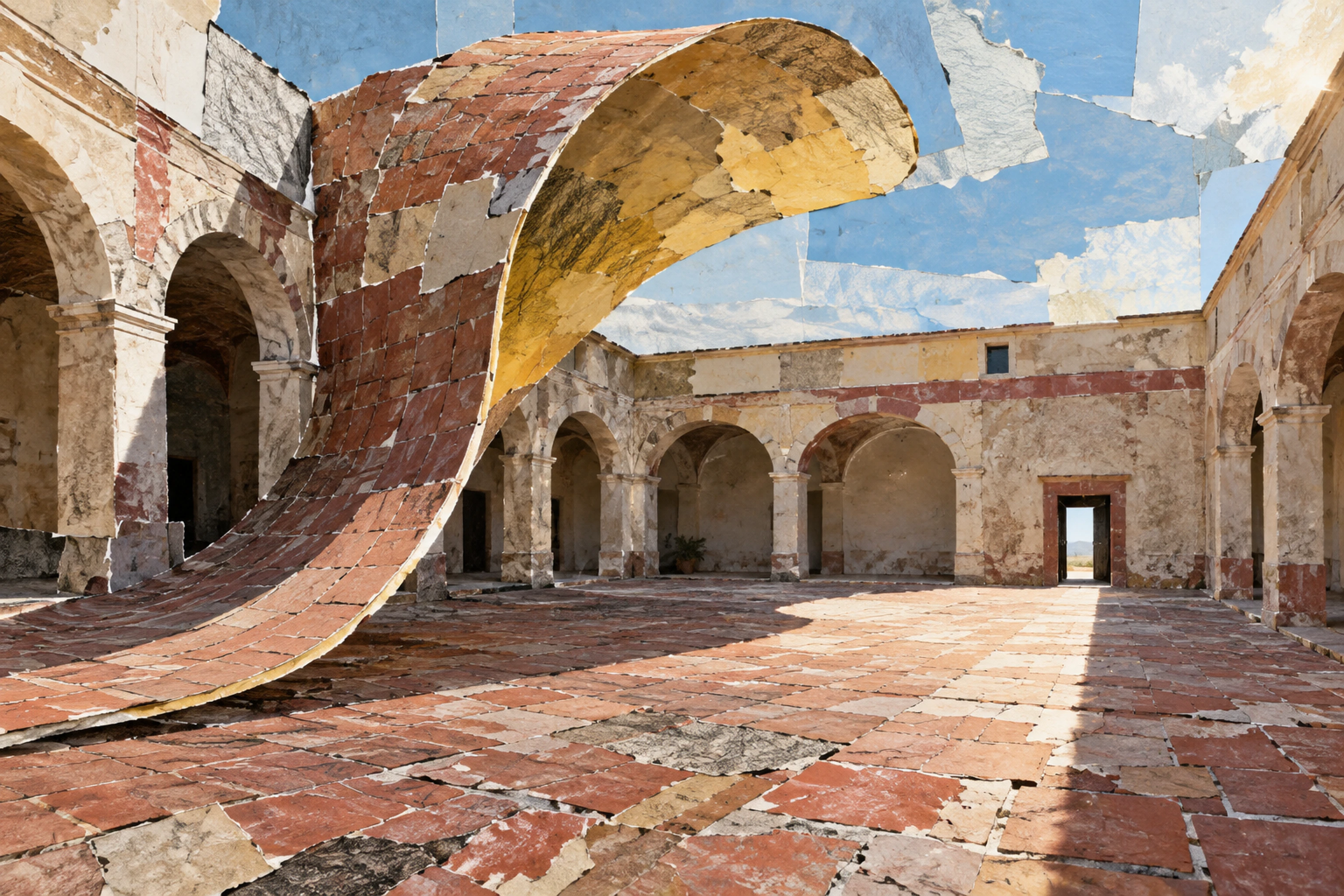
A surreal collage in which a courtyard’s tiled floor curls upward into a monumental canopy, its impossible scale revealed by small doorways and generous empty space.
Remix this referenceCurled Courtyard Floor
- Form language
- Combine blunt cut-paper silhouettes with photographic fragments; exaggerate scale discontinuities while keeping each fragment legible.
- Contour
- Alternate scissor-clean boundaries with torn fibers and occasional pencil extensions; retain slight misregistration at joins.
- Mark-making
- Use found photographic detail beside broad gouache swipes and loose graphite hatching; let each medium keep its own mark scale.
- Surface rendering
- Preserve pasted overlaps, translucent paper veils and rubbed pigment; bridge tonal changes selectively without blending every seam.
Priority
Make the surreal mixed-media collage visibly assembled from contrasting image fragments.
What to avoid & what to check
Exact prompt for this example
MODULE OWNERSHIP
subject: Subject count, type, stable proportions and landmarks, resting face geometry, hair shape, physical materials, garment construction and permanent marks. No emotion, movement, color assignment or rendering recipe.
expression: Facial soft-tissue displacement and pupil direction, muscle coordination, regional intensity, asymmetry and onset/peak/release. No head/body pose, stable appearance, skin color or rendering.
gesture: Head/neck/body/limb orientation, joint movement, support, contact and pose-caused occlusion using existing anatomy. No eye/pupil movement, emotion, identity, props inventory or camera.
props: Prop count, type, construction, physical material and scale relative to the subject. Holding/contact belongs to gesture, position to composition, color to palette.
scene: Environment elements, terrain, backdrop/floor presence and structural detail. No canvas positions, camera, lighting, assigned colors or render texture.
camera: Projection, focal-length impression, camera elevation/yaw/roll, viewing distance and crop. No actor pose, world placement, lighting or canvas aspect ratio.
composition: Normalized 0-100% canvas positions, scale in frame, depth/overlap, focal hierarchy and margins. No joint pose, camera projection, rendering, subject/prop inventory or emotion.
palette: Color anchors, hue/saturation/value ranges, colors assigned to parts and approximate color coverage. No illumination direction, shading algorithm, physical material or layout.
lighting: Light-source direction/softness/intensity, ambient illumination, physical shadow direction/length and highlight position. Absence of directional illumination is allowed. No shading technique, palette or material changes.
style: Reusable form abstraction, contour weight/taper/edge quality, medium and mark scale/density/direction, surface rendering and tonal transition technique. No fixed subject proportions, anatomy, identity, expression, pose, palette, light-source direction, camera or layout.
output: Image count, aspect ratio, size, file/alpha requirements and global lettering/logo/watermark restrictions. No background scenery, crop, style, identity or pose.

SUBJECT
inventory: No standalone subjects or figures; the architecture is the environment.
geometry: No separate subject geometry applies.
resting-face: No faces are present.
appearance: No separate subject appearance applies.

PRIORITY


AVOID


CHECK


PROPS
inventory: No separate props.
construction: No prop construction applies.

PRIORITY


AVOID


CHECK


SCENE
inventory: An empty walled courtyard with tiled paving, plaster arcades, small doorways and open sky.
structure: A continuous section of paving curls upward into a huge canopy; ordinary doorways remain embedded in the surrounding walls.

PRIORITY


AVOID


CHECK


CAMERA
projection: A moderately wide architectural perspective with readable depth and restrained edge stretching.
viewpoint: View from standing height near one courtyard corner, looking diagonally across it with level roll.
crop: Show the courtyard broadly, allowing the nearest paving and one arcade to continue beyond the frame.

PRIORITY


AVOID


CHECK


COMPOSITION
placement: The enormous curl occupies the left side; an open court and a distant doorway hold the right side.
depth: The curled edge overlaps the rear arcade while an uninterrupted floor passage connects foreground and distance.
spacing: Make the curl the dominant focal form and the tiny doorway its scale cue; preserve a spacious interval between them.

PRIORITY


AVOID


CHECK


PALETTE
colors: Warm limestone cream, faded brick red, pale blue, charcoal and restrained butter yellow.
assignment: Cream fills plaster, brick red marks paving, pale blue fills sky, charcoal deepens openings, and yellow accents the curl’s underside.
balance: Keep most colors faded and light, with small dark openings and one warmer underside accent.

PRIORITY


AVOID


CHECK


LIGHTING
sources: Soft sunlight enters from the upper right, supported by diffuse skylight.
shadows: The curl casts a broad shadow toward the lower left; arcade recesses retain softer ambient shadows.
highlights: A broad highlight follows the curl’s upper-right shoulder; avoid sharp glints.

PRIORITY


AVOID


CHECK


STYLE GUIDE
form-language: Combine blunt cut-paper silhouettes with photographic fragments; exaggerate scale discontinuities while keeping each fragment legible.
contour: Alternate scissor-clean boundaries with torn fibers and occasional pencil extensions; retain slight misregistration at joins.
mark-making: Use found photographic detail beside broad gouache swipes and loose graphite hatching; let each medium keep its own mark scale.
surface-rendering: Preserve pasted overlaps, translucent paper veils and rubbed pigment; bridge tonal changes selectively without blending every seam.

PRIORITY
Make the surreal mixed-media collage visibly assembled from contrasting image fragments.

AVOID


CHECK


OUTPUT
format: One finished image, landscape 3:2, 3072 × 2048 pixels, opaque PNG.
restrictions: No lettering, logos or watermarks, including within collage fragments.

PRIORITY


AVOID


CHECK
Model information comes from image provenance. The same prompt may produce a different result.