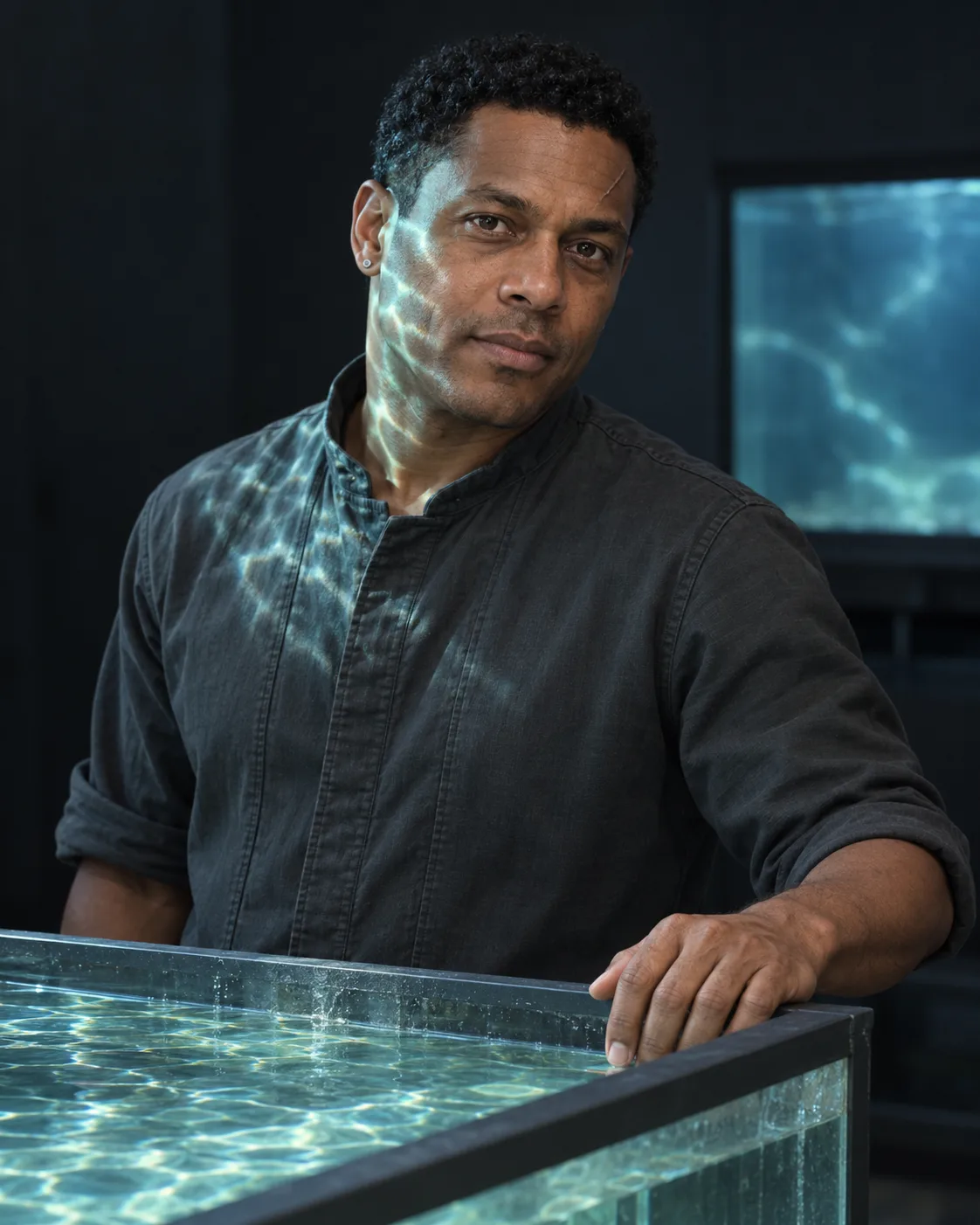
Aquarium Keeper · Water-Caustic Portrait
A photographic portrait that uses water caustics as the key light while preserving legible expression and hand contact.
Aquarium Keeper · Water-Caustic Portrait
- Shape & line
- Keep anatomical edges natural and unoutlined, with hair and fabric boundaries softening gradually against the background. Resolve the eyes, hand-to-rim contact, and waterline sharply; suppress tiny facial retouching and let secondary tank edges fall slightly out of focus.
- Color & light
- Let cool aqua reflected light occupy roughly one-third of the visible skin and tank area, while a neutral soft fill retains the rest of the face; keep the background two stops darker than the face. Caustic highlights may approach white but must avoid the pupils and preserve skin color between bands.
- Texture & material
- Record realistic damp glass with a few vertical streaks, matte woven cloth with fine low-contrast fibers, and skin with visible but restrained pores. Keep the caustic bands smooth-edged at their centers and gently broken at their margins; leave the eyes and background free of decorative texture.
- Composition
- Build a clear triangle from face to contacting hand to waterline, with air around the head and no bright object competing with the eyes. Overlap the forearm with the near tank edge, keep the far glass plane behind the torso, and reserve the darkest negative space beyond the shoulders.
Priority
Protect facial identity, clear eye contact, and believable hand-to-rim contact before increasing caustic contrast; the water pattern can shift slightly without changing the portrait pose.
What to avoid & what to check
Avoid rainbow prisms, underwater hair, wet skin, a second person, fish silhouettes, heavy blue grading, face-obscuring light bands, studio backdrops, lettering, external logos, and watermark.
Check the keeper's identifiers and expression, one hand on the rim, the face-hand-waterline triangle, controlled background depth, natural edges, cool caustics with neutral fill, realistic materials, and an eye-led focal order.
Exact prompt for this example
SUBJECT
One adult aquarium keeper pauses beside a shallow glass tank, one hand resting on its rim while reflected water light crosses the face.

COMPOSITION
A waist-up environmental portrait places the face above the tank corner, with caustic bands concentrated on cheek and neck rather than covering the eyes.

REPRODUCTION LOCKS
IDENTITY: A is exactly one adult human aquarium keeper, about 40 years old, with a calm focused expression, short tightly curled black hair, a faint diagonal scar above the viewer-right eyebrow, a small silver stud in the viewer-left ear, and a square jaw.

GEOMETRY: A has a broad-shouldered, average-build silhouette; head height is about one-seventh of the visible body height. The tank rim is a straight horizontal line at lower chest level, and the near corner projects toward viewer-right for deliberate asymmetry.

APPEARANCE: A wears a dark slate #343E43 cotton work shirt with a standing collar, two visible vertical front seams, and sleeves rolled once below the elbows. Skin is medium-brown #9A654B; the ear stud is dull silver #B9C5C4, and the tank frame is charcoal #30383B.

POSE: A faces three-quarters toward viewer-left, head tilted 8 degrees toward viewer-right, eyes looking directly at the camera. The viewer-right hand rests open on the near tank rim; the viewer-left forearm stays below the crop, and the torso turns 15 degrees away from the tank.

PROPS: One shallow rectangular glass tank occupies the lower frame, its visible near rim about three-quarters of A's shoulder width. Its waterline is visible just below the rim; no net, fish, plants, buckets, tools, jewelry beyond the one stud, or optional objects appear.

CAMERA: Eye-level three-quarter portrait from slightly viewer-right of A, with a normal-to-short-telephoto focal-length impression around 70 mm. Crop from just above the hair to the waist; keep facial proportions natural and the near tank rim in the focal plane.

LAYOUT: A occupies x=27–77%, y=7–94%, with face centered near (53%, 28%). The tank occupies x=5–91%, y=65–100%, with its near corner near (73%, 76%). Leave 20% dark negative space at viewer-left and a 7% top margin.

BACKGROUND: A dim aquarium workroom shows only one soft rectangular blue-gray tank glow behind A at x=74–94%, y=22–57%, and a dark wall elsewhere. No fish, shelves, signage, windows, or distinct equipment are visible.

LIGHTING: Sunlight from high viewer-left passes through shallow rippling water and reflects narrow aqua #86D6D6 caustic bands onto A's viewer-left cheek, neck, and shirt collar. Broad neutral fill from camera-right preserves both eyes; shadows fall softly toward viewer-right.

INVARIANTS: Keep, in order: one keeper with short curls and eyebrow scar; direct gaze; single silver ear stud; viewer-right hand on the tank rim; aqua caustics on cheek and neck but clear pupils; near tank corner at viewer-right; dark workroom. Only the fine ripple pattern may vary.

STYLE GUIDE
1. Shape & line
Keep anatomical edges natural and unoutlined, with hair and fabric boundaries softening gradually against the background. Resolve the eyes, hand-to-rim contact, and waterline sharply; suppress tiny facial retouching and let secondary tank edges fall slightly out of focus.

2. Color & light
Let cool aqua reflected light occupy roughly one-third of the visible skin and tank area, while a neutral soft fill retains the rest of the face; keep the background two stops darker than the face. Caustic highlights may approach white but must avoid the pupils and preserve skin color between bands.

3. Texture & material
Record realistic damp glass with a few vertical streaks, matte woven cloth with fine low-contrast fibers, and skin with visible but restrained pores. Keep the caustic bands smooth-edged at their centers and gently broken at their margins; leave the eyes and background free of decorative texture.

4. Composition
Build a clear triangle from face to contacting hand to waterline, with air around the head and no bright object competing with the eyes. Overlap the forearm with the near tank edge, keep the far glass plane behind the torso, and reserve the darkest negative space beyond the shoulders.

PRIORITY
Preserve the requested identity, count, action, composition and output settings. Apply the style rules within those constraints; a style reference must not replace the subject or layout. Within the style: Protect facial identity, clear eye contact, and believable hand-to-rim contact before increasing caustic contrast; the water pattern can shift slightly without changing the portrait pose.

AVOID
Avoid rainbow prisms, underwater hair, wet skin, a second person, fish silhouettes, heavy blue grading, face-obscuring light bands, studio backdrops, lettering, external logos, and watermark.

OUTPUT
One 4:5 vertical color photograph; waist-up crop, subdued aquarium interior, no lettering, external logos, or watermark.

SELF-CHECK
Check the keeper's identifiers and expression, one hand on the rim, the face-hand-waterline triangle, controlled background depth, natural edges, cool caustics with neutral fill, realistic materials, and an eye-led focal order.
Expression set
Base face
Expressions 32
Performance details
Neutral
Expression prompt
EXPRESSION
Neutral. Resting baseline: release all facial tension.
BROWS: Rest at their natural height without pulling together.
EYES: Rest at natural openness; no squint or widened stare.
CHEEKS: Remain relaxed without lift or nose wrinkling.
MOUTH: Keep lips gently touching and corners level.
JAW: Keep teeth apart slightly behind closed lips; jaw relaxed.
GAZE: Look straight at the viewer with aligned pupils.
EXPRESSION SCOPE: Apply only these facial movements; intensity changes movement amplitude, not identity or rendering style. Keep the head angle, body pose, framing and illumination supplied by the other modules. Use viewer-left/right consistently. Do not add tears, sweat, blush colors, symbols or props unless separately requested.

FACIAL MUSCLE COORDINATION
Resting baseline: release expressive brow, cheek and lip tension. Maintain ordinary eyelid support and comfortable lip contact; leave the jaw unclenched. No unilateral pull, squeezed lids or residual smile.
Full prompt
FACE IDENTITY
IDENTITY: One original adult character, approximately 28 years old, with an androgynous appearance; the same individual in every expression.
PROPORTIONS: Oval face with face height about 1.35 times cheekbone width; eye line near mid-height, with approximately one eye-width between inner eye corners.
EYES: Medium almond-shaped eyes, dark brown irises of equal size, defined upper eyelid folds and gently curved lower lids; preserve inner and outer corner locations.
BROWS: Medium-width straight eyebrows with a soft arch in the outer third; dark brown, with a softly tapered outer tip and a rounded inner end.
NOSE: Straight narrow bridge, softly rounded tip and small symmetrical nostrils; nose base width approximately equals the inner eye-corner distance.
MOUTH: Moderate-width mouth, defined but shallow cupid bow, lower lip slightly fuller than upper lip; preserve resting lip volume and philtrum length.
JAW: Softly tapered jaw, rounded chin and moderate cheekbone projection; ears of equal size at consistent positions beside the head.
SKIN: Even medium warm-brown complexion; keep the same underlying tone and age impression, without expression-dependent changes in skin texture.
HAIR: Short dark brown hair, straight side part at viewer-left, forehead visible, no bangs across the eyes and no facial hair.
MARKS: One small round mole below the viewer-left outer eye corner, about one iris diameter beneath it; no additional freckles, scars or accessories.
These describe the resting identity, not the final expression. Preserve bone structure, landmark spacing, iris size, hairline, age impression and distinctive marks. Only the requested soft-tissue motion may change.

RENDERING STYLE
1. Keep anatomical edges natural and unoutlined, with hair and fabric boundaries softening gradually against the background. Resolve the eyes, hand-to-rim contact, and waterline sharply; suppress tiny facial retouching and let secondary tank edges fall slightly out of focus.
2. Let cool aqua reflected light occupy roughly one-third of the visible skin and tank area, while a neutral soft fill retains the rest of the face; keep the background two stops darker than the face. Caustic highlights may approach white but must avoid the pupils and preserve skin color between bands.
3. Record realistic damp glass with a few vertical streaks, matte woven cloth with fine low-contrast fibers, and skin with visible but restrained pores. Keep the caustic bands smooth-edged at their centers and gently broken at their margins; leave the eyes and background free of decorative texture.
4. Build a clear triangle from face to contacting hand to waterline, with air around the head and no bright object competing with the eyes. Overlap the forearm with the near tank edge, keep the far glass plane behind the torso, and reserve the darkest negative space beyond the shoulders.
STYLE AVOID: Avoid rainbow prisms, underwater hair, wet skin, a second person, fish silhouettes, heavy blue grading, face-obscuring light bands, studio backdrops, lettering, external logos, and watermark.

PORTRAIT FRAME
One head-and-shoulders portrait, square frame, face centered, eye-level straight-on view with zero head roll. Hair and chin fully visible; head occupies about 60% of frame height. Plain light neutral background. Keep the same crop and softly even illumination across the set; use only the shading methods supported by the selected style.

MODULE PRIORITY
Identity landmarks first, facial movements second, fixed portrait framing third; transfer contour, palette relationships, shading and texture from the style. A style-only reference must not supply its identity, facial expression, hair, costume, head pose or scene. Translate movement into the style without adding realistic wrinkles or glossy volume to a flat style. Resting mouth/eyelid descriptions yield only to the requested movement, not to a different identity.

STYLE REFERENCE
https://images.imagenframe.com/v1/bc86a6e2f5cb1d0e0bd4aabb03f2701978ebc3e70346ab1ecfdceb5918d84e9a/af33942c41666535c73e8861cf078fe17f6f0b738fc08247bab50761821a6f34/1600.webp
Attach this image as a rendering-only reference.

QUALITY CHECK
Check the same face outline, eye spacing, nose shape, resting lip proportions, hairline and identifying marks across the set. Check each requested brow, lid, cheek, lip, jaw and gaze movement. Keep anatomy coherent and preserve the chosen rendering technique. No added labels, lettering or watermarks.

EXPRESSION
Neutral. Resting baseline: release all facial tension.
BROWS: Rest at their natural height without pulling together.
EYES: Rest at natural openness; no squint or widened stare.
CHEEKS: Remain relaxed without lift or nose wrinkling.
MOUTH: Keep lips gently touching and corners level.
JAW: Keep teeth apart slightly behind closed lips; jaw relaxed.
GAZE: Look straight at the viewer with aligned pupils.
EXPRESSION SCOPE: Apply only these facial movements; intensity changes movement amplitude, not identity or rendering style. Keep the head angle, body pose, framing and illumination supplied by the other modules. Use viewer-left/right consistently. Do not add tears, sweat, blush colors, symbols or props unless separately requested.

FACIAL MUSCLE COORDINATION
Resting baseline: release expressive brow, cheek and lip tension. Maintain ordinary eyelid support and comfortable lip contact; leave the jaw unclenched. No unilateral pull, squeezed lids or residual smile.

BASE FACE
Generate the neutral reference first. Review the identity and rendering before using this output as the shared face reference for subsequent expressions.Model information comes from image provenance. The same prompt may produce a different result.