Text to imageIllustrationStyle guide
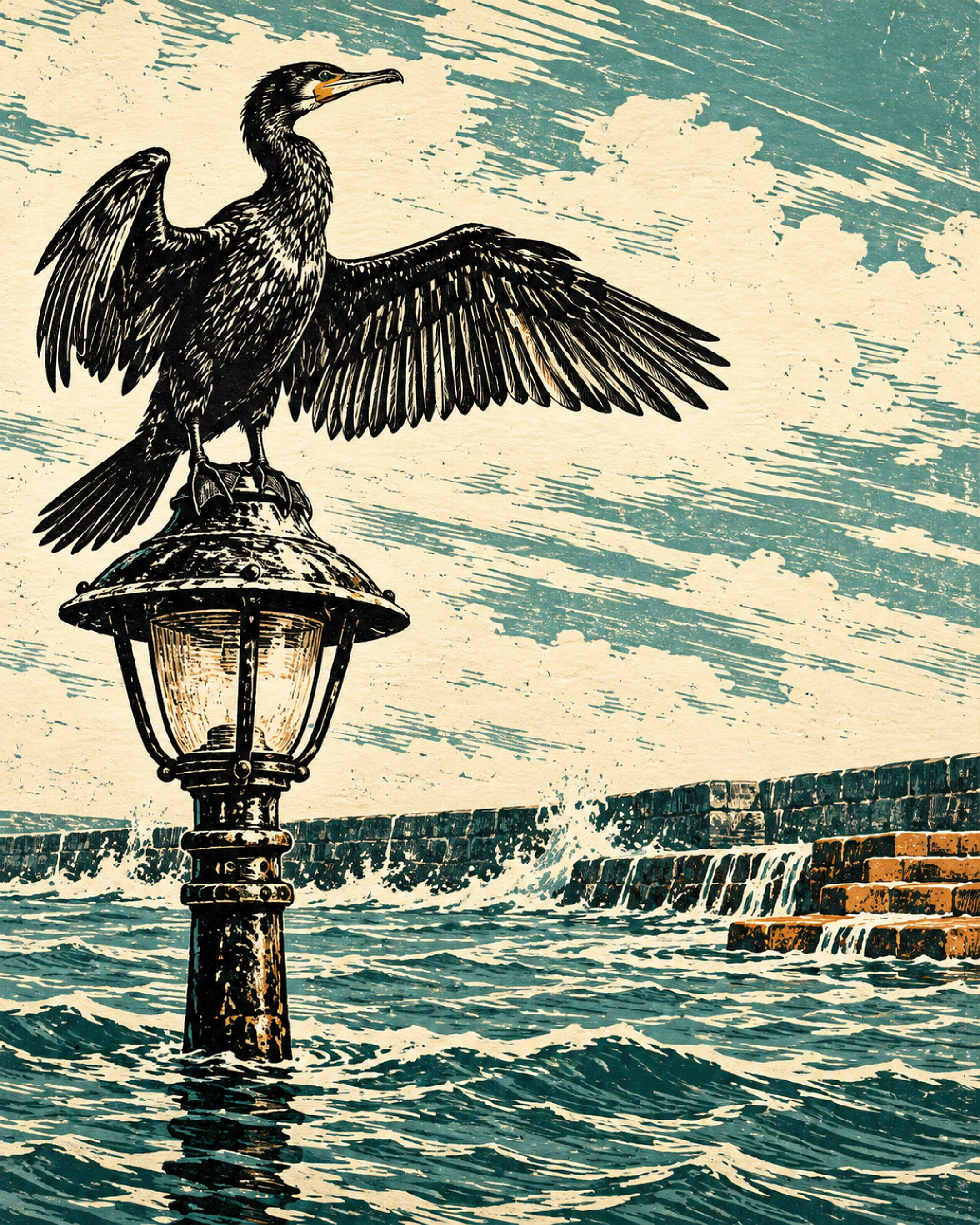
Cormorant on a Flooded Streetlamp
A cormorant spreads its wings on a streetlamp above a flooded coastal square. Spacious sky and boldly carved water give this quiet linocut scene its force.
Remix this referenceCormorant on a Flooded Streetlamp
- Form language
- Simplify forms into broad interlocking masses and irregular wedges, preserving recognition through a few decisive cuts.
- Contour
- Use heavy, slightly ragged printed edges, interrupted by tapered gouge notches; avoid mechanically uniform outlines.
- Mark-making
- Alternate long curved gouges with short chisel dashes in rhythmic clusters; let spacing and cut width vary naturally.
- Surface rendering
- Build tone from solid ink masses opened by paper-colored cuts, with occasional overprint and uneven ink bite.
Priority
Make bold linocut and rhythmic carved marks visibly define the finished image.
What to avoid & what to check
Exact prompt for this example
MODULE OWNERSHIP
subject: Subject count, type, stable proportions and landmarks, resting face geometry, hair shape, physical materials, garment construction and permanent marks. No emotion, movement, color assignment or rendering recipe.
expression: Facial soft-tissue displacement and pupil direction, muscle coordination, regional intensity, asymmetry and onset/peak/release. No head/body pose, stable appearance, skin color or rendering.
gesture: Head/neck/body/limb orientation, joint movement, support, contact and pose-caused occlusion using existing anatomy. No eye/pupil movement, emotion, identity, props inventory or camera.
props: Prop count, type, construction, physical material and scale relative to the subject. Holding/contact belongs to gesture, position to composition, color to palette.
scene: Environment elements, terrain, backdrop/floor presence and structural detail. No canvas positions, camera, lighting, assigned colors or render texture.
camera: Projection, focal-length impression, camera elevation/yaw/roll, viewing distance and crop. No actor pose, world placement, lighting or canvas aspect ratio.
composition: Normalized 0-100% canvas positions, scale in frame, depth/overlap, focal hierarchy and margins. No joint pose, camera projection, rendering, subject/prop inventory or emotion.
palette: Color anchors, hue/saturation/value ranges, colors assigned to parts and approximate color coverage. No illumination direction, shading algorithm, physical material or layout.
lighting: Light-source direction/softness/intensity, ambient illumination, physical shadow direction/length and highlight position. Absence of directional illumination is allowed. No shading technique, palette or material changes.
style: Reusable form abstraction, contour weight/taper/edge quality, medium and mark scale/density/direction, surface rendering and tonal transition technique. No fixed subject proportions, anatomy, identity, expression, pose, palette, light-source direction, camera or layout.
output: Image count, aspect ratio, size, file/alpha requirements and global lettering/logo/watermark restrictions. No background scenery, crop, style, identity or pose.

SUBJECT
inventory: A is one adult cormorant, the only animal or person present.
geometry: A long neck, slender hooked bill, elongated tail and broad webbed feet establish recognizable cormorant construction.
resting-face: Small lateral eyes and a narrow gape beneath the hooked bill define the resting facial geometry.
appearance: Overlapping feathers, a bare throat patch and scaly feet; no clothing or adornment.

PRIORITY


AVOID


CHECK


EXPRESSION — ACTOR A
brows: No visible brow action applies; do not introduce a human frown or eyebrow lift.
lids: The visible eye stays naturally open, without a squint or exaggerated widening.
cheeks: Keep the cheek region at rest, without lifting, bunching or puffing.
nose: No visible nostril deformation or flare.
mouth: The bill remains gently closed, with no pulled gape or smile-like curvature.
jaw: The lower jaw rests against the upper bill without gaping or clenching.
gaze: The visible pupil points slightly toward the wing.
coordination: Open lids and a relaxed closed bill work together as quiet, nonhuman facial acting.
timing: Hold the apex of a sustained neutral expression, between blinks and without a reaction beat.

PRIORITY


AVOID


CHECK


GESTURE
head: A lifts its neck in a loose curve, turning the bill slightly toward the fully extended wing.
torso: A holds its breast upright, with a slight forward lean balancing the tail behind.
limbs: One wing reaches broadly outward while the other remains partly raised, creating an uneven drying stretch.
contact: Both feet grip the lamp hood's rim; the toes overlap its edge and support the bird's weight.

PRIORITY


AVOID


CHECK


PROPS
inventory: No separate props.
construction: No prop construction applies.

PRIORITY


AVOID


CHECK


SCENE
inventory: A flooded coastal square contains one disused streetlamp, a low seawall, submerged paving and tide steps.
structure: An iron post carries a shallow lamp hood; water covers the paving and laps over the lower stone steps.

PRIORITY


AVOID


CHECK


CAMERA
projection: Use restrained perspective with a normal focal-length impression.
viewpoint: Look slightly upward from near water level, obliquely across the square, with no camera roll.
crop: Show the entire bird and lamp hood; let the post and nearest water continue beyond the lower crop.

PRIORITY


AVOID


CHECK


COMPOSITION
placement: The bird and lamp rise through the left third, with the bird near the upper quarter as the primary focus.
depth: Foreground water overlaps the lamp base; the distant seawall and steps form a low, secondary diagonal.
spacing: Keep generous sky to the right and breathing room around the bird; its silhouette spans roughly half the width.

PRIORITY


AVOID


CHECK


PALETTE
colors: Use ink black, faded teal, oxide orange and warm ivory, with muted saturation outside the black.
assignment: Assign black to bird and lamp, teal to water, orange to exposed steps, and ivory to sky and pale water breaks.
balance: Ivory and teal dominate coverage; black provides visual weight and orange remains a small accent.

PRIORITY


AVOID


CHECK


LIGHTING
sources: Broad, soft daylight arrives from the upper left, supported by gentle ambient sky light.
shadows: Short, soft shadows fall rightward beneath the lamp hood and along the exposed steps.
highlights: Light catches the upper-left edges of the bill, shoulder feathers and lamp hood.

PRIORITY


AVOID


CHECK


STYLE GUIDE
form-language: Simplify forms into broad interlocking masses and irregular wedges, preserving recognition through a few decisive cuts.
contour: Use heavy, slightly ragged printed edges, interrupted by tapered gouge notches; avoid mechanically uniform outlines.
mark-making: Alternate long curved gouges with short chisel dashes in rhythmic clusters; let spacing and cut width vary naturally.
surface-rendering: Build tone from solid ink masses opened by paper-colored cuts, with occasional overprint and uneven ink bite.

PRIORITY
Make bold linocut and rhythmic carved marks visibly define the finished image.

AVOID


CHECK


OUTPUT
format: One finished image, portrait 4:5, 2048 × 2560 pixels, opaque PNG.
restrictions: No lettering, logos, signatures or watermarks.

PRIORITY


AVOID


CHECK
Model information comes from image provenance. The same prompt may produce a different result.