Text to imageArt stylesStyle guide
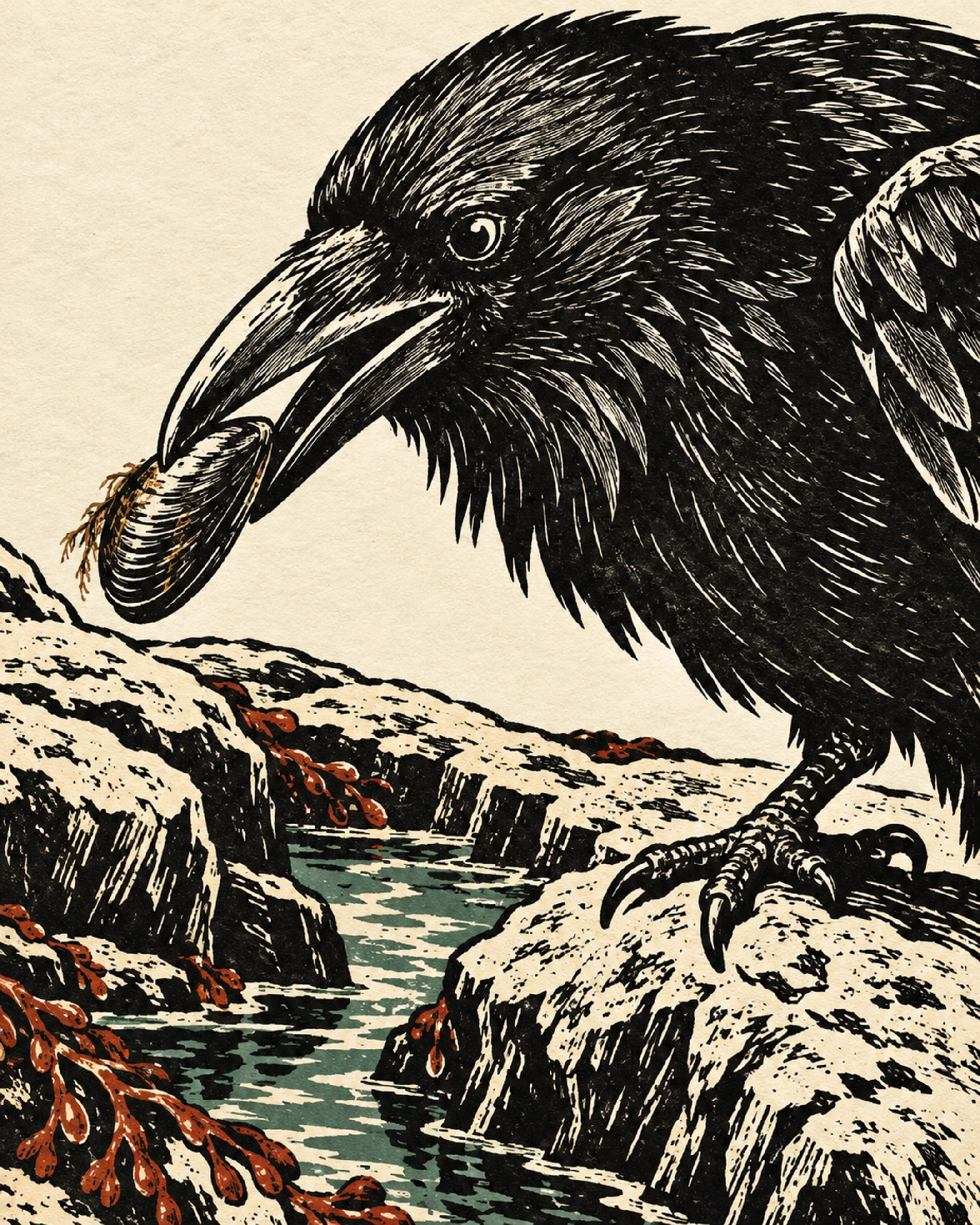
A Raven Lifting a Mussel
An intimately cropped linocut of a raven lifting a mussel from a tidal crevice. Hooked cuts through feathers meet the broken chisel rhythm of rock.
Remix this referenceA Raven Lifting a Mussel
- Form language
- Compress forms into interlocking wedges and hooked curves, preserving a few decisive structural breaks.
- Contour
- Use weighty ink edges interrupted by abrupt gouged notches; taper narrow edges into irregular cut points.
- Mark-making
- Alternate long curved gouges with short chisel bites; let spacing and direction vary naturally with each surface.
- Surface rendering
- Build tone through carved openings within solid ink masses; allow uneven ink transfer and small pressure breaks at edges.
Priority
Make bold linocut legible through rhythmic carving and the tension between printed masses and exposed paper.
What to avoid & what to check
Exact prompt for this example
MODULE OWNERSHIP
subject: Subject count, type, stable proportions and landmarks, resting face geometry, hair shape, physical materials, garment construction and permanent marks. No emotion, movement, color assignment or rendering recipe.
expression: Facial soft-tissue displacement and pupil direction, muscle coordination, regional intensity, asymmetry and onset/peak/release. No head/body pose, stable appearance, skin color or rendering.
gesture: Head/neck/body/limb orientation, joint movement, support, contact and pose-caused occlusion using existing anatomy. No eye/pupil movement, emotion, identity, props inventory or camera.
props: Prop count, type, construction, physical material and scale relative to the subject. Holding/contact belongs to gesture, position to composition, color to palette.
scene: Environment elements, terrain, backdrop/floor presence and structural detail. No canvas positions, camera, lighting, assigned colors or render texture.
camera: Projection, focal-length impression, camera elevation/yaw/roll, viewing distance and crop. No actor pose, world placement, lighting or canvas aspect ratio.
composition: Normalized 0-100% canvas positions, scale in frame, depth/overlap, focal hierarchy and margins. No joint pose, camera projection, rendering, subject/prop inventory or emotion.
palette: Color anchors, hue/saturation/value ranges, colors assigned to parts and approximate color coverage. No illumination direction, shading algorithm, physical material or layout.
lighting: Light-source direction/softness/intensity, ambient illumination, physical shadow direction/length and highlight position. Absence of directional illumination is allowed. No shading technique, palette or material changes.
style: Reusable form abstraction, contour weight/taper/edge quality, medium and mark scale/density/direction, surface rendering and tonal transition technique. No fixed subject proportions, anatomy, identity, expression, pose, palette, light-source direction, camera or layout.
output: Image count, aspect ratio, size, file/alpha requirements and global lettering/logo/watermark restrictions. No background scenery, crop, style, identity or pose.

SUBJECT
inventory: One adult raven, actor A.
geometry: A heavy wedge-shaped bill, compact crown, shaggy throat, broad wings and tapering tail.
resting-face: A round eye opening and a straight bill seam define the resting facial structure.
appearance: Overlapping feathers, scaled feet and a keratin bill; no garments or permanent ornaments.

PRIORITY


AVOID


CHECK


EXPRESSION — ACTOR A
brows: The eye surround stays relaxed, without a brow-like lift or furrow.
lids: Lids remain open and unpinched, with a slight lowering of the upper lid.
cheeks: No cheek lift or expressive puffing accompanies the quiet eye.
nose: No nostril flare or other separate nasal movement is visible.
mouth: The mouth corners stay quiet, without a smile-like pull.
jaw: The jaw maintains a small, steady opening without visible strain.
gaze: The visible pupil turns down and left toward the mussel.
coordination: The directed pupil and quiet lids work together without exaggerated facial tension.
timing: Hold the settled apex of this quiet facial state, without a blink or release cue.

PRIORITY


AVOID


CHECK


GESTURE
head: A extends its neck and turns its bill slightly outward while lifting the shell.
torso: The torso leans forward over the rock, with wings tucked against the body.
limbs: One visible foot spreads its toes to brace against the uneven rock.
contact: The bill tips pinch the mussel rim; the visible claws grip the rock beneath the body.

PRIORITY


AVOID


CHECK


PROPS
inventory: One closed mussel, small enough to fit between the raven's bill tips.
construction: Two elongated mineral shell valves with growth ridges and a short tuft of fibrous attachment threads.

PRIORITY


AVOID


CHECK


SCENE
inventory: A tidal rock ledge with a narrow seawater-filled crevice and sparse bladderwrack.
structure: Angular rock shelves enclose shallow water pockets; no buildings or distant terrain are present.

PRIORITY


AVOID


CHECK


CAMERA
projection: Natural perspective with the restrained depth of a short telephoto view.
viewpoint: A close three-quarter view from slightly below the raven's eye level, with a level camera.
crop: Include the crown, bill, throat and one foot; let the rear body and tail continue beyond the frame.

PRIORITY


AVOID


CHECK


COMPOSITION
placement: The head fills the upper right; the bill reaches into the left third above a low diagonal rock shelf.
depth: The bill-and-shell junction leads, the feather mass follows, and the crevice recedes beneath their overlap.
spacing: An open wedge surrounds the bill tips; the heavier body meets the right edge with little margin.

PRIORITY


AVOID


CHECK


PALETTE
colors: Coal black, warm ivory, muted sea green and a restrained vermilion accent.
assignment: Black anchors the raven and mussel; ivory belongs to rock and paper, green to water, vermilion to seaweed.
balance: Black and ivory dominate; green forms a secondary field and vermilion appears in small accents.

PRIORITY


AVOID


CHECK


LIGHTING
sources: Broad, soft daylight enters from the upper left with moderate ambient fill.
shadows: Short shadows fall toward the lower right, with deeper shade inside the rock crevice.
highlights: Light catches the upper bill ridge, crown and raised shell rim.

PRIORITY


AVOID


CHECK


STYLE GUIDE
form-language: Compress forms into interlocking wedges and hooked curves, preserving a few decisive structural breaks.
contour: Use weighty ink edges interrupted by abrupt gouged notches; taper narrow edges into irregular cut points.
mark-making: Alternate long curved gouges with short chisel bites; let spacing and direction vary naturally with each surface.
surface-rendering: Build tone through carved openings within solid ink masses; allow uneven ink transfer and small pressure breaks at edges.

PRIORITY
Make bold linocut legible through rhythmic carving and the tension between printed masses and exposed paper.

AVOID


CHECK


OUTPUT
format: One image, portrait 4:5, 2048 × 2560 pixels, opaque PNG.
restrictions: No lettering, logos or watermarks.

PRIORITY


AVOID


CHECK
Model information comes from image provenance. The same prompt may produce a different result.