Text to imageLandscapeStyle guide
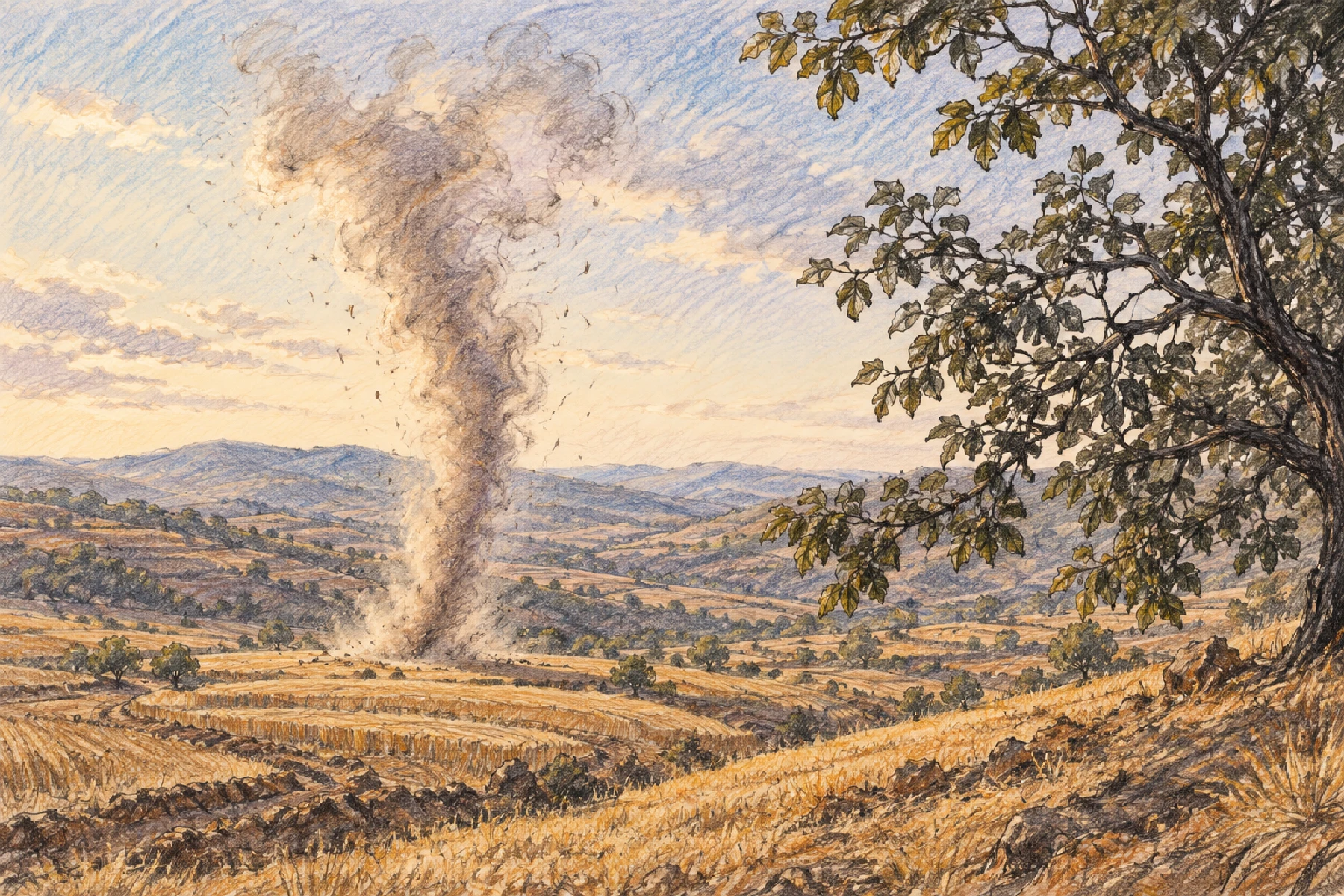
Dust Whirl in the Stubble Fields
A dust column crosses harvested hills beneath overlapping walnut branches, drawn in rough pencil and colored pencil.
Remix this referenceDust Whirl in the Stubble Fields
- Form language
- Reduce complex scenery to elastic ribbons and irregular masses, retaining enough interruption to feel observed rather than diagrammatic.
- Contour
- Use searching graphite contours with doubled passages, pressure changes and occasional unfinished edges.
- Mark-making
- Alternate looping pencil scrawls with long directional hatching; let mark length and density vary naturally.
- Surface rendering
- Layer broken colored-pencil scumbles over toothy paper; build tones through visible overlaps and leave breathing patches of bare paper.
Priority
Preserve the visibly rough pencil and colored-pencil sketchbook character throughout.
What to avoid & what to check
Exact prompt for this example
MODULE OWNERSHIP
subject: Subject count, type, stable proportions and landmarks, resting face geometry, hair shape, physical materials, garment construction and permanent marks. No emotion, movement, color assignment or rendering recipe.
expression: Facial soft-tissue displacement and pupil direction, muscle coordination, regional intensity, asymmetry and onset/peak/release. No head/body pose, stable appearance, skin color or rendering.
gesture: Head/neck/body/limb orientation, joint movement, support, contact and pose-caused occlusion using existing anatomy. No eye/pupil movement, emotion, identity, props inventory or camera.
props: Prop count, type, construction, physical material and scale relative to the subject. Holding/contact belongs to gesture, position to composition, color to palette.
scene: Environment elements, terrain, backdrop/floor presence and structural detail. No canvas positions, camera, lighting, assigned colors or render texture.
camera: Projection, focal-length impression, camera elevation/yaw/roll, viewing distance and crop. No actor pose, world placement, lighting or canvas aspect ratio.
composition: Normalized 0-100% canvas positions, scale in frame, depth/overlap, focal hierarchy and margins. No joint pose, camera projection, rendering, subject/prop inventory or emotion.
palette: Color anchors, hue/saturation/value ranges, colors assigned to parts and approximate color coverage. No illumination direction, shading algorithm, physical material or layout.
lighting: Light-source direction/softness/intensity, ambient illumination, physical shadow direction/length and highlight position. Absence of directional illumination is allowed. No shading technique, palette or material changes.
style: Reusable form abstraction, contour weight/taper/edge quality, medium and mark scale/density/direction, surface rendering and tonal transition technique. No fixed subject proportions, anatomy, identity, expression, pose, palette, light-source direction, camera or layout.
output: Image count, aspect ratio, size, file/alpha requirements and global lettering/logo/watermark restrictions. No background scenery, crop, style, identity or pose.

SUBJECT
inventory: One natural dust whirl is the main subject; no people or animals.
geometry: A tapered column opens into an uneven crown, with gaps interrupting its physical outline.
resting-face: No faces are present.
appearance: The column consists of airborne soil dust and scattered dry straw.

PRIORITY


AVOID


CHECK


PROPS
inventory: No separate props.
construction: No prop construction applies.

PRIORITY


AVOID


CHECK


SCENE
inventory: Harvested hillside fields, shallow drainage furrows, one mature walnut tree and open sky.
structure: Curving field terraces follow the hills; exposed clods and stubble break their edges. Small details may vary.

PRIORITY


AVOID


CHECK


CAMERA
projection: Natural perspective with a moderately wide, approximately 35 mm lens impression.
viewpoint: Use a slightly elevated viewpoint looking outward, with a level horizon and no roll.
crop: Use a broad landscape view that includes the complete dust column and enough terrain to establish distance.

PRIORITY


AVOID


CHECK


COMPOSITION
placement: Place the column near 38% canvas width, at roughly half the frame height; walnut branches enter from the right.
depth: Foreground branches overlap the distant column; successive field ridges carry attention toward its narrow base.
spacing: Keep generous sky around the broken crown and a clear interval between the base and the nearest branch mass.

PRIORITY


AVOID
No decorative borders.

CHECK


PALETTE
colors: Warm parchment, straw ochre, muted violet-gray and deep graphite form the restrained palette.
assignment: Use parchment for sky, ochre for stubble, violet-gray for dust and graphite for the walnut tree.
balance: Let pale warm colors dominate, with a smaller cool dust passage and concentrated dark branches.

PRIORITY


AVOID


CHECK


LIGHTING
sources: Soft late-afternoon sunlight comes from the upper left, supported by broad sky illumination.
shadows: Tree and furrow shadows extend gently to the right, with softened edges.
highlights: A restrained bright fringe catches the column's left edge and the exposed tops of nearby straw.

PRIORITY


AVOID


CHECK


STYLE GUIDE
form-language: Reduce complex scenery to elastic ribbons and irregular masses, retaining enough interruption to feel observed rather than diagrammatic.
contour: Use searching graphite contours with doubled passages, pressure changes and occasional unfinished edges.
mark-making: Alternate looping pencil scrawls with long directional hatching; let mark length and density vary naturally.
surface-rendering: Layer broken colored-pencil scumbles over toothy paper; build tones through visible overlaps and leave breathing patches of bare paper.

PRIORITY
Preserve the visibly rough pencil and colored-pencil sketchbook character throughout.

AVOID


CHECK


OUTPUT
format: Deliver one finished image, 3:2 landscape, 1800 × 1200 pixels, opaque PNG.
restrictions: No lettering, logos or watermarks.

PRIORITY


AVOID


CHECK


FINAL INTEGRATION
subject + scene + composition + style: Let environmental rhythm and varied drawing marks support the subject's readability without making every element equally explicit.
Model information comes from image provenance. The same prompt may produce a different result.