Text to imageArt stylesStyle guide
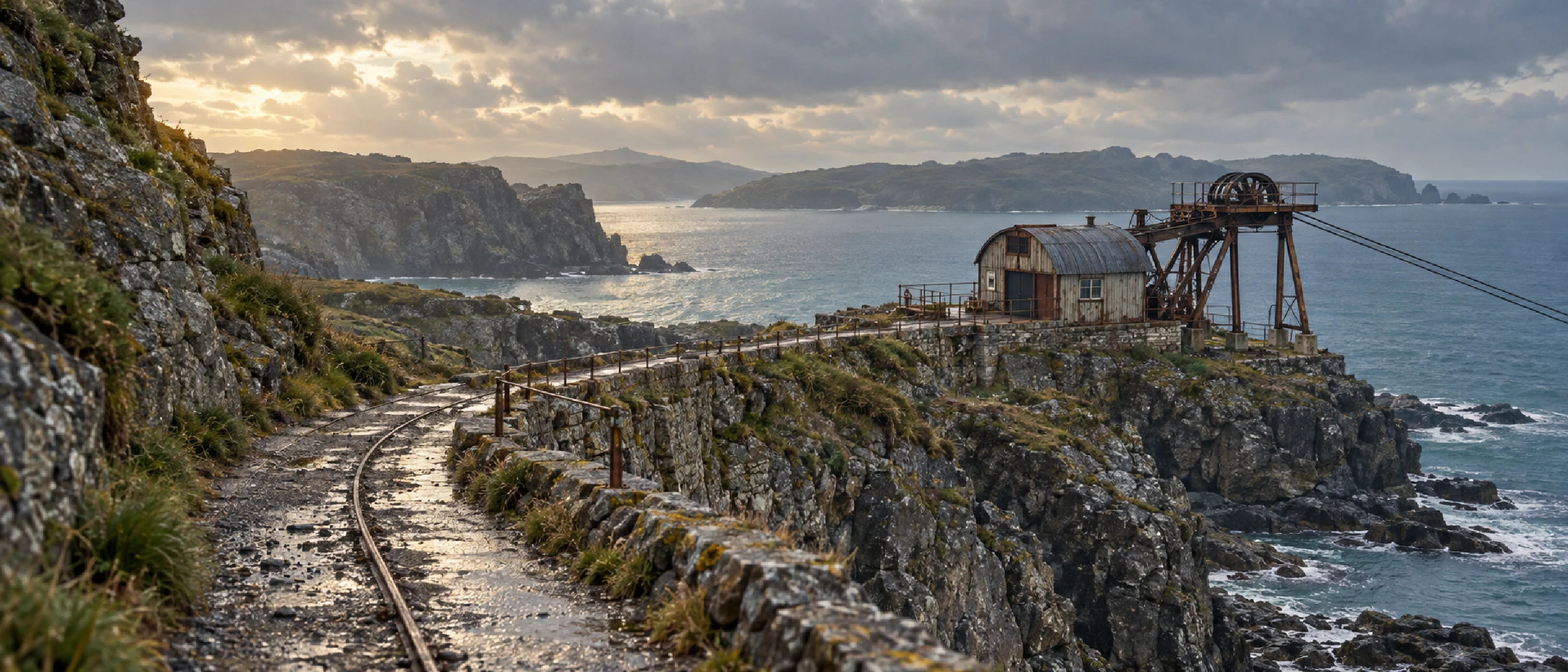
Rainlit Cliffside Cable Station
A panoramic photograph follows a wet cliff path toward a small cable station above a bay. Silver-grain texture and softly blooming highlights give the journey from nearby rock to distant coast expressive depth.
Remix this referenceRainlit Cliffside Cable Station
- Form language
- Retain observed photographic complexity, grouping minor detail into broad readable masses rather than sharpening every surface equally.
- Contour
- Use unoutlined photographic edges: crisp local boundaries soften gradually into atmospheric edges, with slight bloom around bright transitions.
- Mark-making
- Fine irregular silver-grain mottling remains visible in middle tones, with natural density variation and no repeating texture overlay.
- Surface rendering
- Use analog-print tonal response: gently compressed highlights, open textured shadows and continuous transitions with restrained halation.
Priority
Make the analog treatment visible through edges and tonal response.
What to avoid & what to check
Avoid a uniform vintage filter or brittle digital clarity.
Grain, bloom and tonal compression feel integrated into a photographic print.
Exact prompt for this example
MODULE OWNERSHIP
subject: Subject count, type, stable proportions and landmarks, resting face geometry, hair shape, physical materials, garment construction and permanent marks. No emotion, movement, color assignment or rendering recipe.
expression: Facial soft-tissue displacement and pupil direction, muscle coordination, regional intensity, asymmetry and onset/peak/release. No head/body pose, stable appearance, skin color or rendering.
gesture: Head/neck/body/limb orientation, joint movement, support, contact and pose-caused occlusion using existing anatomy. No eye/pupil movement, emotion, identity, props inventory or camera.
props: Prop count, type, construction, physical material and scale relative to the subject. Holding/contact belongs to gesture, position to composition, color to palette.
scene: Environment elements, terrain, backdrop/floor presence and structural detail. No canvas positions, camera, lighting, assigned colors or render texture.
camera: Projection, focal-length impression, camera elevation/yaw/roll, viewing distance and crop. No actor pose, world placement, lighting or canvas aspect ratio.
composition: Normalized 0-100% canvas positions, scale in frame, depth/overlap, focal hierarchy and margins. No joint pose, camera projection, rendering, subject/prop inventory or emotion.
palette: Color anchors, hue/saturation/value ranges, colors assigned to parts and approximate color coverage. No illumination direction, shading algorithm, physical material or layout.
lighting: Light-source direction/softness/intensity, ambient illumination, physical shadow direction/length and highlight position. Absence of directional illumination is allowed. No shading technique, palette or material changes.
style: Reusable form abstraction, contour weight/taper/edge quality, medium and mark scale/density/direction, surface rendering and tonal transition technique. No fixed subject proportions, anatomy, identity, expression, pose, palette, light-source direction, camera or layout.
output: Image count, aspect ratio, size, file/alpha requirements and global lettering/logo/watermark restrictions. No background scenery, crop, style, identity or pose.

SUBJECT
inventory: One original cliffside cable station; no people or animals.
geometry: A low barrel-roofed station joins an open steel gantry with a broad cable wheel and slender supporting legs.
resting-face: No faces are present.
appearance: Corrugated metal roofing, riveted steel supports and timber wall panels show weathering; small fittings may vary.

PRIORITY
Keep the station recognizable through its roof and exposed cable mechanism.

AVOID
Avoid turning the station into a monumental industrial complex.

CHECK
The station reads as a modest, plausible piece of coastal infrastructure.

PROPS
inventory: No separate props.
construction: No prop construction applies.

PRIORITY


AVOID


CHECK


SCENE
inventory: A rocky coastal escarpment, rain-wet maintenance path, embedded rails, tidal bay and distant headlands.
structure: The path follows the cliff around a sheltered inlet; broken rock shelves and sparse grasses interrupt its retaining wall.

PRIORITY
Make the coast feel continuous and traversable.

AVOID
Avoid unrelated scenic landmarks crowding the inlet.

CHECK
The path, retaining wall and cliff belong to one coherent environment.

CAMERA
projection: Rectilinear perspective with a moderately wide photographic lens impression and natural recession.
viewpoint: View from standing height on the path, looking obliquely along the cliff; keep the horizon level.
crop: A distant environmental view includes the whole station while nearby rock and path continue beyond the frame.

PRIORITY
Use a viewpoint that invites entry into the coast.

AVOID
Avoid fisheye distortion or an aerial survey feeling.

CHECK
The view feels photographed from a place someone could stand.

COMPOSITION
placement: Set the station near the right third; the foreground path enters from the lower left and leads toward it.
depth: Large near rock edges overlap the middle-distance path; the station anchors the journey before receding headlands.
spacing: Leave a spacious bay between the enclosing cliff and distant coast, with breathing room above the station.

PRIORITY
Let the eye travel through the panorama before settling on the station.

AVOID
Avoid equal emphasis across every depth layer.

CHECK
The station is the destination of a readable visual journey.

PALETTE
colors: Petrol blue, slate gray, weathered rust and pale cream; restrained saturation with generous middle values.
assignment: Assign petrol blue to the bay, slate to rock and roofing, rust to steel, and pale cream to sky and wet glints.
balance: Cool tones dominate; the station carries the small warm accent, while the sky supplies the broad pale area.

PRIORITY
Make the warm station register within a cool coastal field.

AVOID
Avoid vivid postcard blues.

CHECK
The restrained anchors hold together across the entire panorama.

LIGHTING
sources: Broad late-day light breaks through cloud from the upper left, supported by soft overcast ambient illumination.
shadows: Soft shadows extend toward the right; recesses under the station remain visibly deeper than exposed rock.
highlights: Wet path edges and upward-facing roof ridges catch intermittent highlights; distant water has a broad faint sheen.

PRIORITY
Let the passing break in cloud reveal the route.

AVOID
Avoid theatrical spotlights on individual landmarks.

CHECK
Illumination feels like one coastal weather event.

STYLE GUIDE
form-language: Retain observed photographic complexity, grouping minor detail into broad readable masses rather than sharpening every surface equally.
contour: Use unoutlined photographic edges: crisp local boundaries soften gradually into atmospheric edges, with slight bloom around bright transitions.
mark-making: Fine irregular silver-grain mottling remains visible in middle tones, with natural density variation and no repeating texture overlay.
surface-rendering: Use analog-print tonal response: gently compressed highlights, open textured shadows and continuous transitions with restrained halation.

PRIORITY
Make the analog treatment visible through edges and tonal response.

AVOID
Avoid a uniform vintage filter or brittle digital clarity.

CHECK
Grain, bloom and tonal compression feel integrated into a photographic print.

OUTPUT
format: One finished image, 21:9 aspect ratio, 2520 × 1080 pixels, opaque PNG.
restrictions: No lettering, logos, watermarks or presentation borders.

PRIORITY
Deliver a complete panoramic reference.

AVOID
Avoid contact sheets or annotated variants.

CHECK
The single export meets the requested dimensions and contains no added graphics.

FINAL INTEGRATION
scene + camera + composition: Environmental continuity, viewpoint and hierarchy cooperate to make the panorama feel like a journey.
palette + lighting + style: Color relationships and illumination remain legible through the analog print treatment.
Model information comes from image provenance. The same prompt may produce a different result.