Text to imageArt stylesStyle guide
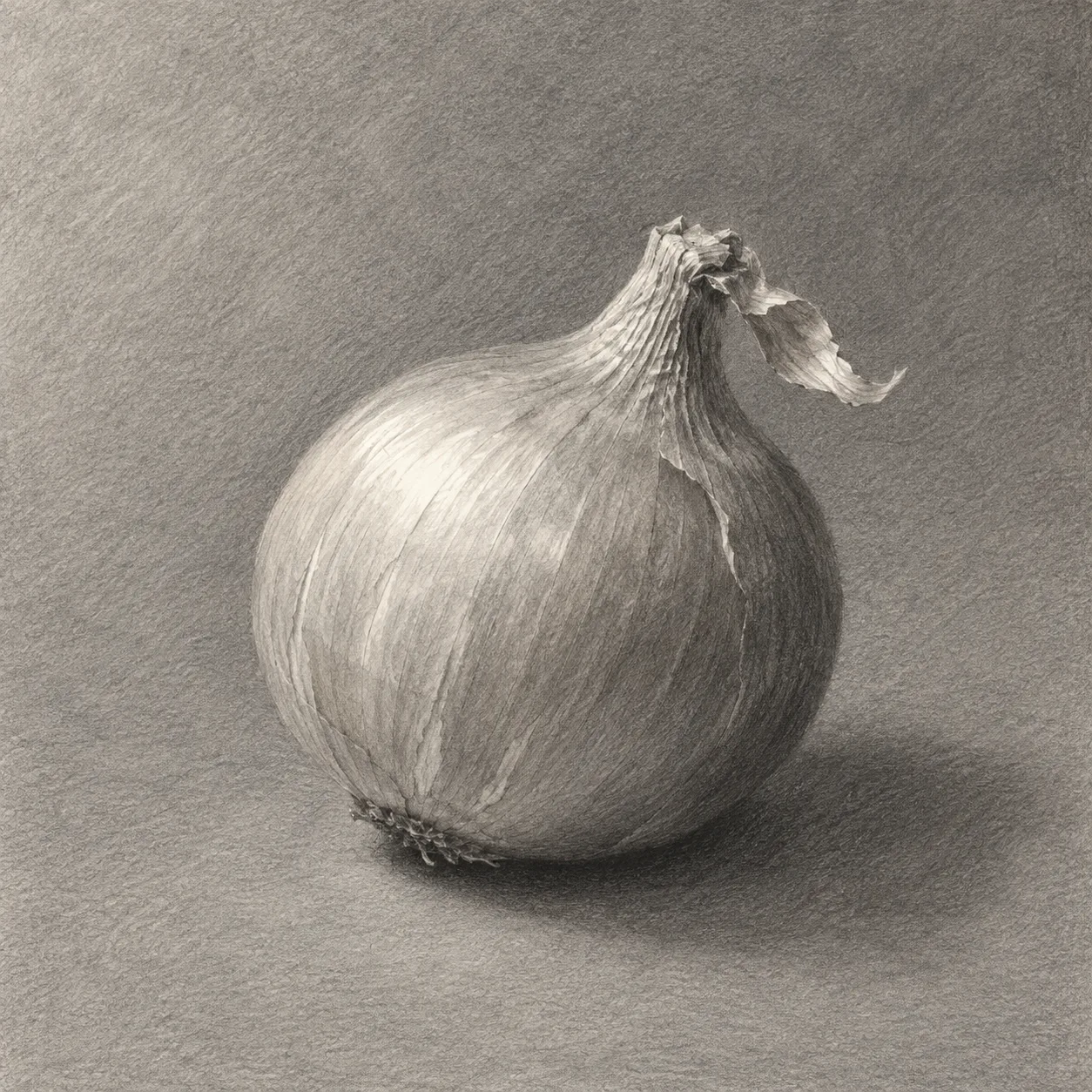
One Onion · Subtractive Graphite Drawing
Lift light from a graphite midtone with an eraser to reveal an onion’s rounded volume and thin papery skin.
One Onion · Subtractive Graphite Drawing
- Shape & line
- Build the bulb as a broad rounded mass tapering into a short neck. Lift a few curved pale bands that follow its swelling surface, and reinforce only the neck folds and lower-right contour with darker graphite; leave parts of the upper-left outline softly open.
- Color & light
- Use only graphite gray and exposed paper white. Place the light at image upper left: erase the brightest patch on the bulb’s upper-left shoulder, retain midgray across its center, and deepen the lower-right side. Keep a dark contact crescent beneath the onion and a softer cast shadow extending toward image lower right.
- Texture & material
- Begin with a rubbed graphite ground whose paper grain remains visible. Use broad, soft eraser lifts for the bulb and a few narrow lifted creases for the dry skin; preserve gray between the highlights so the result feels rubbed and lifted rather than filled with opaque white paint.
- Composition
- Keep the onion and its shadow together in the lower central area. Give the attached skin curl a small clear gap from the bulb so its lifted edge reads, and leave the surrounding ground quiet, with the strongest light-dark contrast concentrated on the onion.
Priority
Make erased light within a continuous graphite ground the defining visual technique.
What to avoid & what to check
Avoid opaque white highlights, uniformly traced outlines, and metallic-looking skin.
Check that lifted highlights describe the bulb’s curvature and agree with the upper-left light.
Exact prompt for this example
SUBJECT
One whole onion with a short dry neck and a small attached curl of papery skin, resting on a plain surface. Keep the bulb, neck, and skin curl visibly connected.

COMPOSITION
Show the entire onion in a slightly elevated three-quarter view, centered just below the middle of the image. Let it occupy roughly half the frame width, with generous graphite-toned space around it and its contact shadow visible.

STYLE GUIDE
1. Shape & line
Build the bulb as a broad rounded mass tapering into a short neck. Lift a few curved pale bands that follow its swelling surface, and reinforce only the neck folds and lower-right contour with darker graphite; leave parts of the upper-left outline softly open.

2. Color & light
Use only graphite gray and exposed paper white. Place the light at image upper left: erase the brightest patch on the bulb’s upper-left shoulder, retain midgray across its center, and deepen the lower-right side. Keep a dark contact crescent beneath the onion and a softer cast shadow extending toward image lower right.

3. Texture & material
Begin with a rubbed graphite ground whose paper grain remains visible. Use broad, soft eraser lifts for the bulb and a few narrow lifted creases for the dry skin; preserve gray between the highlights so the result feels rubbed and lifted rather than filled with opaque white paint.

4. Composition
Keep the onion and its shadow together in the lower central area. Give the attached skin curl a small clear gap from the bulb so its lifted edge reads, and leave the surrounding ground quiet, with the strongest light-dark contrast concentrated on the onion.

PRIORITY
Preserve the requested identity, count, action, composition and output settings. Apply the style rules within those constraints; a style reference must not replace the subject or layout. Within the style: Make erased light within a continuous graphite ground the defining visual technique.

AVOID
Avoid opaque white highlights, uniformly traced outlines, and metallic-looking skin.

OUTPUT
One finished image in a square 1:1 aspect ratio, with no lettering, captions, signature, or watermark.

SELF-CHECK
Check that lifted highlights describe the bulb’s curvature and agree with the upper-left light.
Model information comes from image provenance. The same prompt may produce a different result.