Text to imagePortraitStyle guide
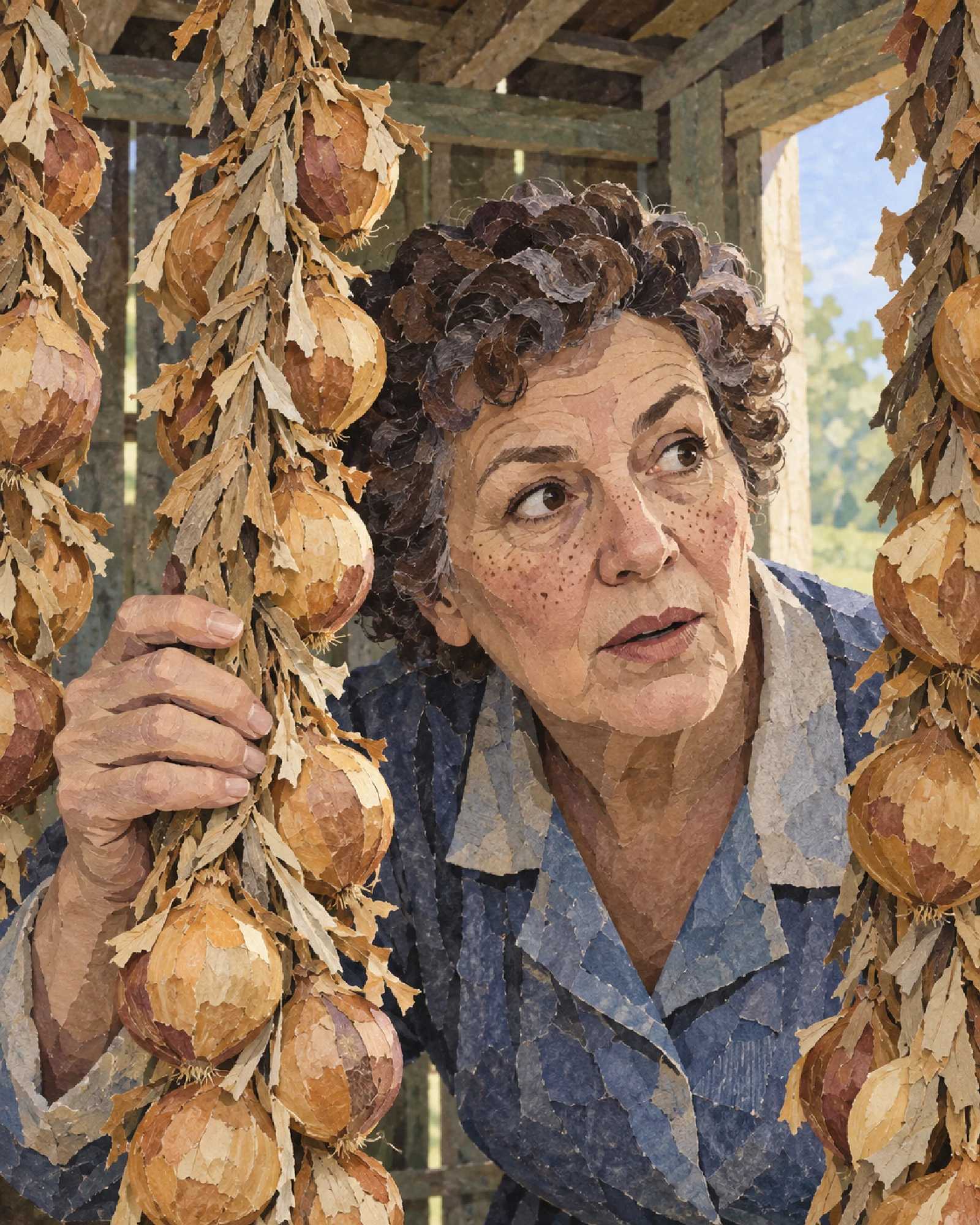
Woman Parting Onion Braids
A woman parts suspended onion braids to peer out of a drying shed. Overlapping paper edges and glimpses of underlying layers give the environmental portrait tactile depth.
Remix this referenceWoman Parting Onion Braids
- Form language
- Build forms from interlocking cut-paper masses, using smaller inset pieces only where a change of plane matters.
- Contour
- Let scissor-cut edges carry the contours, mixing long confident cuts with small angular interruptions and occasional torn ends.
- Mark-making
- Use sparse rubbed pigment and broad hand-painted streaks within the pieces; let their density and direction vary naturally.
- Surface rendering
- Expose underlayers at selected overlaps and retain raised paper lips; stepped tonal pieces coexist with softly rubbed transitions.
Priority
The finished image must visibly read as layered cut-paper collage with tactile overlaps.
What to avoid & what to check
Exact prompt for this example
MODULE OWNERSHIP
subject: Subject count, type, stable proportions and landmarks, resting face geometry, hair shape, physical materials, garment construction and permanent marks. No emotion, movement, color assignment or rendering recipe.
expression: Facial soft-tissue displacement and pupil direction, muscle coordination, regional intensity, asymmetry and onset/peak/release. No head/body pose, stable appearance, skin color or rendering.
gesture: Head/neck/body/limb orientation, joint movement, support, contact and pose-caused occlusion using existing anatomy. No eye/pupil movement, emotion, identity, props inventory or camera.
props: Prop count, type, construction, physical material and scale relative to the subject. Holding/contact belongs to gesture, position to composition, color to palette.
scene: Environment elements, terrain, backdrop/floor presence and structural detail. No canvas positions, camera, lighting, assigned colors or render texture.
camera: Projection, focal-length impression, camera elevation/yaw/roll, viewing distance and crop. No actor pose, world placement, lighting or canvas aspect ratio.
composition: Normalized 0-100% canvas positions, scale in frame, depth/overlap, focal hierarchy and margins. No joint pose, camera projection, rendering, subject/prop inventory or emotion.
palette: Color anchors, hue/saturation/value ranges, colors assigned to parts and approximate color coverage. No illumination direction, shading algorithm, physical material or layout.
lighting: Light-source direction/softness/intensity, ambient illumination, physical shadow direction/length and highlight position. Absence of directional illumination is allowed. No shading technique, palette or material changes.
style: Reusable form abstraction, contour weight/taper/edge quality, medium and mark scale/density/direction, surface rendering and tonal transition technique. No fixed subject proportions, anatomy, identity, expression, pose, palette, light-source direction, camera or layout.
output: Image count, aspect ratio, size, file/alpha requirements and global lettering/logo/watermark restrictions. No background scenery, crop, style, identity or pose.

SUBJECT
inventory: One original older adult woman, actor A.
geometry: Broad cheekbones, a compact chin, a substantial nose bridge, and ordinary adult proportions.
resting-face: Deep-set almond eyes, low arched brows, and a broad mouth with a fuller lower lip.
appearance: Short clustered curls, scattered cheek freckles, and a woven work smock with a folded collar.

PRIORITY


AVOID


CHECK


EXPRESSION — ACTOR A
brows: The brow nearest the opening lifts slightly more than the other.
lids: Upper lids rise gently; lower lids retain a relaxed curve.
cheeks: Cheeks stay loose, without smile-driven bunching.
nose: Nostrils remain relaxed and the nose stays unwrinkled.
mouth: Lips separate narrowly, with neither corner pulled upward.
jaw: The jaw releases just enough to support the small lip opening.
gaze: Pupils shift toward the opening beside the displaced braid.
coordination: Unequal brow lift leads the response; the lower face remains quiet.
timing: Catch curiosity at onset, before the mouth develops a larger response.

PRIORITY


AVOID


CHECK


GESTURE
head: Head and neck extend slightly forward through the opening, with the chin level.
torso: The upper torso inclines forward while one shoulder advances with the reaching arm.
limbs: The left elbow bends outward and the left hand opens around a braid.
contact: Left fingers gather the braid's dry stems and push it aside, leaving the face unobstructed.

PRIORITY


AVOID


CHECK


PROPS
inventory: Three onion braids, each longer than A's head and carrying palm-sized bulbs.
construction: Dry onion stems interweave into flexible cords; papery bulb skins retain irregular loose tips.

PRIORITY


AVOID


CHECK


SCENE
inventory: An onion-drying shed with timber rafters, a slatted wall, and an open doorway; the floor is unseen.
structure: Rafter joints and uneven gaps between wall slats suggest a practical, well-used agricultural building.

PRIORITY


AVOID


CHECK


CAMERA
projection: Natural perspective with a moderate portrait-lens impression and little apparent distortion.
viewpoint: Eye-level view from inside the shed, slightly oblique to the doorway, with no roll.
crop: Medium close portrait including the head, upper chest, and working hand; the lower body and other arm are outside the crop.

PRIORITY


AVOID


CHECK


COMPOSITION
placement: Place the face around 60% across and 40% down; the hand enters the lower-left area, and the doorway occupies the upper right.
depth: Braids hang from the rafters in the foreground and overlap the shed framing; the face occupies a middle-depth opening against the rear wall.
spacing: The face is the first read, the hand the second; uneven edge crops surround a generous opening beside the face.

PRIORITY


AVOID


CHECK


PALETTE
colors: Use smoky plum, muted golden ochre, pale sage, dusty blue, and warm cream with restrained saturation.
assignment: Warm cream and plum describe the face; ochre belongs to onions, blue to the smock, and sage to the shed.
balance: Sage and blue form broad quiet fields; ochre supplies recurring accents, with plum providing the deepest values.

PRIORITY


AVOID


CHECK


LIGHTING
sources: Broad soft daylight comes from upper right, with gentle ambient light inside the shed.
shadows: Braids cast soft shadows down-left; close overlaps produce short, slightly darker contact shadows.
highlights: Light gathers on the right cheek, upper fingers, and doorway-facing bulb edges.

PRIORITY


AVOID


CHECK


STYLE GUIDE
form-language: Build forms from interlocking cut-paper masses, using smaller inset pieces only where a change of plane matters.
contour: Let scissor-cut edges carry the contours, mixing long confident cuts with small angular interruptions and occasional torn ends.
mark-making: Use sparse rubbed pigment and broad hand-painted streaks within the pieces; let their density and direction vary naturally.
surface-rendering: Expose underlayers at selected overlaps and retain raised paper lips; stepped tonal pieces coexist with softly rubbed transitions.

PRIORITY
The finished image must visibly read as layered cut-paper collage with tactile overlaps.

AVOID


CHECK


OUTPUT
format: One finished image, 4:5 aspect ratio, 1600 × 2000 pixels, opaque PNG.
restrictions: No lettering, logos, signatures, or watermarks.

PRIORITY


AVOID


CHECK


FINAL INTEGRATION
gesture + composition + style: Let the parting action and layered overlaps work together while preserving an immediately readable hand-to-face relationship.
Model information comes from image provenance. The same prompt may produce a different result.