Text to imagePortraitStyle guide
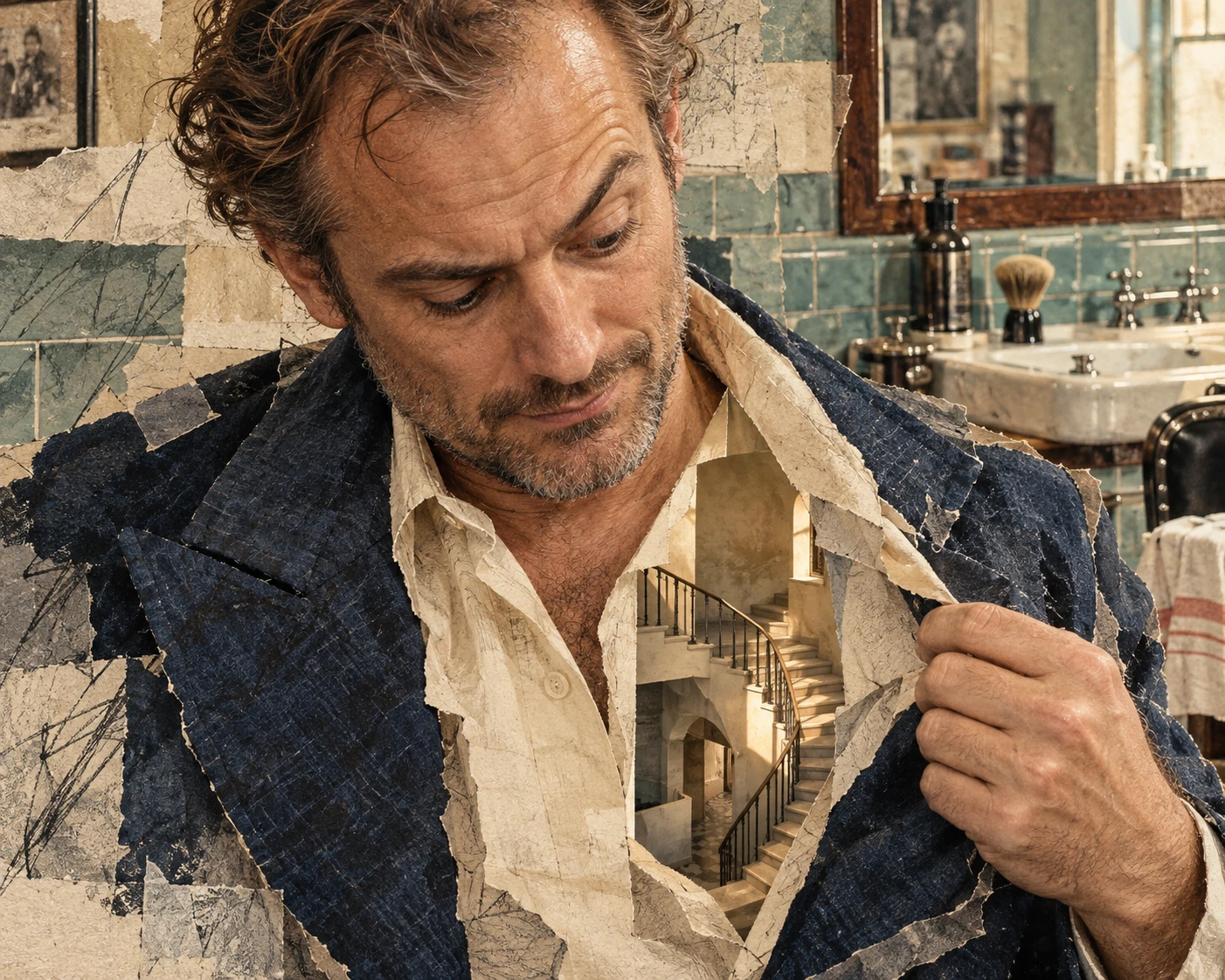
Man Looking into a Staircase in His Collar
Seated in a barbershop, a man opens his jacket to reveal a tiny stairwell descending inside his collar. Photographic fragments, torn paper and graphite bring a familiar face into contact with an impossible architectural scale.
Remix this referenceMan Looking into a Staircase in His Collar
- Form language
- Join recognizable photographic fragments to simplified paper planes, preserving deliberate differences in detail between adjoining pieces.
- Contour
- Alternate precise scissor edges with fibrous tears; let occasional graphite outlines continue beyond a cut edge.
- Mark-making
- Use rubbed graphite, loose construction strokes and translucent tracing-paper patches; vary their pressure and overlap naturally.
- Surface rendering
- Retain continuous photographic tones beside matte paper passages; visible joins and thin veils interrupt otherwise smooth transitions.
Priority
The surreal mixed-media collage must visibly retain the different origins of its assembled fragments
What to avoid & what to check
Exact prompt for this example
MODULE OWNERSHIP
subject: Subject count, type, stable proportions and landmarks, resting face geometry, hair shape, physical materials, garment construction and permanent marks. No emotion, movement, color assignment or rendering recipe.
expression: Facial soft-tissue displacement and pupil direction, muscle coordination, regional intensity, asymmetry and onset/peak/release. No head/body pose, stable appearance, skin color or rendering.
gesture: Head/neck/body/limb orientation, joint movement, support, contact and pose-caused occlusion using existing anatomy. No eye/pupil movement, emotion, identity, props inventory or camera.
props: Prop count, type, construction, physical material and scale relative to the subject. Holding/contact belongs to gesture, position to composition, color to palette.
scene: Environment elements, terrain, backdrop/floor presence and structural detail. No canvas positions, camera, lighting, assigned colors or render texture.
camera: Projection, focal-length impression, camera elevation/yaw/roll, viewing distance and crop. No actor pose, world placement, lighting or canvas aspect ratio.
composition: Normalized 0-100% canvas positions, scale in frame, depth/overlap, focal hierarchy and margins. No joint pose, camera projection, rendering, subject/prop inventory or emotion.
palette: Color anchors, hue/saturation/value ranges, colors assigned to parts and approximate color coverage. No illumination direction, shading algorithm, physical material or layout.
lighting: Light-source direction/softness/intensity, ambient illumination, physical shadow direction/length and highlight position. Absence of directional illumination is allowed. No shading technique, palette or material changes.
style: Reusable form abstraction, contour weight/taper/edge quality, medium and mark scale/density/direction, surface rendering and tonal transition technique. No fixed subject proportions, anatomy, identity, expression, pose, palette, light-source direction, camera or layout.
output: Image count, aspect ratio, size, file/alpha requirements and global lettering/logo/watermark restrictions. No background scenery, crop, style, identity or pose.

SUBJECT
inventory: One middle-aged man, actor A; no other people.
geometry: A broad forehead, long nose, substantial jaw and ordinary human proportions. No internal anatomy is exposed.
resting-face: Deep-set eyes, uneven brow arches, a narrow upper lip and a small cleft in the chin.
appearance: Receding wavy hair and close beard stubble; an open-collar cotton shirt beneath a wool jacket with broad lapels.

PRIORITY


AVOID


CHECK


EXPRESSION — ACTOR A
brows: One brow rises while the other draws inward slightly.
lids: Upper lids lift modestly; lower lids remain loose.
cheeks: Cheeks remain mostly relaxed, with a small lift on one side.
nose: Keep the nose relaxed, without wrinkling or nostril flare.
mouth: Lips stay together; one corner begins to curl upward.
jaw: The jaw stays loose without dropping.
gaze: Pupils angle downward toward the opening inside the collar.
coordination: The questioning brow leads; the mouth responds with a delayed hint of amusement.
timing: Capture the onset of noticing, before curiosity becomes a full smile.

PRIORITY


AVOID


CHECK


GESTURE
head: Incline the head forward and lower the chin slightly, leaving the face readable.
torso: Sit with a small forward bend and one shoulder slightly advanced.
limbs: Raise one forearm toward the chest; the other arm's pose is unspecified.
contact: Thumb and fingers pull one lapel outward, partly covering its edge while leaving the collar opening clear.

PRIORITY


AVOID


CHECK


PROPS
inventory: No separate props.
construction: No prop construction applies.

PRIORITY


AVOID


CHECK


SCENE
inventory: A barbershop interior with wall tiles, a mirror fragment and a fixed washbasin; a miniature stairwell forms a second environment.
structure: The stairwell has plaster walls, turning flights and a slender rail; it is an impossible architectural insertion.

PRIORITY


AVOID


CHECK


CAMERA
projection: Use a natural portrait-lens impression with restrained perspective.
viewpoint: Look from slightly above eye level with a small side offset and no roll.
crop: A close bust portrait includes the crown, face, collar opening and raised hand; the lower torso and other arm are outside the frame.

PRIORITY


AVOID


CHECK


COMPOSITION
placement: Set the face around 40% across the canvas; place the stairwell within the collar opening below and to its right.
depth: The face leads, followed by the tiny descending architecture; collar edges overlap the stairwell entrance.
spacing: Leave an irregular pocket of background beside the head; keep the raised hand clear of the miniature entrance.

PRIORITY


AVOID


CHECK


PALETTE
colors: Warm sepia, ink blue, faded celadon and pale buff, with restrained saturation throughout.
assignment: Sepia skin and hair, ink-blue jacket, buff shirt and stairwell, celadon tiles and basin.
balance: Muted middle values dominate; the jacket supplies the darkest anchor and the stairwell the palest interruption.

PRIORITY


AVOID


CHECK


LIGHTING
sources: Soft window light enters from the upper right, with enough ambient light to retain the stairwell interior.
shadows: Broad shadows fall leftward beneath the brow, chin and lapel; the staircase recess deepens gradually.
highlights: Place soft highlights on the right forehead, nose ridge and exposed rail edges.

PRIORITY


AVOID


CHECK


STYLE GUIDE
form-language: Join recognizable photographic fragments to simplified paper planes, preserving deliberate differences in detail between adjoining pieces.
contour: Alternate precise scissor edges with fibrous tears; let occasional graphite outlines continue beyond a cut edge.
mark-making: Use rubbed graphite, loose construction strokes and translucent tracing-paper patches; vary their pressure and overlap naturally.
surface-rendering: Retain continuous photographic tones beside matte paper passages; visible joins and thin veils interrupt otherwise smooth transitions.

PRIORITY
The surreal mixed-media collage must visibly retain the different origins of its assembled fragments

AVOID


CHECK


OUTPUT
format: Not applicable.
restrictions: One finished image, 5:4 landscape, at least 2400 pixels wide, opaque PNG; no lettering, logos or watermarks.

PRIORITY


AVOID


CHECK


FINAL INTEGRATION
subject + scene + composition: Keep the portrait legible as the garment opening becomes the meeting point between the two environmental scales.
style + lighting: Use a shared illumination logic to connect fragments while retaining their visibly different surface treatments.
Model information comes from image provenance. The same prompt may produce a different result.