Text to imageCharacterStyle guide
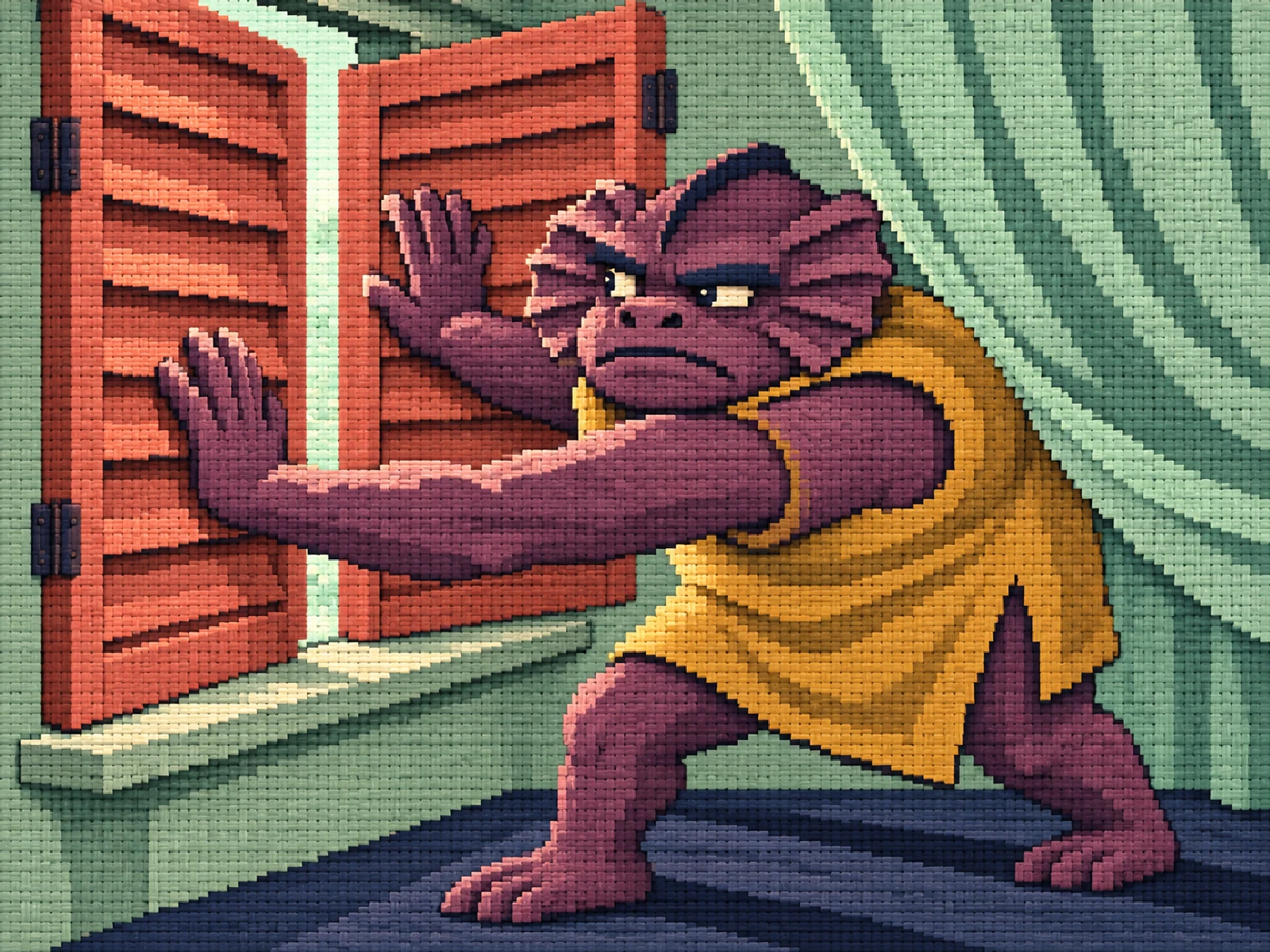
A Frill-Cheeked Keeper Closing the Shutters
A small keeper with fan-shaped cheek flanges pushes the shutters closed with both hands. Overlapping curtain and arms turn the moment into a lively woven-pixel character illustration.
Remix this referenceA Frill-Cheeked Keeper Closing the Shutters
- Form language
- Translate forms into interlocking pixel clusters, using broad blocks and selective stepped notches; simplify minor details freely.
- Contour
- Keep deliberate low-resolution stair steps, with broken dark edge segments where separation is needed and no smoothed interpolation.
- Mark-making
- Use short horizontal and vertical thread bars that alternate like warp and weft; irregular crossings give clusters a woven pulse.
- Surface rendering
- Group tones into nested block bands with occasional stitch-sized interruptions; let woven variation soften transitions without blur.
Priority
The image must combine visibly woven marks with deliberate low-resolution pixel edges.
What to avoid & what to check
Exact prompt for this example
MODULE OWNERSHIP
subject: Subject count, type, stable proportions and landmarks, resting face geometry, hair shape, physical materials, garment construction and permanent marks. No emotion, movement, color assignment or rendering recipe.
expression: Facial soft-tissue displacement and pupil direction, muscle coordination, regional intensity, asymmetry and onset/peak/release. No head/body pose, stable appearance, skin color or rendering.
gesture: Head/neck/body/limb orientation, joint movement, support, contact and pose-caused occlusion using existing anatomy. No eye/pupil movement, emotion, identity, props inventory or camera.
props: Prop count, type, construction, physical material and scale relative to the subject. Holding/contact belongs to gesture, position to composition, color to palette.
scene: Environment elements, terrain, backdrop/floor presence and structural detail. No canvas positions, camera, lighting, assigned colors or render texture.
camera: Projection, focal-length impression, camera elevation/yaw/roll, viewing distance and crop. No actor pose, world placement, lighting or canvas aspect ratio.
composition: Normalized 0-100% canvas positions, scale in frame, depth/overlap, focal hierarchy and margins. No joint pose, camera projection, rendering, subject/prop inventory or emotion.
palette: Color anchors, hue/saturation/value ranges, colors assigned to parts and approximate color coverage. No illumination direction, shading algorithm, physical material or layout.
lighting: Light-source direction/softness/intensity, ambient illumination, physical shadow direction/length and highlight position. Absence of directional illumination is allowed. No shading technique, palette or material changes.
style: Reusable form abstraction, contour weight/taper/edge quality, medium and mark scale/density/direction, surface rendering and tonal transition technique. No fixed subject proportions, anatomy, identity, expression, pose, palette, light-source direction, camera or layout.
output: Image count, aspect ratio, size, file/alpha requirements and global lettering/logo/watermark restrictions. No background scenery, crop, style, identity or pose.

SUBJECT
inventory: Actor A is one original adult humanoid keeper with rigid fan-shaped cheek flanges.
geometry: A barrel torso, long forearms, stout legs, and a broad head with scalloped cheek flanges and a single crown ridge.
resting-face: Widely spaced eyes beneath straight brow pads, a short broad muzzle, a low nose, and a wide resting mouth.
appearance: Pebbled skin and a sleeveless canvas tunic with a split hem; no hair or applied markings.

PRIORITY


AVOID


CHECK


EXPRESSION — ACTOR A
brows: Inner brow pads draw down, with the left slightly lower.
lids: Upper lids narrow while lower lids firm upward.
cheeks: Soft muzzle cheeks tighten toward the mouth corners.
nose: Nostrils remain relaxed, without a visible flare.
mouth: Lips press together, with one corner pulled slightly sideways.
jaw: The jaw is held firm without exposed teeth.
gaze: Both pupils aim left toward the meeting edges of the shutters.
coordination: Brow and lid tension work together; the mouth stays less tense.
timing: Hold the apex of sustained effort before the face releases.

PRIORITY


AVOID


CHECK


GESTURE
head: A's head extends toward the shutters, with the chin slightly tucked between raised shoulders.
torso: The torso leans forward from the hips and turns slightly toward the nearer shutter.
limbs: Arms spread into a broad pushing span; bent knees and staggered feet brace the movement.
contact: Each palm presses a separate shutter panel; both feet bear against the floorboards.

PRIORITY


AVOID


CHECK


PROPS
inventory: No separate props.
construction: No prop construction applies.

PRIORITY


AVOID


CHECK


SCENE
inventory: A window alcove with two hinged shutters, an interior sill, floorboards, and one long curtain.
structure: Shutters open inward and have broad slats; the loosely pleated curtain forms a broad bowed fold.

PRIORITY


AVOID


CHECK


CAMERA
projection: Shallow perspective with a normal-lens impression.
viewpoint: An eye-height view from inside the room, looking diagonally toward the window, without camera roll.
crop: A medium full-body view includes complete feet and enough surrounding window structure to explain the action.

PRIORITY


AVOID


CHECK


COMPOSITION
placement: Place A near 60% across and 56% down; the shutter assembly occupies the left half and crosses the middle.
depth: The near curtain overlaps one shoulder and part of an arm; keep the face and both palm contacts readable.
spacing: Face and hands form the main focal group; staggered shutter edges and curtain folds create a lively enclosing rhythm.

PRIORITY


AVOID


CHECK


PALETTE
colors: Aubergine, mustard, dusty coral, and pale mint, supported by a small amount of deep navy.
assignment: Aubergine skin, mustard tunic, coral shutters, mint curtain and wall, navy floor and facial details.
balance: Keep mint as the largest quiet field; warmer blocks and dark accents provide compact contrasts.

PRIORITY


AVOID


CHECK


LIGHTING
sources: Soft daylight enters through the remaining window gap from the left, with low room fill.
shadows: Broad shadows fall rightward across the floor; overlapping cloth and arms have soft contact shadows.
highlights: Light catches the left brow, the upper hands, and the window-facing edges of the tunic.

PRIORITY


AVOID


CHECK


STYLE GUIDE
form-language: Translate forms into interlocking pixel clusters, using broad blocks and selective stepped notches; simplify minor details freely.
contour: Keep deliberate low-resolution stair steps, with broken dark edge segments where separation is needed and no smoothed interpolation.
mark-making: Use short horizontal and vertical thread bars that alternate like warp and weft; irregular crossings give clusters a woven pulse.
surface-rendering: Group tones into nested block bands with occasional stitch-sized interruptions; let woven variation soften transitions without blur.

PRIORITY
The image must combine visibly woven marks with deliberate low-resolution pixel edges.

AVOID


CHECK


OUTPUT
format: One finished image, landscape 4:3, 1600 × 1200 pixels, PNG with an opaque background.
restrictions: No lettering, logos, signatures, or watermarks.

PRIORITY


AVOID


CHECK
Model information comes from image provenance. The same prompt may produce a different result.