Text to imageCharacterStyle guide
A Giant in a Photo Booth
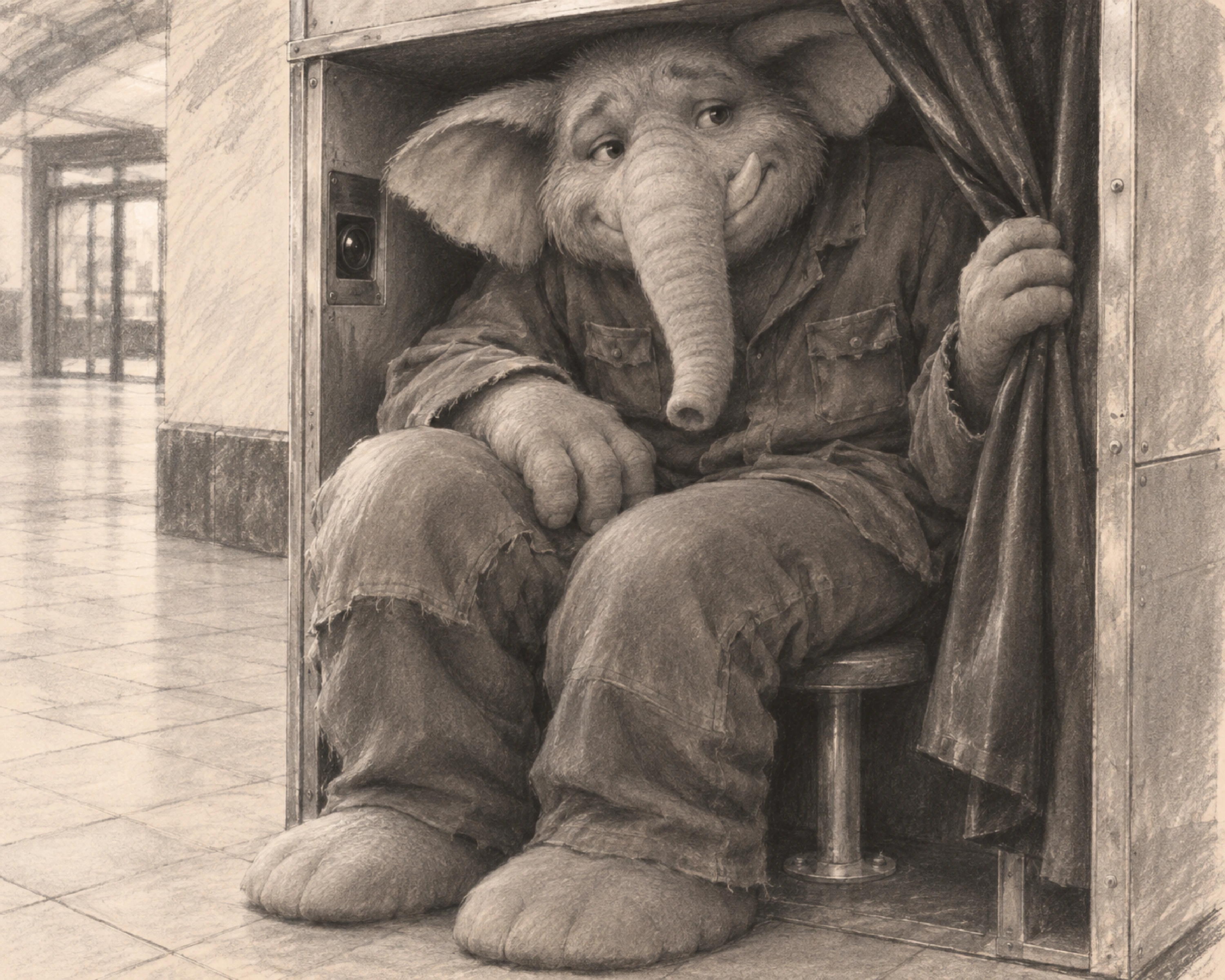
A shaggy, broad-eared giant folds into a station photo booth and prepares an awkward smile. Rubbed charcoal and erased light observe the cramped enclosure and the creature's soft face.
Remix this referenceA Giant in a Photo Booth
- Form language
- Observe broad masses before small features, retaining slight searching corrections that make the drawing feel discovered.
- Contour
- Alternate rubbed, almost-lost edges with short compressed-charcoal accents; never give every form an equal outline.
- Mark-making
- Broad side strokes establish masses, loose directional strokes describe surfaces, and occasional finger smudges connect passages.
- Surface rendering
- Build velvety rubbed midtones on toothy paper, then lift light with a kneaded eraser in broad patches and a few crisp slivers.
Priority
Make observational charcoal visible through smudged transitions, searching edges and erased light.
What to avoid & what to check
Exact prompt for this example
MODULE OWNERSHIP
subject: Subject count, type, stable proportions and landmarks, resting face geometry, hair shape, physical materials, garment construction and permanent marks. No emotion, movement, color assignment or rendering recipe.
expression: Facial soft-tissue displacement and pupil direction, muscle coordination, regional intensity, asymmetry and onset/peak/release. No head/body pose, stable appearance, skin color or rendering.
gesture: Head/neck/body/limb orientation, joint movement, support, contact and pose-caused occlusion using existing anatomy. No eye/pupil movement, emotion, identity, props inventory or camera.
props: Prop count, type, construction, physical material and scale relative to the subject. Holding/contact belongs to gesture, position to composition, color to palette.
scene: Environment elements, terrain, backdrop/floor presence and structural detail. No canvas positions, camera, lighting, assigned colors or render texture.
camera: Projection, focal-length impression, camera elevation/yaw/roll, viewing distance and crop. No actor pose, world placement, lighting or canvas aspect ratio.
composition: Normalized 0-100% canvas positions, scale in frame, depth/overlap, focal hierarchy and margins. No joint pose, camera projection, rendering, subject/prop inventory or emotion.
palette: Color anchors, hue/saturation/value ranges, colors assigned to parts and approximate color coverage. No illumination direction, shading algorithm, physical material or layout.
lighting: Light-source direction/softness/intensity, ambient illumination, physical shadow direction/length and highlight position. Absence of directional illumination is allowed. No shading technique, palette or material changes.
style: Reusable form abstraction, contour weight/taper/edge quality, medium and mark scale/density/direction, surface rendering and tonal transition technique. No fixed subject proportions, anatomy, identity, expression, pose, palette, light-source direction, camera or layout.
output: Image count, aspect ratio, size, file/alpha requirements and global lettering/logo/watermark restrictions. No background scenery, crop, style, identity or pose.

SUBJECT
inventory: A is one original adult giant creature with a humanlike body and broad, soft ears.
geometry: A long trunk, substantial hands, oversized knees and oval feet accompany a broad skull, short muzzle and flattened triangular ears.
resting-face: Wide-set eyes sit beneath low brow ridges; a small rounded nose rests above a broad, gently curved mouth.
appearance: Short dense fur surrounds a bare muzzle; a collarless work suit has roomy patch pockets and worn fabric edges.

PRIORITY


AVOID


CHECK


EXPRESSION — ACTOR A
brows: Inner brows lift slightly while the outer ends remain nearly level.
lids: Upper lids lower a little; the lower lids tighten gently.
cheeks: One cheek gathers more strongly as the tentative smile begins.
nose: The nose stays relaxed without wrinkling or flared nostrils.
mouth: Closed lips pull unevenly outward, with one corner rising before the other.
jaw: The jaw stays lightly closed without clenching.
gaze: Both pupils turn toward the booth's built-in camera lens.
coordination: Keep the uneven mouth stronger than the brow movement for a readable, restrained embarrassment.
timing: Capture the onset of a camera-ready smile before both mouth corners settle.

PRIORITY


AVOID


CHECK


GESTURE
head: A lowers the head beneath the booth ceiling and turns the muzzle toward the built-in lens.
torso: The seated torso folds forward, with rounded shoulders fitting inside the narrow enclosure.
limbs: Bent knees extend through the opening; both feet rest on the station floor, and one hand rests on a knee.
contact: The other hand gathers the curtain aside; the stool supports the hips and the ceiling lightly compresses one ear.

PRIORITY


AVOID


CHECK


PROPS
inventory: No separate props.
construction: No prop construction applies.

PRIORITY


AVOID


CHECK


SCENE
inventory: A station photo booth stands in a tiled concourse with a wall skirting and a distant doorway.
structure: The booth has a rigid shell, vinyl curtain, bolted stool and recessed lens housing; its ordinary seat barely fits A.

PRIORITY


AVOID


CHECK


CAMERA
projection: Use natural perspective with the calm spatial impression of a normal lens.
viewpoint: View obliquely into the booth from stool height, far enough away to include the feet; keep the camera level.
crop: Include the complete creature and booth opening, cropping only part of the outer shell and surrounding concourse.

PRIORITY


AVOID


CHECK


COMPOSITION
placement: The booth occupies the right side; A's face sits above the middle and the knees project into the lower-left area.
depth: The face leads, followed by the ear and knees; the curtain overlaps one shoulder, and one knee overlaps the other.
spacing: Keep a quiet strip of concourse at left and clear air around the feet so the enclosure feels unusually small.

PRIORITY


AVOID


CHECK


PALETTE
colors: Use charcoal black, warm paper ivory and a restrained range of neutral grays.
assignment: Fur takes middle grays, the work suit and curtain take deeper values, and the muzzle and tiles remain pale.
balance: Let pale paper remain abundant, with the deepest blacks confined to a few structural recesses.

PRIORITY


AVOID


CHECK


LIGHTING
sources: Soft station daylight enters from the left; dim ambient light reaches the booth interior.
shadows: Shadows fall softly to the right, gathering beneath the seat and chin and between the knees.
highlights: The left cheek, outer ear and forward knee catch broad highlights; no flash has fired.

PRIORITY


AVOID


CHECK


STYLE GUIDE
form-language: Observe broad masses before small features, retaining slight searching corrections that make the drawing feel discovered.
contour: Alternate rubbed, almost-lost edges with short compressed-charcoal accents; never give every form an equal outline.
mark-making: Broad side strokes establish masses, loose directional strokes describe surfaces, and occasional finger smudges connect passages.
surface-rendering: Build velvety rubbed midtones on toothy paper, then lift light with a kneaded eraser in broad patches and a few crisp slivers.

PRIORITY
Make observational charcoal visible through smudged transitions, searching edges and erased light.

AVOID


CHECK


OUTPUT
format: One finished image, landscape 5:4, 3000 × 2400 pixels, opaque PNG; no lettering, logos or watermarks.
restrictions: One finished image, landscape 5:4, 3000 × 2400 pixels, opaque PNG; no lettering, logos or watermarks.

PRIORITY


AVOID


CHECK


FINAL INTEGRATION
subject + gesture + scene: Let the familiar enclosure make the creature's unusual scale legible through ordinary points of support and contact.
expression + composition + style: Keep the facial acting readable within the larger charcoal masses while allowing secondary passages to remain exploratory.
lighting + style: Use erased passages to articulate the established illumination without polishing away the drawing's rubbed character.
Model information comes from image provenance. The same prompt may produce a different result.