Text to imageComicsStyle guide
Catching the Wind-Filled Coat
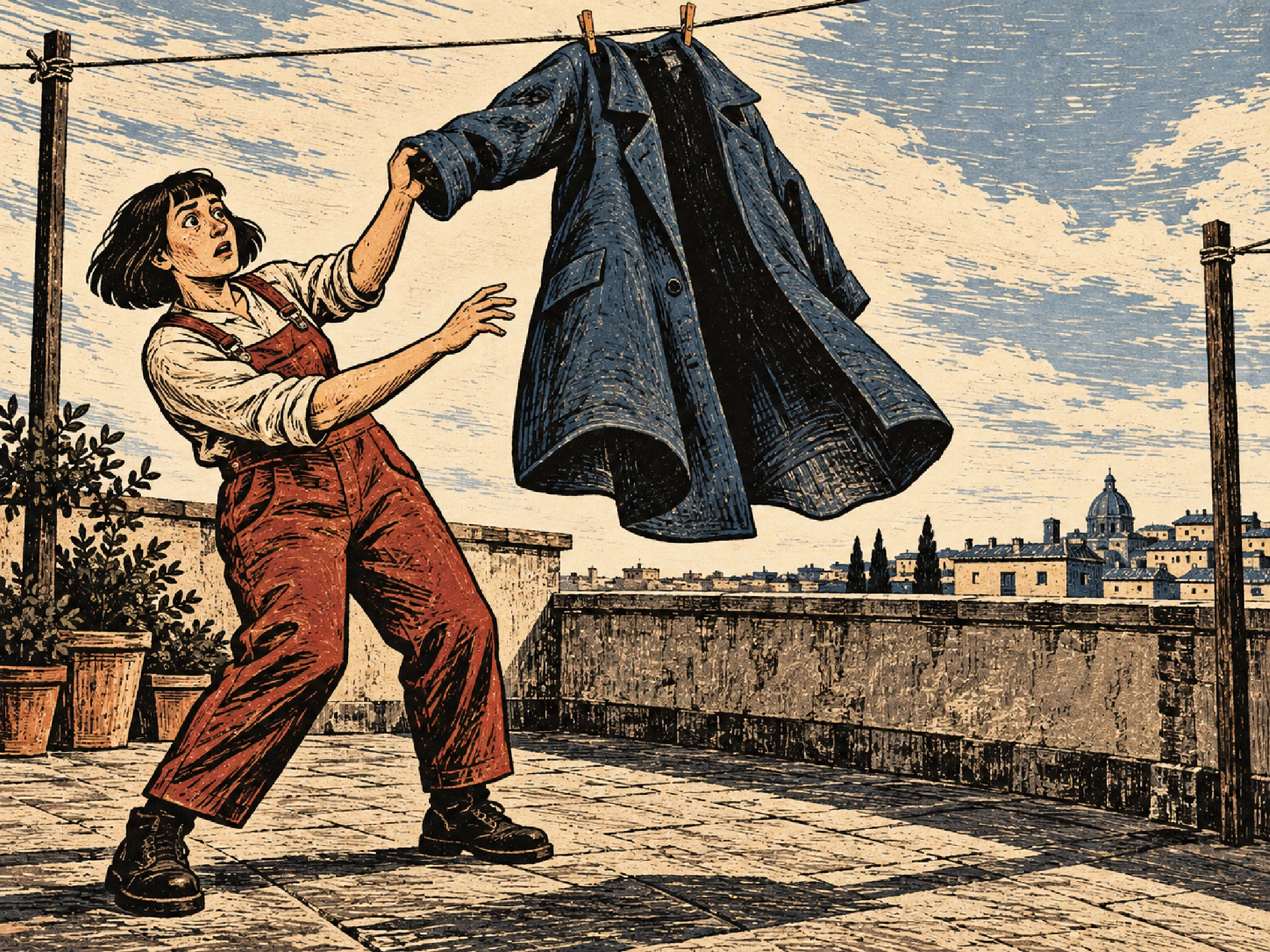
A woman catches the sleeve of a coat ballooning from a rooftop clothesline. Rough woodcut marks and an expansive sky give the sudden struggle a comic spring.
Remix this referenceCatching the Wind-Filled Coat
- Form language
- Translate forms into interlocking wedges and bowed planes, alternating blunt corners with generous curves.
- Contour
- Use heavy, uneven relief-cut contours with chipped edges, blunt endings and occasional gaps where forms remain legible.
- Mark-making
- Carve short gouges and longer curved channels through ink masses; let spacing and tool pressure vary naturally.
- Surface rendering
- Build tone from bitten ink fields and exposed paper, with slight roller skips and rough stepped transitions between values.
Priority
Rendering medium: Woodcut graphic-novel illustration.
What to avoid & what to check
Exact prompt for this example
MODULE OWNERSHIP
subject: Subject count, type, stable proportions and landmarks, resting face geometry, hair shape, physical materials, garment construction and permanent marks. No emotion, movement, color assignment or rendering recipe.
expression: Facial soft-tissue displacement and pupil direction, muscle coordination, regional intensity, asymmetry and onset/peak/release. No head/body pose, stable appearance, skin color or rendering.
gesture: Head/neck/body/limb orientation, joint movement, support, contact and pose-caused occlusion using existing anatomy. No eye/pupil movement, emotion, identity, props inventory or camera.
props: Prop count, type, construction, physical material and scale relative to the subject. Holding/contact belongs to gesture, position to composition, color to palette.
scene: Environment elements, terrain, backdrop/floor presence and structural detail. No canvas positions, camera, lighting, assigned colors or render texture.
camera: Projection, focal-length impression, camera elevation/yaw/roll, viewing distance and crop. No actor pose, world placement, lighting or canvas aspect ratio.
composition: Normalized 0-100% canvas positions, scale in frame, depth/overlap, focal hierarchy and margins. No joint pose, camera projection, rendering, subject/prop inventory or emotion.
palette: Color anchors, hue/saturation/value ranges, colors assigned to parts and approximate color coverage. No illumination direction, shading algorithm, physical material or layout.
lighting: Light-source direction/softness/intensity, ambient illumination, physical shadow direction/length and highlight position. Absence of directional illumination is allowed. No shading technique, palette or material changes.
style: Reusable form abstraction, contour weight/taper/edge quality, medium and mark scale/density/direction, surface rendering and tonal transition technique. No fixed subject proportions, anatomy, identity, expression, pose, palette, light-source direction, camera or layout.
output: Image count, aspect ratio, size, file/alpha requirements and global lettering/logo/watermark restrictions. No background scenery, crop, style, identity or pose.

SUBJECT
inventory: One adult woman, actor A; no other figures.
geometry: A has a sturdy build, broad hands and an elongated nose; keep her proportions recognizably human.
resting-face: Her resting facial structure has a broad jaw, widely spaced eyes and a thin upper lip.
appearance: A blunt bob frames her jaw; she wears cotton overalls over a collarless shirt and sturdy ankle boots.

PRIORITY


AVOID


CHECK


EXPRESSION — ACTOR A
brows: Both brows lift, with one rising slightly ahead of the other.
lids: Upper lids lift while lower lids remain lightly engaged.
cheeks: Cheeks remain mostly relaxed, without a smile lift.
nose: Nostrils widen slightly; the nose bridge stays unwrinkled.
mouth: Lips part into a small uneven oval.
jaw: The jaw releases only enough to support the small mouth opening.
gaze: Both pupils track the coat sleeve.
coordination: The upper face reacts more strongly than the mouth, suggesting a caught breath.
timing: Show the onset of surprise, before the reaction becomes a full gasp.

PRIORITY


AVOID


CHECK


GESTURE
head: A turns her head toward the coat, neck extended slightly above the raised shoulder.
torso: Her torso leans back from the hips with a small twist toward the gripping arm.
limbs: One arm stretches upward; the other reaches toward the hem. Bent knees and staggered feet brace her.
contact: One hand grips the loose sleeve cuff; the other has not reached the hem. Both soles meet the terrace.

PRIORITY


AVOID


CHECK


PROPS
inventory: One adult-sized long coat and two wooden clothespins.
construction: The wool coat has a roomy, rounded hollow body, broad sleeves and an open hem; the pegs have simple spring hinges.

PRIORITY


AVOID


CHECK


SCENE
inventory: A rooftop drying terrace with a low masonry parapet, a fixed clothesline and open sky.
structure: Two plain posts support the taut line; the terrace has a worn paved floor and a simple parapet cap.

PRIORITY


AVOID


CHECK


CAMERA
projection: Use natural perspective with a moderate wide-lens impression and restrained edge distortion.
viewpoint: View from just below standing eye level, obliquely across the terrace, with no camera roll.
crop: A medium-wide full-figure view includes the entire coat and enough terrace to read her footing.

PRIORITY


AVOID


CHECK


COMPOSITION
placement: Group A in the lower left and the coat above and inward from her; leave a spacious field of sky to the right.
depth: The sleeve overlaps A's hand; the coat sits before the line, with the parapet behind the action.
spacing: Make the hand-to-sleeve junction the first read, then the face and broad coat silhouette; preserve air around the hem.

PRIORITY
Keep one undivided image.

AVOID


CHECK


PALETTE
colors: Use soot black, warm oatmeal, muted storm blue and a restrained rusty red.
assignment: Oatmeal serves sky and skin; soot anchors hair and boots; storm blue belongs to the coat and rusty red to the overalls.
balance: Oatmeal is the largest color field, soot supplies substantial dark masses, and the two chromatic inks remain localized.

PRIORITY


AVOID


CHECK


LIGHTING
sources: Broad daylight enters from the upper left, supported by soft open-sky ambient light.
shadows: Short, soft-edged cast shadows fall toward the lower right; the coat interior receives less light.
highlights: Broad highlights touch upper-left-facing folds, the brow ridge and the tops of the hands.

PRIORITY


AVOID


CHECK


STYLE GUIDE
form-language: Translate forms into interlocking wedges and bowed planes, alternating blunt corners with generous curves.
contour: Use heavy, uneven relief-cut contours with chipped edges, blunt endings and occasional gaps where forms remain legible.
mark-making: Carve short gouges and longer curved channels through ink masses; let spacing and tool pressure vary naturally.
surface-rendering: Build tone from bitten ink fields and exposed paper, with slight roller skips and rough stepped transitions between values.

PRIORITY
Rendering medium: Woodcut graphic-novel illustration.

AVOID


CHECK


OUTPUT
format: One finished illustration, landscape 4:3, 2048 × 1536 pixels, opaque PNG.
restrictions: No speech balloons, lettering, logos or watermarks.

PRIORITY


AVOID


CHECK


FINAL INTEGRATION
expression + gesture: Let the facial reaction and physical bracing feel like simultaneous parts of one interrupted task.
style + lighting: Use the carved tonal vocabulary to express the stated illumination while retaining natural print irregularity.
Model information comes from image provenance. The same prompt may produce a different result.