Text to imageLandscapeStyle guide
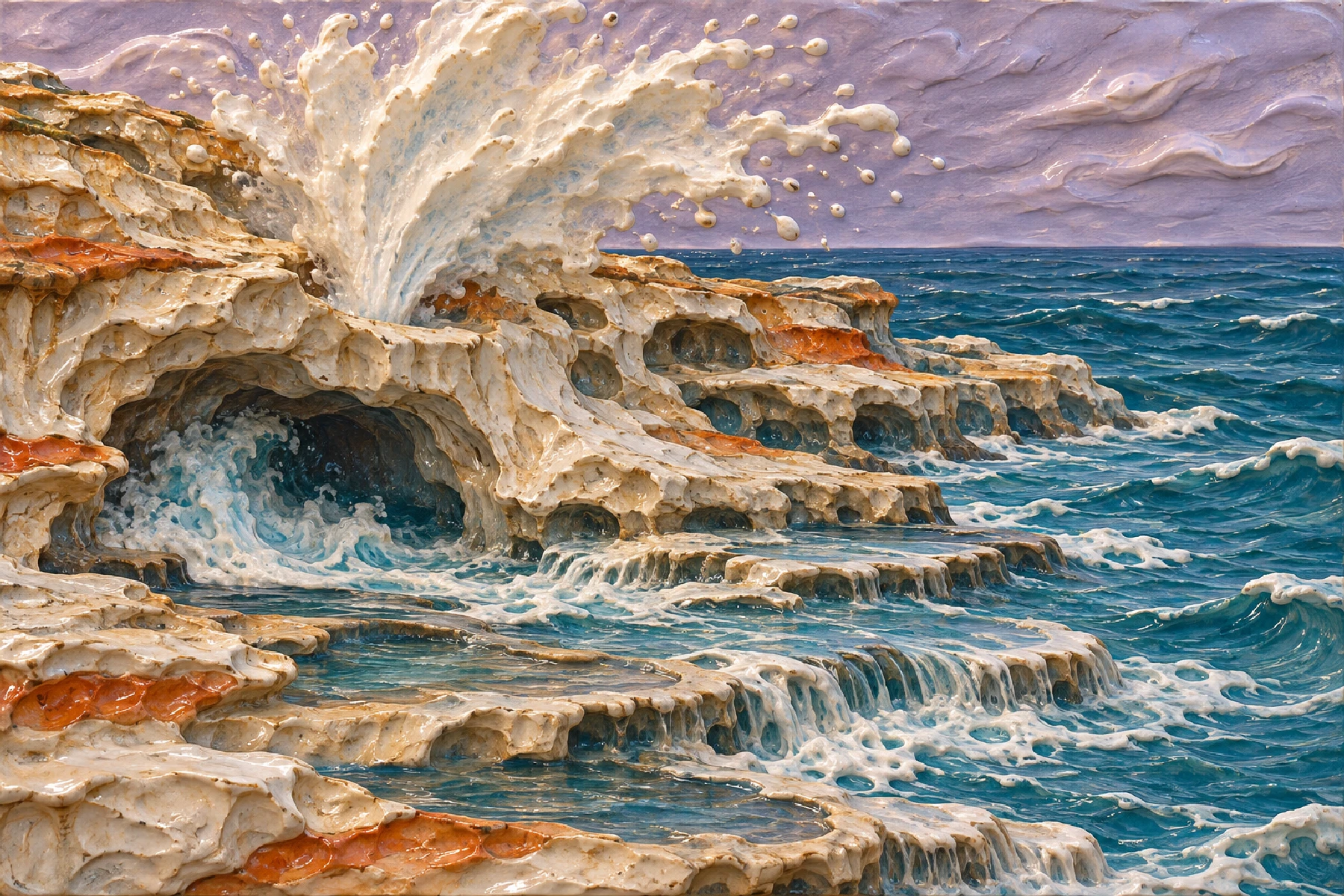
Surf Erupting Through a Cliff Blowhole
Surf erupts through a coastal blowhole and crosses overlapping rock shelves. Rounded relief and pooled glaze give the rugged shoreline a vivid, tactile presence.
Remix this referenceSurf Erupting Through a Cliff Blowhole
- Form language
- Build a ceramic relief illustration from interlocking rounded slabs and swollen ribbons, varying their thickness with handmade irregularity.
- Contour
- Use softly rolled relief lips instead of drawn outlines; occasional blunt chips interrupt otherwise supple edges.
- Mark-making
- Retain selective thumb presses and short dragged grooves; let their spacing vary naturally rather than repeat as a pattern.
- Surface rendering
- Model glossy glaze pooling in recesses and thinning over ridges; translucent tonal shifts reveal the uneven clay beneath.
Priority
The image must visibly read as modeled, glazed ceramic relief.
What to avoid & what to check
Exact prompt for this example
MODULE OWNERSHIP
subject: Subject count, type, stable proportions and landmarks, resting face geometry, hair shape, physical materials, garment construction and permanent marks. No emotion, movement, color assignment or rendering recipe.
expression: Facial soft-tissue displacement and pupil direction, muscle coordination, regional intensity, asymmetry and onset/peak/release. No head/body pose, stable appearance, skin color or rendering.
gesture: Head/neck/body/limb orientation, joint movement, support, contact and pose-caused occlusion using existing anatomy. No eye/pupil movement, emotion, identity, props inventory or camera.
props: Prop count, type, construction, physical material and scale relative to the subject. Holding/contact belongs to gesture, position to composition, color to palette.
scene: Environment elements, terrain, backdrop/floor presence and structural detail. No canvas positions, camera, lighting, assigned colors or render texture.
camera: Projection, focal-length impression, camera elevation/yaw/roll, viewing distance and crop. No actor pose, world placement, lighting or canvas aspect ratio.
composition: Normalized 0-100% canvas positions, scale in frame, depth/overlap, focal hierarchy and margins. No joint pose, camera projection, rendering, subject/prop inventory or emotion.
palette: Color anchors, hue/saturation/value ranges, colors assigned to parts and approximate color coverage. No illumination direction, shading algorithm, physical material or layout.
lighting: Light-source direction/softness/intensity, ambient illumination, physical shadow direction/length and highlight position. Absence of directional illumination is allowed. No shading technique, palette or material changes.
style: Reusable form abstraction, contour weight/taper/edge quality, medium and mark scale/density/direction, surface rendering and tonal transition technique. No fixed subject proportions, anatomy, identity, expression, pose, palette, light-source direction, camera or layout.
output: Image count, aspect ratio, size, file/alpha requirements and global lettering/logo/watermark restrictions. No background scenery, crop, style, identity or pose.

SUBJECT
inventory: No discrete characters or standalone subjects; the coastal landscape is described in scene.
geometry: No character proportions or anatomical landmarks apply.
resting-face: No faces are present.
appearance: No character appearance or garments apply.

PRIORITY


AVOID


CHECK


PROPS
inventory: No separate props.
construction: No prop construction applies.

PRIORITY


AVOID


CHECK


SCENE
inventory: A limestone headland, a natural blowhole, scalloped tidal shelves, open sea and sky.
structure: An incoming breaker fills a sea cave; a broad spray fan erupts through its roof opening above water-filled shelves.

PRIORITY


AVOID


CHECK


CAMERA
projection: A compressed perspective with a long-lens impression keeps the headland readable as layered masses.
viewpoint: Look landward from slightly above the offshore rocks, with a level horizon and no roll.
crop: Use a broad landscape view; crop the nearest shelves while retaining the complete spray fan.

PRIORITY


AVOID


CHECK


COMPOSITION
placement: Place the blowhole left of center; its spray is the first focal point, followed by the descending shelf rhythm.
depth: Overlap foreground ledges, the perforated headland and distant water; let spray interrupt their boundaries.
spacing: Keep a narrow sky band, space above the spray and a relatively open right third; gather overlaps below the spray.

PRIORITY


AVOID


CHECK


PALETTE
colors: Use petrol blue, chalk cream, smoky lavender and a restrained burnt-orange accent.
assignment: Assign petrol blue to sea and pools, cream to spray and limestone, lavender to sky, and orange to exposed rock bands.
balance: Let blue and cream dominate; keep lavender subdued and orange confined to small interruptions.

PRIORITY


AVOID


CHECK


LIGHTING
sources: Broad light from upper left grazes the relief, supported by gentle ambient illumination.
shadows: Short shadows fall toward lower right beneath raised edges; cavities retain deeper shade.
highlights: Broken highlights gather along upper-left ridges, with a few stronger glints on rounded crests.

PRIORITY


AVOID


CHECK


STYLE GUIDE
form-language: Build a ceramic relief illustration from interlocking rounded slabs and swollen ribbons, varying their thickness with handmade irregularity.
contour: Use softly rolled relief lips instead of drawn outlines; occasional blunt chips interrupt otherwise supple edges.
mark-making: Retain selective thumb presses and short dragged grooves; let their spacing vary naturally rather than repeat as a pattern.
surface-rendering: Model glossy glaze pooling in recesses and thinning over ridges; translucent tonal shifts reveal the uneven clay beneath.

PRIORITY
The image must visibly read as modeled, glazed ceramic relief.

AVOID


CHECK


OUTPUT
format: One finished image, landscape 3:2, 1800 × 1200 pixels, opaque PNG.
restrictions: No lettering, logos, signatures or watermarks.

PRIORITY


AVOID


CHECK


FINAL INTEGRATION
scene + composition + style: Keep the environmental event legible through the overlapping relief while allowing incidental forms to vary.
Model information comes from image provenance. The same prompt may produce a different result.