Text to imageArt stylesStyle guide
Forehead Against the Train Window
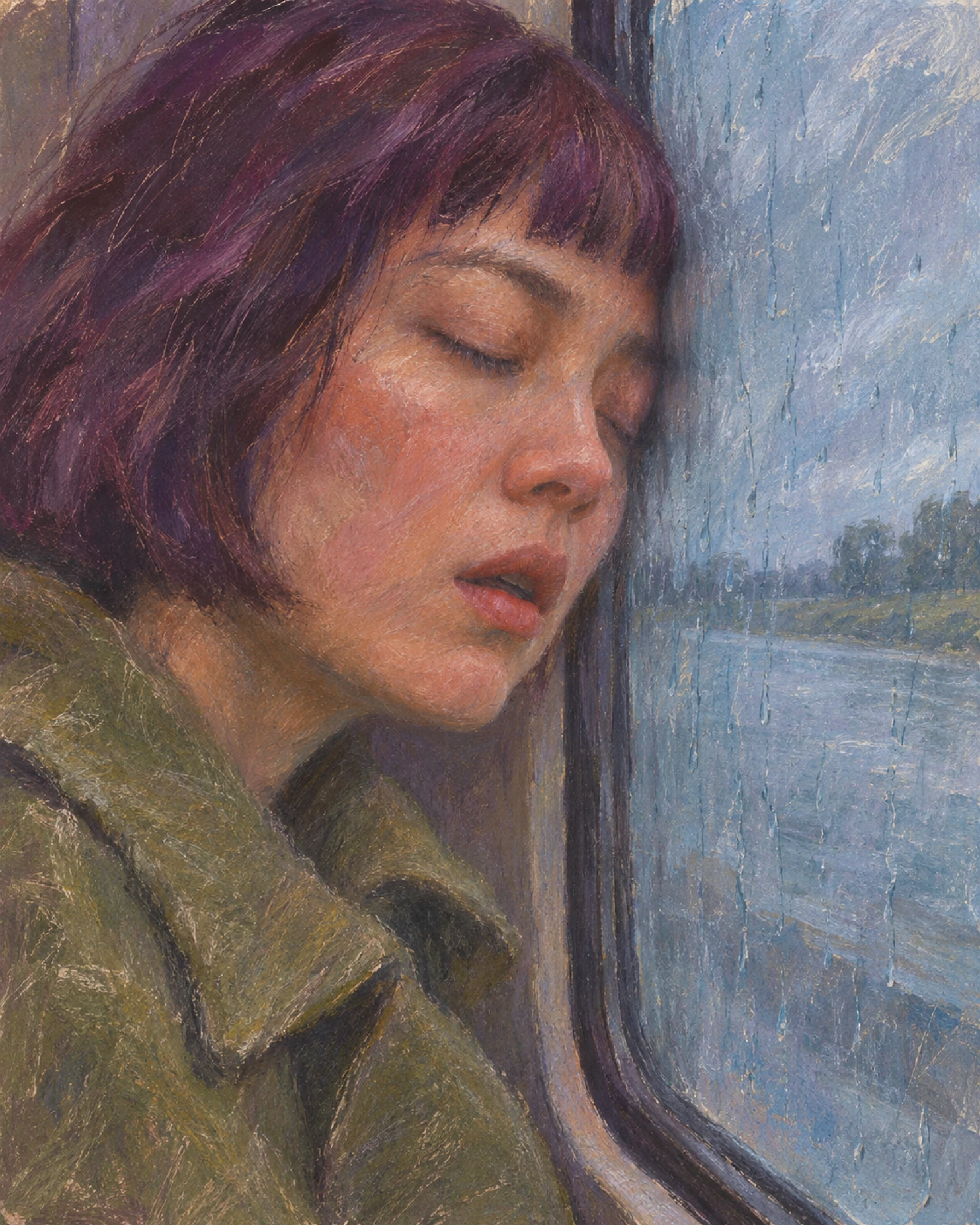
An intimate portrait of a woman resting her forehead against a rain-streaked train window. Rubbed oil pastel and scratched passages surround a quiet release of tension.
Remix this referenceForehead Against the Train Window
- Form language
- Build forms from broad, slightly swollen masses; simplify small detail while allowing uneven, dreamlike transitions.
- Contour
- Let rubbed edges dissolve and return as blunt broken contours; reserve occasional narrow scratches for sharp interruptions.
- Mark-making
- Lay oil pastel on its side, rub selected passages with a cloth, then scratch through layers in irregular trailing strokes.
- Surface rendering
- Keep waxy drag, exposed underlayers and cloudy smears visible; blend tones unevenly with natural variation in pressure.
Priority
The defining treatment is dreamlike oil pastel with visibly rubbed and scratched marks.
What to avoid & what to check
Exact prompt for this example
MODULE OWNERSHIP
subject: Subject count, type, stable proportions and landmarks, resting face geometry, hair shape, physical materials, garment construction and permanent marks. No emotion, movement, color assignment or rendering recipe.
expression: Facial soft-tissue displacement and pupil direction, muscle coordination, regional intensity, asymmetry and onset/peak/release. No head/body pose, stable appearance, skin color or rendering.
gesture: Head/neck/body/limb orientation, joint movement, support, contact and pose-caused occlusion using existing anatomy. No eye/pupil movement, emotion, identity, props inventory or camera.
props: Prop count, type, construction, physical material and scale relative to the subject. Holding/contact belongs to gesture, position to composition, color to palette.
scene: Environment elements, terrain, backdrop/floor presence and structural detail. No canvas positions, camera, lighting, assigned colors or render texture.
camera: Projection, focal-length impression, camera elevation/yaw/roll, viewing distance and crop. No actor pose, world placement, lighting or canvas aspect ratio.
composition: Normalized 0-100% canvas positions, scale in frame, depth/overlap, focal hierarchy and margins. No joint pose, camera projection, rendering, subject/prop inventory or emotion.
palette: Color anchors, hue/saturation/value ranges, colors assigned to parts and approximate color coverage. No illumination direction, shading algorithm, physical material or layout.
lighting: Light-source direction/softness/intensity, ambient illumination, physical shadow direction/length and highlight position. Absence of directional illumination is allowed. No shading technique, palette or material changes.
style: Reusable form abstraction, contour weight/taper/edge quality, medium and mark scale/density/direction, surface rendering and tonal transition technique. No fixed subject proportions, anatomy, identity, expression, pose, palette, light-source direction, camera or layout.
output: Image count, aspect ratio, size, file/alpha requirements and global lettering/logo/watermark restrictions. No background scenery, crop, style, identity or pose.

SUBJECT
inventory: One adult woman, actor A.
geometry: An oval head, broad cheekbones and a compact neck retain recognizable adult proportions.
resting-face: A short rounded nose, gently arched brows and a lower lip fuller than the upper lip.
appearance: A blunt bob with short fringe; a woven wool coat with a broad folded collar.

PRIORITY


AVOID


CHECK


EXPRESSION — ACTOR A
brows: Inner brows release their slight upward tension.
lids: Both lids settle gently closed without squeezing.
cheeks: Cheeks soften, with one side relaxing slightly ahead of the other.
nose: Nostrils remain relaxed, without a flare or wrinkle.
mouth: Lips part narrowly for an exhale; the corners remain loose.
jaw: The jaw releases just enough to support the small mouth opening.
gaze: Closed lids conceal the pupils; no pupil direction is prescribed.
coordination: The mouth releases first while the upper face finishes settling.
timing: Catch the release during one quiet exhale, before the lips close again.

PRIORITY


AVOID


CHECK


GESTURE
head: The chin dips as the head inclines toward the window.
torso: The upper torso leans toward the pane while the shoulders settle downward.
limbs: No limb movement is specified.
contact: The forehead rests lightly against the glass; the nose and lips remain clear of it.

PRIORITY


AVOID


CHECK


PROPS
inventory: No separate props.
construction: No prop construction applies.

PRIORITY


AVOID


CHECK


SCENE
inventory: A train window with exterior rain, a narrow interior wall and a distant riverbank.
structure: A rubber gasket borders the tall pane; the riverbank remains low beside an open stretch of water.

PRIORITY


AVOID


CHECK


CAMERA
projection: Perspective with a short portrait-lens impression and restrained depth compression.
viewpoint: View from inside the carriage, slightly above eye level and near a three-quarter profile.
crop: A close head-and-shoulder view trims the crown slightly and cuts through the near shoulder.

PRIORITY


AVOID


CHECK


COMPOSITION
placement: The head dominates left of center; the forehead is the primary focus.
depth: The near cheek leads into the shallow glass plane; the riverbank recedes as a subordinate interval.
spacing: A quiet strip of window balances the dense portrait, with a small open gap beyond the nose.

PRIORITY


AVOID


CHECK


PALETTE
colors: Muted coral, aubergine, smoke blue, moss olive and chalk ivory.
assignment: Coral skin, aubergine hair, olive coat and smoke-blue glass; ivory marks the palest passages.
balance: Coral and smoke blue carry most of the image; darker anchors stay compact and ivory remains sparse.

PRIORITY


AVOID


CHECK


LIGHTING
sources: Broad overcast daylight enters from the window at the right, with subdued carriage ambient light.
shadows: Soft shadows fall leftward, with a short shadow beneath the chin.
highlights: Gentle highlights touch the window-facing brow ridge and upper cheek.

PRIORITY


AVOID


CHECK


STYLE GUIDE
form-language: Build forms from broad, slightly swollen masses; simplify small detail while allowing uneven, dreamlike transitions.
contour: Let rubbed edges dissolve and return as blunt broken contours; reserve occasional narrow scratches for sharp interruptions.
mark-making: Lay oil pastel on its side, rub selected passages with a cloth, then scratch through layers in irregular trailing strokes.
surface-rendering: Keep waxy drag, exposed underlayers and cloudy smears visible; blend tones unevenly with natural variation in pressure.

PRIORITY
The defining treatment is dreamlike oil pastel with visibly rubbed and scratched marks.

AVOID


CHECK


OUTPUT
format: One finished image, 4:5 aspect ratio, 1600 × 2000 pixels, PNG with opaque alpha.
restrictions: No lettering, logos or watermarks.

PRIORITY


AVOID


CHECK


FINAL INTEGRATION
expression + gesture + style: Let the acting and physical contact remain readable through the medium's softened passages.
Model information comes from image provenance. The same prompt may produce a different result.