Text to imageAnimationStyle guide
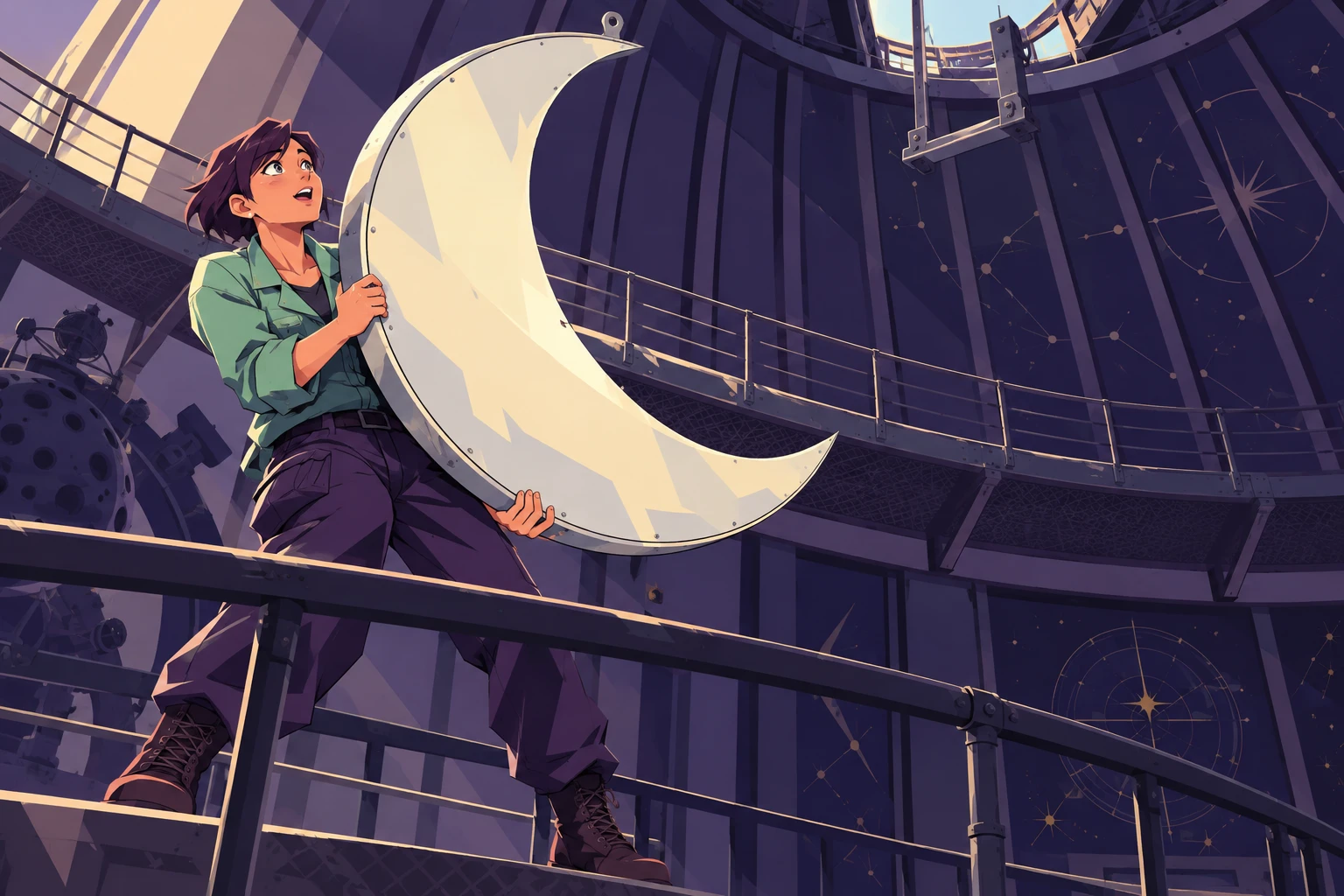
Planetarium Keeper Catching a Moon
A planetarium keeper catches an oversized crescent decoration. Overlapping forms and sweeping dome ribs turn the startled moment into a vivid arrangement of angular planes.
Remix this referencePlanetarium Keeper Catching a Moon
- Form language
- Abstract turning surfaces into wedges, triangles and interlocking angular facets; vary facet sizes naturally.
- Contour
- Use bold exterior weight contrasts and short, sharp interior cuts, with decisive tapered ends and occasional open edges.
- Mark-making
- Place sparse sharp strokes and small angular accents at structural turns; leave broad clean planes largely unmarked.
- Surface rendering
- Build surfaces from a small set of sharply separated tonal planes in place of gradients; allow irregular, hand-drawn boundaries.
Priority
Rendering medium: 2D angular Japanese anime graphic illustration; formal rendering reference: TRIGGER · 2010s · Promare (2019)
What to avoid & what to check
Avoid uniformly rounded modeling and mechanically identical facets.
Are angular abstraction, contour contrast and discrete tonal planes visibly distinct?
Exact prompt for this example
MODULE OWNERSHIP
subject: Subject count, type, stable proportions and landmarks, resting face geometry, hair shape, physical materials, garment construction and permanent marks. No emotion, movement, color assignment or rendering recipe.
expression: Facial soft-tissue displacement and pupil direction, muscle coordination, regional intensity, asymmetry and onset/peak/release. No head/body pose, stable appearance, skin color or rendering.
gesture: Head/neck/body/limb orientation, joint movement, support, contact and pose-caused occlusion using existing anatomy. No eye/pupil movement, emotion, identity, props inventory or camera.
props: Prop count, type, construction, physical material and scale relative to the subject. Holding/contact belongs to gesture, position to composition, color to palette.
scene: Environment elements, terrain, backdrop/floor presence and structural detail. No canvas positions, camera, lighting, assigned colors or render texture.
camera: Projection, focal-length impression, camera elevation/yaw/roll, viewing distance and crop. No actor pose, world placement, lighting or canvas aspect ratio.
composition: Normalized 0-100% canvas positions, scale in frame, depth/overlap, focal hierarchy and margins. No joint pose, camera projection, rendering, subject/prop inventory or emotion.
palette: Color anchors, hue/saturation/value ranges, colors assigned to parts and approximate color coverage. No illumination direction, shading algorithm, physical material or layout.
lighting: Light-source direction/softness/intensity, ambient illumination, physical shadow direction/length and highlight position. Absence of directional illumination is allowed. No shading technique, palette or material changes.
style: Reusable form abstraction, contour weight/taper/edge quality, medium and mark scale/density/direction, surface rendering and tonal transition technique. No fixed subject proportions, anatomy, identity, expression, pose, palette, light-source direction, camera or layout.
output: Image count, aspect ratio, size, file/alpha requirements and global lettering/logo/watermark restrictions. No background scenery, crop, style, identity or pose.

SUBJECT
inventory: A: one original adult woman, a planetarium keeper; no other characters.
geometry: A compact, sturdy build with broad shoulders, a short waist and substantial hands.
resting-face: A broad oval face, straight brows, almond eye openings, a short nose and a wide closed mouth at rest.
appearance: Short side-parted hair with a stepped fringe; a canvas work jacket with overlapping lapels, loose trousers and leather boots.

PRIORITY
Give the keeper a recognizable practical silhouette.

AVOID
Avoid recognizable franchise costume features.

CHECK
Does A read as one consistent original adult?

EXPRESSION — ACTOR A
brows: Both brows rise, with the right brow slightly higher.
lids: Upper lids lift clearly; lower lids remain lightly engaged.
cheeks: One cheek lifts subtly with the beginning of a smile.
nose: The nose remains relaxed, without wrinkling or nostril flare.
mouth: Lips part in a small gasp; one corner begins to curl upward.
jaw: The jaw drops modestly, leaving the mouth opening compact.
gaze: Pupils track the crescent's upper tip.
coordination: Strong upper-face surprise meets an emerging, asymmetric smile.
timing: Freeze the surprise peak just before the face relaxes.

PRIORITY
Keep the startled gasp lightly comic.

AVOID
Avoid an extreme scream or equally tense facial regions.

CHECK
Do the lifted brows and emerging smile read together?

GESTURE
head: A's neck extends slightly and her head turns toward the crescent's upper tip.
torso: A bends into a shallow crouch, twisting her chest against the crescent's weight.
limbs: Bent elbows gather inward; staggered feet and flexed knees support the catch.
contact: One palm supports the lower tip; the other grips the inner rim. The panel conceals part of her abdomen.

PRIORITY
Make the catch feel improvised but supported.

AVOID
Avoid stiff, symmetrical arms.

CHECK
Are both visible hand contacts convincing?

PROPS
inventory: One oversized crescent moon decoration, roughly as tall as A's torso.
construction: A shallow hollow aluminum panel with enamel coating, a rolled rim and a small mounting tab.

PRIORITY
Keep the crescent recognizable as a removable stage decoration.

AVOID
Avoid turning the panel into a weapon or celestial body.

CHECK
Does its rim communicate a lightweight hollow construction?

SCENE
inventory: An old planetarium interior with a ribbed dome, overhead service opening, curved maintenance catwalk, railing and suspended mounting bracket.
structure: The catwalk follows the dome's interior curve; exposed joints and an empty bracket suggest recent maintenance.

PRIORITY
Let the architecture explain the loose decoration.

AVOID
Avoid a generic empty studio backdrop.

CHECK
Is the setting legible as a maintained planetarium?

CAMERA
projection: Perspective with a moderately wide focal-length impression and restrained edge distortion.
viewpoint: View from just below catwalk level, with a three-quarter yaw and a slight upward pitch; no roll.
crop: A medium-wide full-body view includes both boots and the entire crescent; dome ribs continue beyond the crop.

PRIORITY
Make the overhead structure feel close enough to matter.

AVOID
Avoid extreme fisheye distortion.

CHECK
Can the face and supporting hands be read at this distance?

COMPOSITION
placement: A occupies the left third; the crescent sweeps across the middle toward spacious upper-right architecture.
depth: The crescent overlaps A; a foreground railing overlaps her lower legs, with dome ribs receding behind.
spacing: Face and hand contacts lead the hierarchy; preserve clear gaps around the moon tips and breathing room above.

PRIORITY
Use overlapping forms to carry the narrative.

AVOID
Avoid reference-sheet divisions and merging the moon tips with structural edges.

CHECK
Does attention travel from face to hands to crescent?

PALETTE
colors: Deep aubergine, electric mint, apricot and chalk ivory, with strong value separation.
assignment: Aubergine for architecture and trousers; mint for the jacket; apricot for skin; ivory for the moon; dark plum for hair.
balance: Dark architecture dominates; the pale crescent forms the largest bright accent, with mint concentrated on A.

PRIORITY
Keep the pale moon distinct from the vivid workwear.

AVOID
Avoid equal saturation across every surface.

CHECK
Do the four anchors organize the image clearly?

LIGHTING
sources: Broad, moderately firm light enters from the upper left; ambient fill stays low.
shadows: The crescent casts a visible shadow across the jacket; floor and railing shadows extend toward the right.
highlights: Highlights favor the upper-left rim of the moon and the upward-facing cheek and knuckles.

PRIORITY
Let the moon's cast shadow clarify its closeness to A.

AVOID
Avoid competing light directions.

CHECK
Do highlights and cast shadows agree?

STYLE GUIDE
form-language: Abstract turning surfaces into wedges, triangles and interlocking angular facets; vary facet sizes naturally.
contour: Use bold exterior weight contrasts and short, sharp interior cuts, with decisive tapered ends and occasional open edges.
mark-making: Place sparse sharp strokes and small angular accents at structural turns; leave broad clean planes largely unmarked.
surface-rendering: Build surfaces from a small set of sharply separated tonal planes in place of gradients; allow irregular, hand-drawn boundaries.

PRIORITY
Rendering medium: 2D angular Japanese anime graphic illustration; formal rendering reference: TRIGGER · 2010s · Promare (2019)

AVOID
Avoid uniformly rounded modeling and mechanically identical facets.

CHECK
Are angular abstraction, contour contrast and discrete tonal planes visibly distinct?

OUTPUT
format: One finished image, landscape 3:2, 1536 × 1024 pixels, opaque PNG.
restrictions: No lettering, logos, signatures or watermarks.

PRIORITY
Deliver a complete, presentation-ready image.

AVOID
Avoid explanatory labels.

CHECK
Is the export one finished image in the requested format?

FINAL INTEGRATION
gesture + composition + props: Let physical construction and visible contact support the overlapping arrangement without obscuring its readability.
expression + lighting + style: Preserve the facial acting through the chosen illumination and graphic simplification.
Art direction
트리거 / TRIGGER · 2010s · 프로메어(2019) / Promare (2019) ↗- Abstract form surfaces into wedges, triangles and angular facets
- Strong exterior weight contrast with short sharp interior cuts
- Small angular facets and sharp marks, with no marks in clean planes
- A small set of sharply separated tonal planes in place of gradients
Model information comes from image provenance. The same prompt may produce a different result.