Text to imageCharacterStyle guide
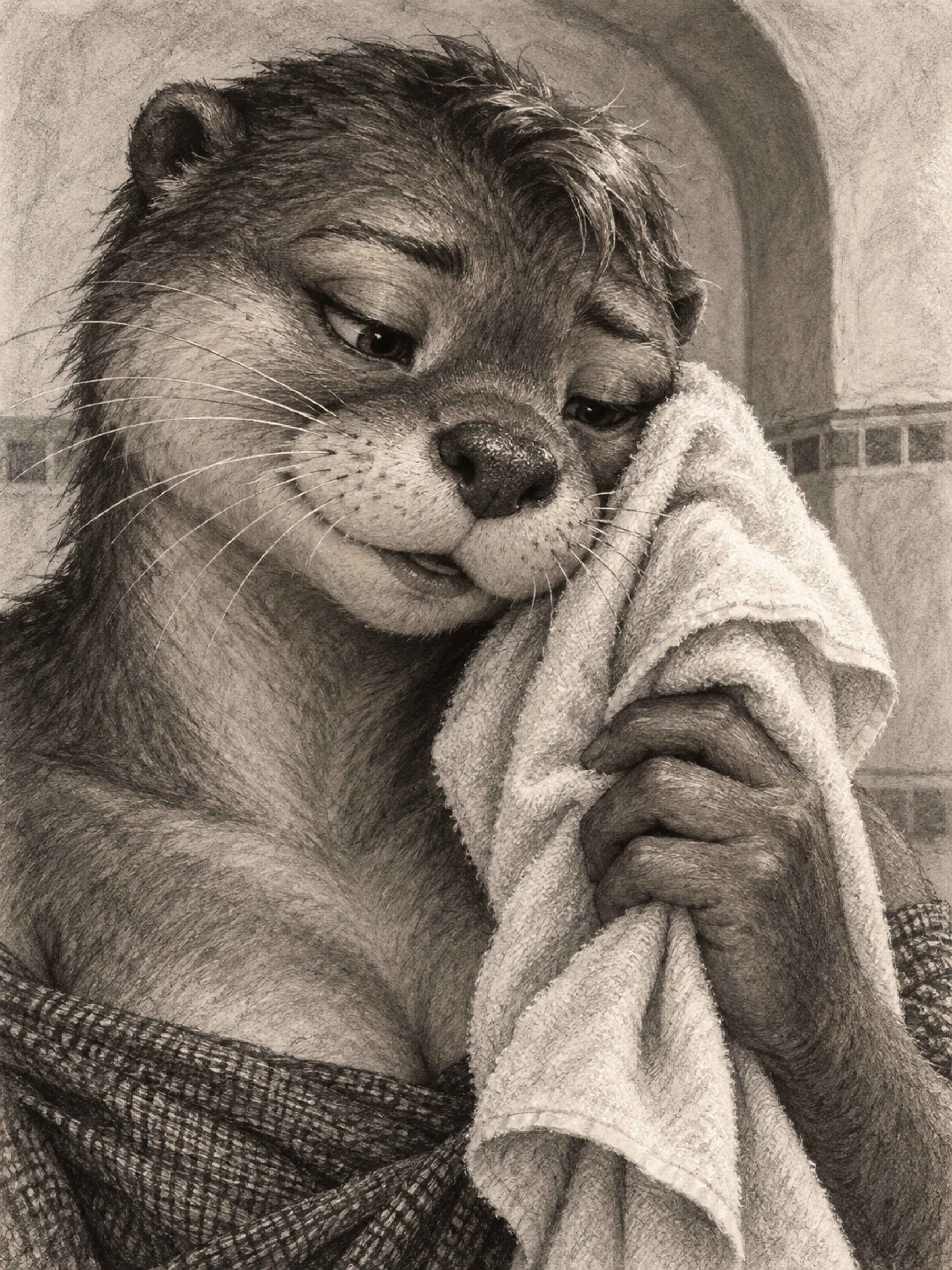
Otter Woman Drying Her Whiskers
An otter woman presses a folded towel against her cheek after bathing. An intimate charcoal crop uses smudges and erased light to reveal damp whiskers and a softening expression.
Remix this referenceOtter Woman Drying Her Whiskers
- Form language
- Observe volumes as joined weight-bearing masses, simplifying small changes into broad planes while retaining irregularities.
- Contour
- Alternate broken charcoal edges with soft lost contours; use firmer narrow accents only where forms press together.
- Mark-making
- Combine broad side-of-stick sweeps, directional finger smudges and a few sharp strokes; allow searching marks to remain.
- Surface rendering
- Rub charcoal into paper tooth, lift light with kneaded-eraser dabs and pull selected fine lines through the smudged tone.
Priority
Make observational charcoal, smudged tone and erased light visibly essential.
What to avoid & what to check
Exact prompt for this example
MODULE OWNERSHIP
subject: Subject count, type, stable proportions and landmarks, resting face geometry, hair shape, physical materials, garment construction and permanent marks. No emotion, movement, color assignment or rendering recipe.
expression: Facial soft-tissue displacement and pupil direction, muscle coordination, regional intensity, asymmetry and onset/peak/release. No head/body pose, stable appearance, skin color or rendering.
gesture: Head/neck/body/limb orientation, joint movement, support, contact and pose-caused occlusion using existing anatomy. No eye/pupil movement, emotion, identity, props inventory or camera.
props: Prop count, type, construction, physical material and scale relative to the subject. Holding/contact belongs to gesture, position to composition, color to palette.
scene: Environment elements, terrain, backdrop/floor presence and structural detail. No canvas positions, camera, lighting, assigned colors or render texture.
camera: Projection, focal-length impression, camera elevation/yaw/roll, viewing distance and crop. No actor pose, world placement, lighting or canvas aspect ratio.
composition: Normalized 0-100% canvas positions, scale in frame, depth/overlap, focal hierarchy and margins. No joint pose, camera projection, rendering, subject/prop inventory or emotion.
palette: Color anchors, hue/saturation/value ranges, colors assigned to parts and approximate color coverage. No illumination direction, shading algorithm, physical material or layout.
lighting: Light-source direction/softness/intensity, ambient illumination, physical shadow direction/length and highlight position. Absence of directional illumination is allowed. No shading technique, palette or material changes.
style: Reusable form abstraction, contour weight/taper/edge quality, medium and mark scale/density/direction, surface rendering and tonal transition technique. No fixed subject proportions, anatomy, identity, expression, pose, palette, light-source direction, camera or layout.
output: Image count, aspect ratio, size, file/alpha requirements and global lettering/logo/watermark restrictions. No background scenery, crop, style, identity or pose.

SUBJECT
inventory: One original adult anthropomorphic otter woman, actor A.
geometry: A compact torso, supple neck, broad otter muzzle, small round ears and dexterous humanlike hands.
resting-face: Low brow ridges, almond-shaped eyes, rounded whisker pads and a short mouth beneath a broad nose.
appearance: Dense short fur, an uneven brow tuft, stiff whiskers and a bare leathery nose; a woven wrap crosses the shoulders.

PRIORITY


AVOID


CHECK


EXPRESSION — ACTOR A
brows: The brow ridges release their central tension and settle low.
lids: Both upper lids droop softly; the towel-side lower lid rises slightly.
cheeks: The towel-side cheek compresses upward; the opposite whisker pad relaxes.
nose: Keep the nose unwrinkled and the nostrils relaxed.
mouth: The lips rest barely apart, with a faint lift at the unobstructed corner.
jaw: Let the jaw settle loosely with no visible clenching.
gaze: The visible pupils look downward toward the towel edge.
coordination: Keep the release gentle; local cheek compression creates the main facial asymmetry.
timing: Catch the release as the last facial tension subsides.

PRIORITY


AVOID


CHECK


GESTURE
head: Incline the head into the towel with a slight forward bend of the neck.
torso: Round the shoulders gently and bring the upper torso slightly forward.
limbs: One visible hand bunches the towel, with relaxed fingers curling around its folded edge.
contact: Press the towel against one cheek and the outer whiskers, leaving the nose and opposite eye clear.

PRIORITY


AVOID


CHECK


PROPS
inventory: One folded hand towel, broad enough to cover a cheek.
construction: Soft absorbent linen with a plain hem and loosely doubled folds; minor fold details may vary.

PRIORITY


AVOID


CHECK


SCENE
inventory: A bathhouse wash alcove with a plaster wall and a narrow tile border; no floor is visible.
structure: A curved plaster return and shallow arched recess suggest a small enclosed room with little ornament.

PRIORITY


AVOID


CHECK


CAMERA
projection: Natural perspective with a short-telephoto impression and minimal facial distortion.
viewpoint: Eye-level viewing from a slight three-quarter yaw, with no camera roll.
crop: An intimate head-and-shoulders crop cutting one outer ear tip and the upper chest.

PRIORITY


AVOID


CHECK


COMPOSITION
placement: Set the face above and left of middle; let the towel and hand occupy the lower-right foreground.
depth: The hand overlaps the towel, the towel overlaps the cheek and the alcove remains a shallow rear layer.
spacing: The visible eye and muzzle lead, followed by the compressed towel folds; leave a quiet gap beside the far cheek.

PRIORITY


AVOID


CHECK


PALETTE
colors: Use charcoal black, warm gray and ivory paper, without a separate accent hue.
assignment: Give the fur middle grays and deep roots, the nose and wrap dark values, and the towel the palest values.
balance: Let middle grays dominate, with compact dark accents and generous ivory passages.

PRIORITY


AVOID


CHECK


LIGHTING
sources: A broad soft source above and right meets low, diffuse room illumination.
shadows: Short soft shadows fall leftward and collect beneath the muzzle, hand and towel folds.
highlights: Light catches the brow tuft, nose ridge, selected whiskers and the towel's upper folds.

PRIORITY


AVOID


CHECK


STYLE GUIDE
form-language: Observe volumes as joined weight-bearing masses, simplifying small changes into broad planes while retaining irregularities.
contour: Alternate broken charcoal edges with soft lost contours; use firmer narrow accents only where forms press together.
mark-making: Combine broad side-of-stick sweeps, directional finger smudges and a few sharp strokes; allow searching marks to remain.
surface-rendering: Rub charcoal into paper tooth, lift light with kneaded-eraser dabs and pull selected fine lines through the smudged tone.

PRIORITY
Make observational charcoal, smudged tone and erased light visibly essential.

AVOID


CHECK


OUTPUT
format: One finished image, portrait 3:4 aspect ratio, 2400 × 3200 pixels, opaque PNG.
restrictions: No lettering, logos, signatures or watermarks.

PRIORITY


AVOID


CHECK
Model information comes from image provenance. The same prompt may produce a different result.