Text to imageCharacterStyle guide
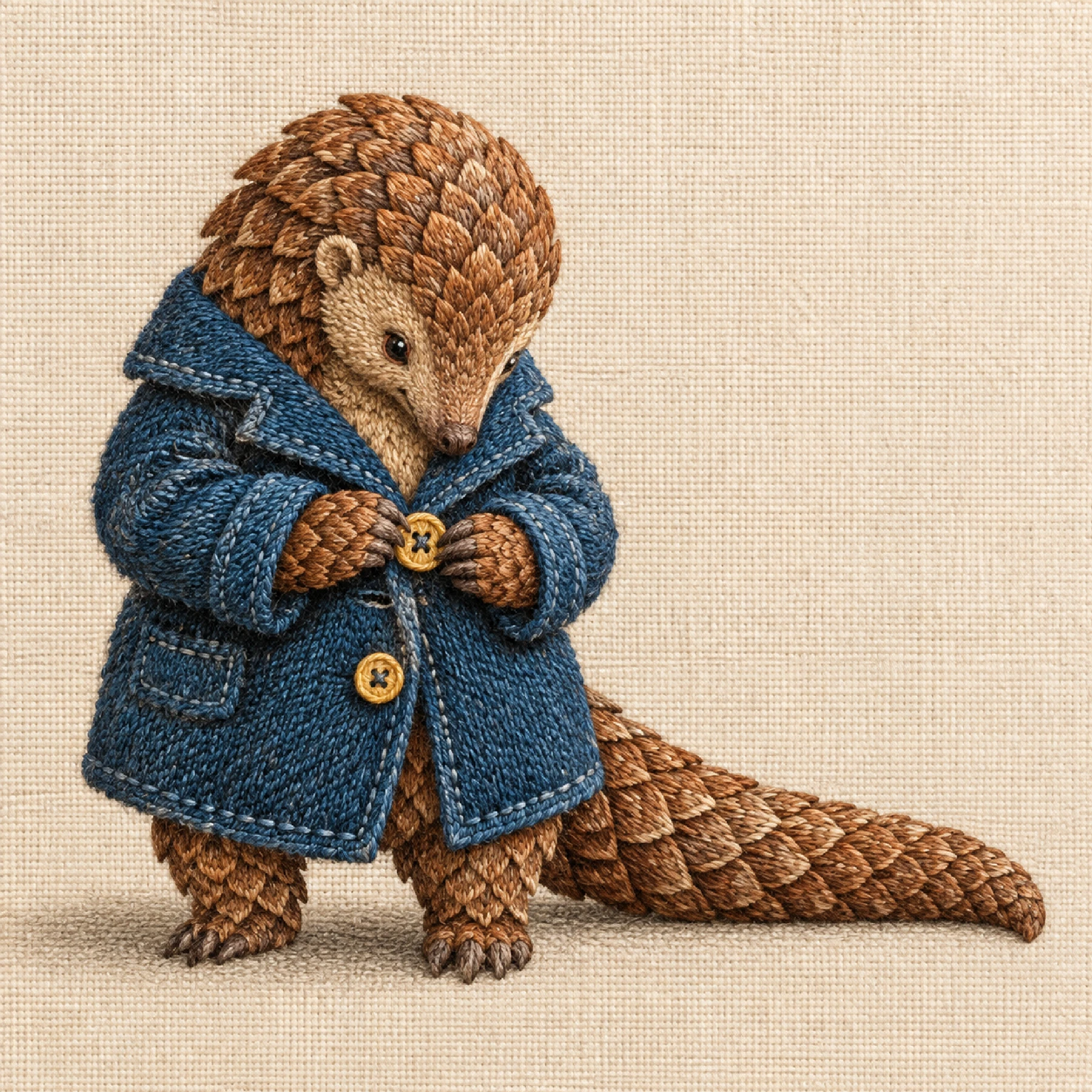
Pangolin Buttoning a Large Coat
A pangolin character carefully fastening the top button of a generously oversized coat. A sweeping tail and generous empty space shape an embroidered illustration with raised thread and exposed ground cloth.
Remix this referencePangolin Buttoning a Large Coat
- Form language
- Simplify forms into padded lobes and nested tapered facets, balancing broad silhouettes with a few compact internal shapes.
- Contour
- Build edges with slightly uneven corded outlines; let some boundaries emerge from adjacent stitch directions instead of lines.
- Mark-making
- Use directional satin stitches, loose couching and occasional knots; vary thread spacing and stitch length with a handmade rhythm.
- Surface rendering
- Layer embroidery over visible woven ground; padded areas rise above flatter stitching, with tonal changes made by interleaved threads.
Priority
Visible thread relief and exposed woven ground must establish the embroidered textile treatment.
What to avoid & what to check
Exact prompt for this example
MODULE OWNERSHIP
subject: Subject count, type, stable proportions and landmarks, resting face geometry, hair shape, physical materials, garment construction and permanent marks. No emotion, movement, color assignment or rendering recipe.
expression: Facial soft-tissue displacement and pupil direction, muscle coordination, regional intensity, asymmetry and onset/peak/release. No head/body pose, stable appearance, skin color or rendering.
gesture: Head/neck/body/limb orientation, joint movement, support, contact and pose-caused occlusion using existing anatomy. No eye/pupil movement, emotion, identity, props inventory or camera.
props: Prop count, type, construction, physical material and scale relative to the subject. Holding/contact belongs to gesture, position to composition, color to palette.
scene: Environment elements, terrain, backdrop/floor presence and structural detail. No canvas positions, camera, lighting, assigned colors or render texture.
camera: Projection, focal-length impression, camera elevation/yaw/roll, viewing distance and crop. No actor pose, world placement, lighting or canvas aspect ratio.
composition: Normalized 0-100% canvas positions, scale in frame, depth/overlap, focal hierarchy and margins. No joint pose, camera projection, rendering, subject/prop inventory or emotion.
palette: Color anchors, hue/saturation/value ranges, colors assigned to parts and approximate color coverage. No illumination direction, shading algorithm, physical material or layout.
lighting: Light-source direction/softness/intensity, ambient illumination, physical shadow direction/length and highlight position. Absence of directional illumination is allowed. No shading technique, palette or material changes.
style: Reusable form abstraction, contour weight/taper/edge quality, medium and mark scale/density/direction, surface rendering and tonal transition technique. No fixed subject proportions, anatomy, identity, expression, pose, palette, light-source direction, camera or layout.
output: Image count, aspect ratio, size, file/alpha requirements and global lettering/logo/watermark restrictions. No background scenery, crop, style, identity or pose.

SUBJECT
inventory: One original anthropomorphic pangolin with forepaws capable of simple garment fastening.
geometry: A tapered snout, compact belly, short legs and a long heavy tail retain a recognizable pangolin build.
resting-face: Small round eyes sit above a narrow closed mouth; the brow ridge is smooth and the ears are tiny. No separate eyebrows are present.
appearance: Overlapping keratin scales cover the back and tail; a roomy wool coat has broad lapels and large horn buttons.

PRIORITY


AVOID


CHECK


EXPRESSION — ACTOR A
brows: The brow region stays relaxed, with no visible lift or gathering.
lids: The lids narrow slightly without closing the eyes.
cheeks: The cheek area remains relaxed, without a smile lift.
nose: The nose remains still, with no wrinkle or flare.
mouth: The mouth line presses gently closed, evenly on both sides.
jaw: The jaw stays closed with only mild tension.
gaze: Both pupils look down toward the top button.
coordination: Slight lid narrowing carries the effort; the muzzle stays quiet.
timing: Hold the apex of quiet concentration during the fastening.

PRIORITY


AVOID


CHECK


GESTURE
head: A bows the head toward the chest, with the neck comfortably shortened.
torso: The torso leans forward slightly while standing in a small, settled crouch.
limbs: The elbows tuck inward; both forepaws work close together while the feet stay planted apart.
contact: One forepaw steadies the buttonhole and the other guides the button through; the tail rests on the floor in a broad curve.

PRIORITY


AVOID


CHECK


PROPS
inventory: No separate props.
construction: No prop construction applies.

PRIORITY


AVOID


CHECK


SCENE
inventory: A plain continuous backdrop and a simple floor, with no additional environmental objects.
structure: Backdrop and floor meet without a visible architectural seam or horizon.

PRIORITY


AVOID


CHECK


CAMERA
projection: Near-orthographic perspective gives the character a graphic, gently dimensional presence.
viewpoint: View at chest height from a shallow front three-quarter angle, with no roll.
crop: Show the complete character and tail from a moderate viewing distance.

PRIORITY


AVOID


CHECK


COMPOSITION
placement: Place the compact body left of center; let the tail sweep through the lower-right region.
depth: The forepaws overlap the coat opening; the tail recedes behind the body before reappearing.
spacing: The fastening is the focal detail; preserve a large empty upper-right field and generous outer margins.

PRIORITY


AVOID


CHECK


PALETTE
colors: Anchor the image in oatmeal, deep petrol blue, copper brown and a restrained butter yellow.
assignment: Oatmeal fills the backdrop, petrol blue the coat, copper brown the scales and yellow the buttons.
balance: The pale ground occupies most of the image; rich dark and warm areas form a compact accent group.

PRIORITY


AVOID


CHECK


LIGHTING
sources: Soft, moderately bright light arrives from the upper right with ample ambient fill.
shadows: A short soft shadow extends left beneath the feet and tail; relief casts tiny shadows in the same direction.
highlights: Highlights catch the upper-right edges of raised thread, lapels and buttons.

PRIORITY


AVOID


CHECK


STYLE GUIDE
form-language: Simplify forms into padded lobes and nested tapered facets, balancing broad silhouettes with a few compact internal shapes.
contour: Build edges with slightly uneven corded outlines; let some boundaries emerge from adjacent stitch directions instead of lines.
mark-making: Use directional satin stitches, loose couching and occasional knots; vary thread spacing and stitch length with a handmade rhythm.
surface-rendering: Layer embroidery over visible woven ground; padded areas rise above flatter stitching, with tonal changes made by interleaved threads.

PRIORITY
Visible thread relief and exposed woven ground must establish the embroidered textile treatment.

AVOID


CHECK


OUTPUT
format: One finished image, square 1:1, 1800 × 1800 pixels, PNG with an opaque background.
restrictions: No lettering, logos or watermarks.

PRIORITY


AVOID


CHECK


FINAL INTEGRATION
subject + gesture + expression: Keep the garment fastening readable through the character's existing forepaws and restrained facial acting.
composition + style + lighting: Let the open arrangement expose the textile ground while soft illumination reveals the stitch relief.
Model information comes from image provenance. The same prompt may produce a different result.