Text to imageAnimationStyle guide
Meadow Beyond the Door
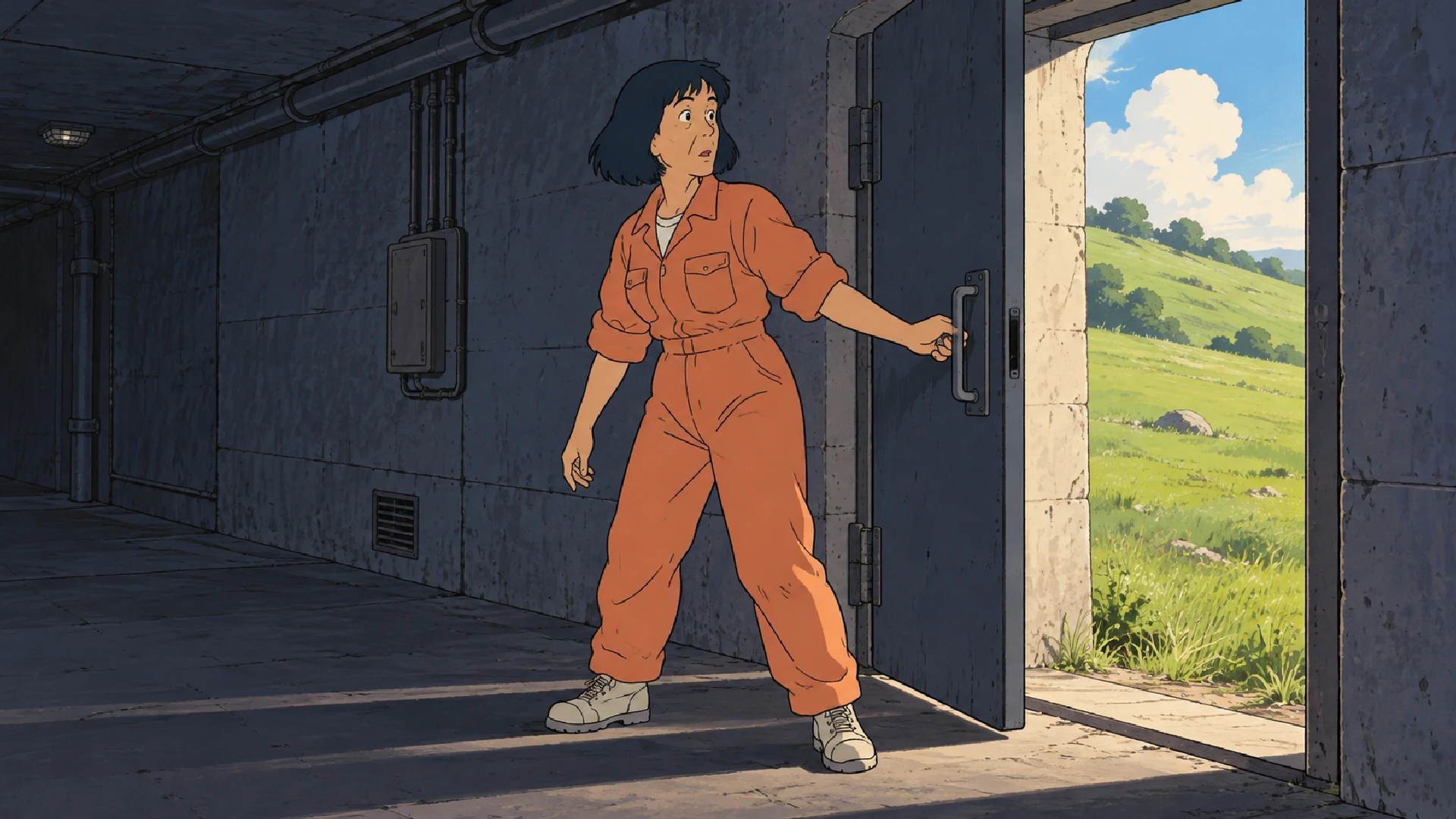
A caretaker opens an underground service door onto a sunlit meadow. Spacious tunnel darkness frames a small, arrested moment of surprise in a cel animation scene.
Remix this referenceMeadow Beyond the Door
- Form language
- Combine rounded masses with decisive wedge-like facets; simplify small irregularities while allowing organic shapes to vary naturally.
- Contour
- Use continuous ink exterior contours, finer interior separators and modest taper at line endings; retain slight hand-drawn unevenness.
- Mark-making
- Place short tapered crease marks sparingly; use loose grouped strokes for incidental detail rather than uniform descriptive hatching.
- Surface rendering
- Build opaque cel fills with hard-edged base and single secondary tonal planes; retain restrained cel-surface variation and occasional paint softness.
Priority
Rendering medium: 2D Japanese television-anime cel illustration; formal rendering reference: Toei Animation · 1980s · Dragon Ball (1986)
What to avoid & what to check
Exact prompt for this example
MODULE OWNERSHIP
subject: Subject count, type, stable proportions and landmarks, resting face geometry, hair shape, physical materials, garment construction and permanent marks. No emotion, movement, color assignment or rendering recipe.
expression: Facial soft-tissue displacement and pupil direction, muscle coordination, regional intensity, asymmetry and onset/peak/release. No head/body pose, stable appearance, skin color or rendering.
gesture: Head/neck/body/limb orientation, joint movement, support, contact and pose-caused occlusion using existing anatomy. No eye/pupil movement, emotion, identity, props inventory or camera.
props: Prop count, type, construction, physical material and scale relative to the subject. Holding/contact belongs to gesture, position to composition, color to palette.
scene: Environment elements, terrain, backdrop/floor presence and structural detail. No canvas positions, camera, lighting, assigned colors or render texture.
camera: Projection, focal-length impression, camera elevation/yaw/roll, viewing distance and crop. No actor pose, world placement, lighting or canvas aspect ratio.
composition: Normalized 0-100% canvas positions, scale in frame, depth/overlap, focal hierarchy and margins. No joint pose, camera projection, rendering, subject/prop inventory or emotion.
palette: Color anchors, hue/saturation/value ranges, colors assigned to parts and approximate color coverage. No illumination direction, shading algorithm, physical material or layout.
lighting: Light-source direction/softness/intensity, ambient illumination, physical shadow direction/length and highlight position. Absence of directional illumination is allowed. No shading technique, palette or material changes.
style: Reusable form abstraction, contour weight/taper/edge quality, medium and mark scale/density/direction, surface rendering and tonal transition technique. No fixed subject proportions, anatomy, identity, expression, pose, palette, light-source direction, camera or layout.
output: Image count, aspect ratio, size, file/alpha requirements and global lettering/logo/watermark restrictions. No background scenery, crop, style, identity or pose.

SUBJECT
inventory: One original middle-aged human woman, a passage caretaker; no other figures.
geometry: A sturdy torso, ordinary-length limbs, broad hands and a long face with a rounded chin establish her build.
resting-face: Her resting face has widely spaced almond-shaped eyes, straight brows, a broad nose and a narrow upper lip.
appearance: A blunt jaw-length bob, cotton coveralls with a broad collar and rolled sleeves, and canvas work shoes; minor wear may vary.

PRIORITY


AVOID


CHECK


EXPRESSION — ACTOR A
brows: Both brows lift slightly, with one beginning to rise first.
lids: Upper lids lift; lower lids remain loose.
cheeks: Cheeks remain relaxed without a smile lift.
nose: The nose stays relaxed, without wrinkling or flaring.
mouth: Lips part narrowly, with relaxed corners.
jaw: The jaw releases just enough to separate the lips.
gaze: Both pupils turn toward the meadow through the doorway.
coordination: The lifted upper face leads the quieter mouth response.
timing: Catch the first recognition, before the surprise fully develops.

PRIORITY


AVOID


CHECK


GESTURE
head: A turns her head toward the opening, keeping her neck extended naturally.
torso: Her torso leans back slightly against the door's weight, arrested midway through the pull.
limbs: One elbow bends to pull; her free arm hangs loosely, with both feet planted apart for support.
contact: One hand encloses the door handle; both soles remain in contact with the tunnel floor.

PRIORITY


AVOID


CHECK


PROPS
inventory: No separate props.
construction: No prop construction applies.

PRIORITY


AVOID


CHECK


SCENE
inventory: A concrete underground passage opens directly onto a grassy hillside beneath open sky.
structure: A heavy hinged service door, recessed frame and shallow threshold interrupt the bare tunnel; grass reaches the sill.

PRIORITY


AVOID


CHECK


CAMERA
projection: Moderate wide-angle perspective with a natural, approximately 35 mm lens impression.
viewpoint: View from inside the passage at adult eye height, oblique to the doorway, with a level horizon.
crop: A full-body environmental view includes the door's full height and ample surrounding passage.

PRIORITY


AVOID


CHECK


COMPOSITION
placement: A is near 58% canvas width; the doorway occupies the right third, leaving broad passage space on the left.
depth: The open door overlaps the near wall; A remains distinct from its edge, with the meadow receding beyond the threshold.
spacing: The face and opening form the focal pair; A fills roughly two-thirds of the image height, with breathing room above and below.

PRIORITY


AVOID


CHECK


PALETTE
colors: Anchor the image in charcoal blue, muted apricot, yellow-green and warm ivory.
assignment: Use charcoal blue for the passage, door and hair; apricot for coveralls, warm ochre skin, yellow-green grass and ivory sky.
balance: Dark cool colors occupy the largest area; a smaller share of warm hues balances the fresh exterior colors.

PRIORITY


AVOID


CHECK


LIGHTING
sources: Strong, broadly softened daylight enters from the doorway on the right; faint ambient light reaches the passage.
shadows: The door and caretaker cast long shadows leftward into the tunnel, with gently softened outer edges.
highlights: Light catches the doorway-facing cheek, sleeve ridge and handle; the far side remains subdued.

PRIORITY


AVOID


CHECK


STYLE GUIDE
form-language: Combine rounded masses with decisive wedge-like facets; simplify small irregularities while allowing organic shapes to vary naturally.
contour: Use continuous ink exterior contours, finer interior separators and modest taper at line endings; retain slight hand-drawn unevenness.
mark-making: Place short tapered crease marks sparingly; use loose grouped strokes for incidental detail rather than uniform descriptive hatching.
surface-rendering: Build opaque cel fills with hard-edged base and single secondary tonal planes; retain restrained cel-surface variation and occasional paint softness.

PRIORITY
Rendering medium: 2D Japanese television-anime cel illustration; formal rendering reference: Toei Animation · 1980s · Dragon Ball (1986)

AVOID


CHECK


OUTPUT
format: One finished image, 16:9 aspect ratio, 1920 × 1080 pixels, opaque PNG.
restrictions: No lettering, logos, captions or watermarks.

PRIORITY


AVOID


CHECK


FINAL INTEGRATION
expression + gesture: Coordinate the first facial response with the interrupted action so they read as one discovery.
composition + lighting + style: Let spatial hierarchy and physical illumination remain clear through the economical cel treatment.
Art direction
토에이 애니메이션 / Toei Animation · 1980s · 드래곤볼(1986) / Dragon Ball (1986) ↗- Combine rounded masses and wedge-like facets into readable form abstractions
- Continuous ink exterior contours with finer interior separators
- Short tapered crease marks and sparse marks inside filled areas
- Hard-edged base and single secondary tonal planes with restrained cel-surface texture
Model information comes from image provenance. The same prompt may produce a different result.