Text to imageProductStyle guide
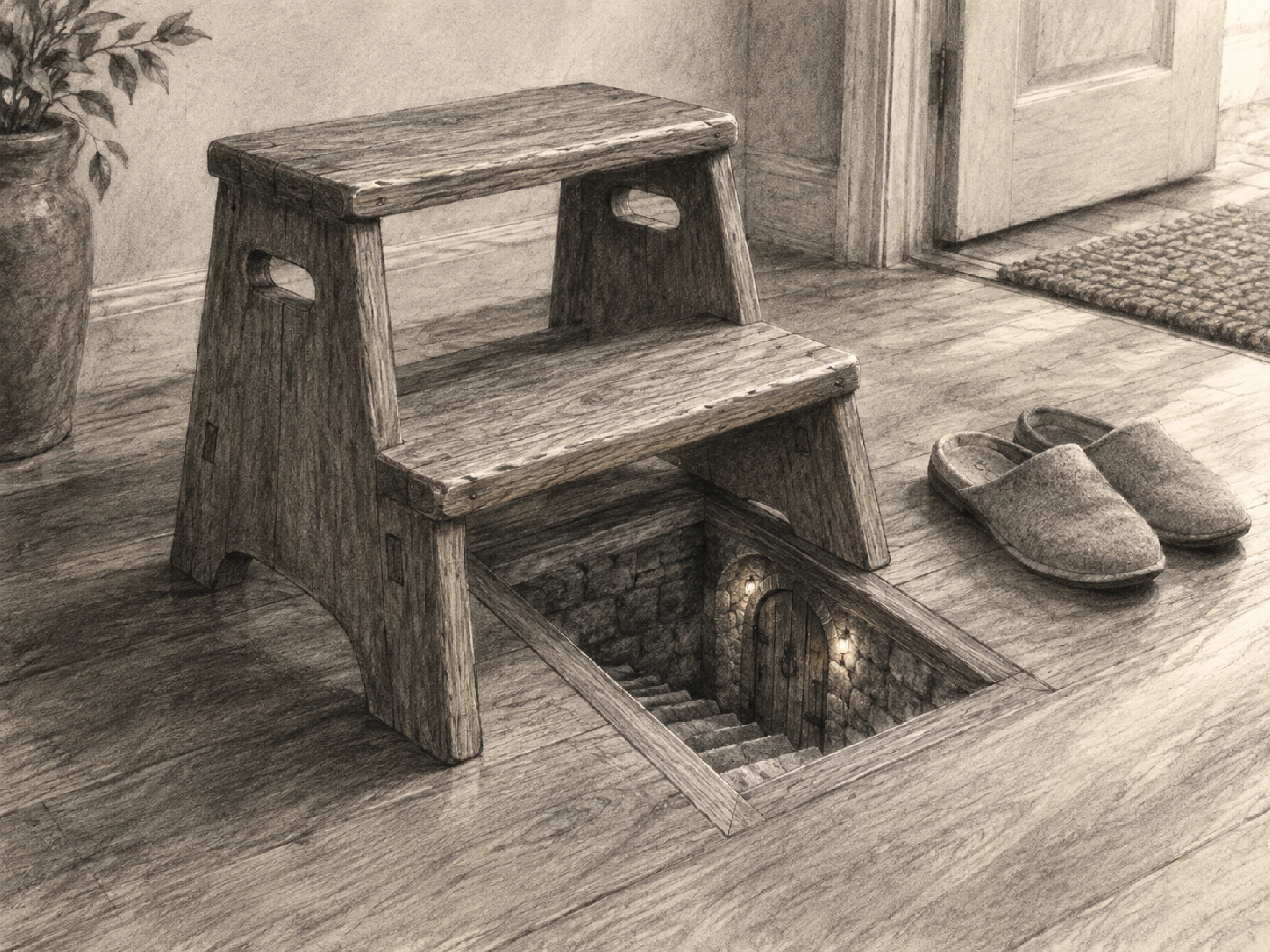
Step Stool Over a Tiny Stairwell
An oak step stool spans a palm-sized stairwell opening in an ordinary entrance hall. Smudged charcoal and erased light bring weight to the everyday product and wonder to the unexpected architectural scale.
Remix this referenceStep Stool Over a Tiny Stairwell
- Form language
- Build observed volumes from broad planes and selective structural landmarks; allow small irregularities without losing solidity.
- Contour
- Use pressure-varied charcoal edges, firm at decisive junctions and broken or lost where neighboring tones merge.
- Mark-making
- Drag the charcoal stick sideways for broad grainy strokes, adding sparse directional hatching with naturally uneven spacing.
- Surface rendering
- Rub powder into soft middle tones and lift light with a kneaded eraser; retain smudge halos and occasional untouched paper.
Priority
Observational charcoal with smudges and erased light must remain visibly central to the finished art
What to avoid & what to check
Exact prompt for this example
MODULE OWNERSHIP
subject: Subject count, type, stable proportions and landmarks, resting face geometry, hair shape, physical materials, garment construction and permanent marks. No emotion, movement, color assignment or rendering recipe.
expression: Facial soft-tissue displacement and pupil direction, muscle coordination, regional intensity, asymmetry and onset/peak/release. No head/body pose, stable appearance, skin color or rendering.
gesture: Head/neck/body/limb orientation, joint movement, support, contact and pose-caused occlusion using existing anatomy. No eye/pupil movement, emotion, identity, props inventory or camera.
props: Prop count, type, construction, physical material and scale relative to the subject. Holding/contact belongs to gesture, position to composition, color to palette.
scene: Environment elements, terrain, backdrop/floor presence and structural detail. No canvas positions, camera, lighting, assigned colors or render texture.
camera: Projection, focal-length impression, camera elevation/yaw/roll, viewing distance and crop. No actor pose, world placement, lighting or canvas aspect ratio.
composition: Normalized 0-100% canvas positions, scale in frame, depth/overlap, focal hierarchy and margins. No joint pose, camera projection, rendering, subject/prop inventory or emotion.
palette: Color anchors, hue/saturation/value ranges, colors assigned to parts and approximate color coverage. No illumination direction, shading algorithm, physical material or layout.
lighting: Light-source direction/softness/intensity, ambient illumination, physical shadow direction/length and highlight position. Absence of directional illumination is allowed. No shading technique, palette or material changes.
style: Reusable form abstraction, contour weight/taper/edge quality, medium and mark scale/density/direction, surface rendering and tonal transition technique. No fixed subject proportions, anatomy, identity, expression, pose, palette, light-source direction, camera or layout.
output: Image count, aspect ratio, size, file/alpha requirements and global lettering/logo/watermark restrictions. No background scenery, crop, style, identity or pose.

SUBJECT
inventory: One original oak step stool is the featured product; no people or animals.
geometry: Two broad ascending treads join tall cheek panels with oval handholds and gently splayed feet.
resting-face: No facial anatomy applies.
appearance: Solid oak has exposed end grain, rounded tread edges and inset wooden joints; wear may vary naturally.

PRIORITY


AVOID


CHECK


PROPS
inventory: One adult-sized pair of house slippers establishes the stool's everyday scale.
construction: The slippers have soft felt uppers and thin flexible soles, each shorter than a stool tread.

PRIORITY


AVOID


CHECK


SCENE
inventory: An ordinary entrance hall contains a wooden floor, skirting, a full-sized doorway and a miniature sunken stairwell.
structure: A palm-sized floor opening holds descending masonry steps and a tiny arched door; the surrounding hall stays ordinary.

PRIORITY


AVOID


CHECK


CAMERA
projection: Use natural perspective with a moderate wide-lens impression and little edge distortion.
viewpoint: Look obliquely downward from crouching height, close enough to see both tread surfaces and the stairwell interior.
crop: Include the complete stool and floor opening, with enough surrounding floor and doorway to identify the hall.

PRIORITY


AVOID


CHECK


COMPOSITION
placement: Place the stool around 40% across the frame; the tiny opening emerges beneath its right side and slippers sit farther right.
depth: The stool bridges the opening's near edge; a clear gap reveals the descending steps, with the hall receding behind.
spacing: Make the stool the first read and the tiny door the discovery; leave a generous quiet floor area beside this overlap.

PRIORITY


AVOID


CHECK


PALETTE
colors: Use warm paper ivory, smoky gray and deep charcoal, with restrained saturation throughout.
assignment: Give the stool middle grays, the stairwell recess deep charcoal, and the floor and slippers lighter gray values.
balance: Let ivory and pale gray occupy most of the image; concentrate the darkest accents in a few connected passages.

PRIORITY


AVOID


CHECK


LIGHTING
sources: Soft daylight enters from the upper right, with gentle ambient light reaching the hall.
shadows: Broad stool shadows extend leftward across the floor; the little stairwell darkens gradually below its rim.
highlights: Light catches the upper tread edges and the opening's right lip, while the tiny door receives only faint spill.

PRIORITY


AVOID


CHECK


STYLE GUIDE
form-language: Build observed volumes from broad planes and selective structural landmarks; allow small irregularities without losing solidity.
contour: Use pressure-varied charcoal edges, firm at decisive junctions and broken or lost where neighboring tones merge.
mark-making: Drag the charcoal stick sideways for broad grainy strokes, adding sparse directional hatching with naturally uneven spacing.
surface-rendering: Rub powder into soft middle tones and lift light with a kneaded eraser; retain smudge halos and occasional untouched paper.

PRIORITY
Observational charcoal with smudges and erased light must remain visibly central to the finished art

AVOID


CHECK


OUTPUT
format: Deliver one finished 4:3 landscape image, 2400 × 1800 pixels, as an opaque PNG.
restrictions: No lettering, logos or watermarks.

PRIORITY


AVOID


CHECK


FINAL INTEGRATION
subject + scene + composition: Product recognition and architectural surprise should reinforce each other while leaving the small discovery legible.
lighting + style: Use the medium's subtractive treatment to express the established light and preserve tangible depth.
Model information comes from image provenance. The same prompt may produce a different result.