Text to imageIllustrationStyle guide
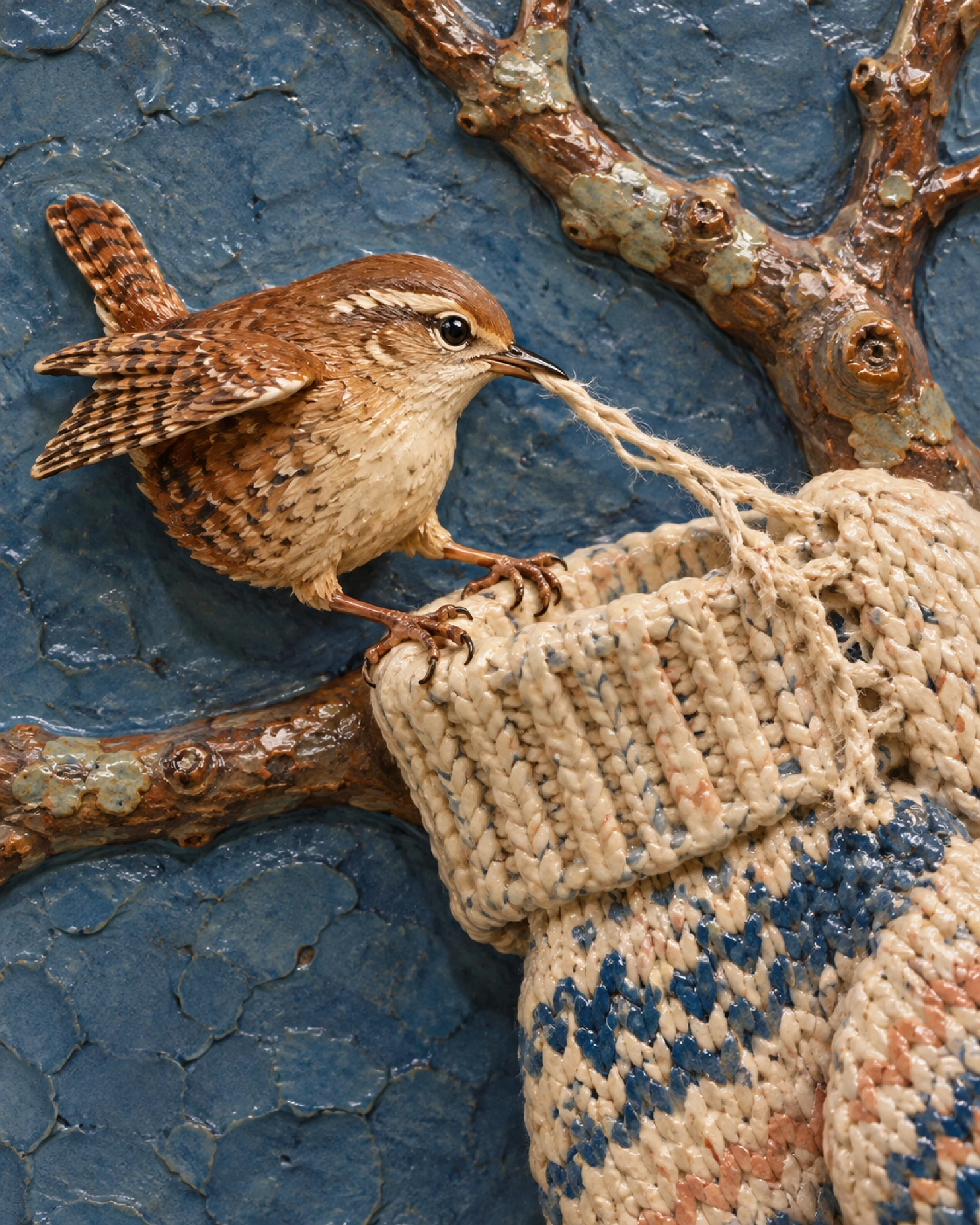
Wren Tugging Wool from a Mitten
A wren braces against an old mitten’s cuff and tugs a loose tuft of wool. Bold cropping and the bird’s taut movement become an intimate ceramic relief, with glaze pooling in modeled hollows.
Remix this referenceWren Tugging Wool from a Mitten
- Form language
- Build shallow ceramic relief from broad modeled masses and a few raised ribbons; simplify detail into readable dents and folds.
- Contour
- Rounded rims, pinched edges and occasional broken lips define contours instead of a continuous drawn outline.
- Mark-making
- Cluster irregular thumb presses and short dragged-tool grooves selectively; let their spacing and depth vary naturally.
- Surface rendering
- Translucent glaze pools in hollows and thins over crests, creating softly uneven tonal transitions and occasional exposed clay edges.
Priority
Make modeled relief and pooled glaze visibly define the illustration’s medium.
What to avoid & what to check
Exact prompt for this example
MODULE OWNERSHIP
subject: Subject count, type, stable proportions and landmarks, resting face geometry, hair shape, physical materials, garment construction and permanent marks. No emotion, movement, color assignment or rendering recipe.
expression: Facial soft-tissue displacement and pupil direction, muscle coordination, regional intensity, asymmetry and onset/peak/release. No head/body pose, stable appearance, skin color or rendering.
gesture: Head/neck/body/limb orientation, joint movement, support, contact and pose-caused occlusion using existing anatomy. No eye/pupil movement, emotion, identity, props inventory or camera.
props: Prop count, type, construction, physical material and scale relative to the subject. Holding/contact belongs to gesture, position to composition, color to palette.
scene: Environment elements, terrain, backdrop/floor presence and structural detail. No canvas positions, camera, lighting, assigned colors or render texture.
camera: Projection, focal-length impression, camera elevation/yaw/roll, viewing distance and crop. No actor pose, world placement, lighting or canvas aspect ratio.
composition: Normalized 0-100% canvas positions, scale in frame, depth/overlap, focal hierarchy and margins. No joint pose, camera projection, rendering, subject/prop inventory or emotion.
palette: Color anchors, hue/saturation/value ranges, colors assigned to parts and approximate color coverage. No illumination direction, shading algorithm, physical material or layout.
lighting: Light-source direction/softness/intensity, ambient illumination, physical shadow direction/length and highlight position. Absence of directional illumination is allowed. No shading technique, palette or material changes.
style: Reusable form abstraction, contour weight/taper/edge quality, medium and mark scale/density/direction, surface rendering and tonal transition technique. No fixed subject proportions, anatomy, identity, expression, pose, palette, light-source direction, camera or layout.
output: Image count, aspect ratio, size, file/alpha requirements and global lettering/logo/watermark restrictions. No background scenery, crop, style, identity or pose.

SUBJECT
inventory: One wren, actor A; no human figure.
geometry: A compact rounded bird with a fine pointed beak, short wings, a narrow tail and slender toes.
resting-face: A small round eye above the beak base; the beak has a straight resting closure.
appearance: Feathered body with a fine eyebrow stripe and barred wing and tail landmarks; minor feather details may vary.

PRIORITY


AVOID


CHECK


EXPRESSION — ACTOR A
brows: No visible brow contraction or expressive lifting.
lids: The visible eye stays open with relaxed lids and no squint.
cheeks: No visible cheek bunching or puffing.
nose: No independently visible nasal movement.
mouth: Beak edges remain aligned without an expressive upward curl.
jaw: Maintain firm, steady closure without a slack gape.
gaze: The visible pupil points toward the tensioned wool.
coordination: Keep the eye region quiet while maintaining steady beak closure.
timing: Hold this settled facial state at the apex, without blinking or beak chatter.

PRIORITY


AVOID


CHECK


GESTURE
head: A extends its neck away from the cuff, aligning its beak with the pull of the wool.
torso: The body leans backward against the pull, with the tail lifted as a counterbalance.
limbs: Both feet brace on the cuff; one wing opens slightly while the other stays folded.
contact: Toes indent the cuff; wool runs taut from beak to seam, and the mitten rests in the branch fork.

PRIORITY


AVOID


CHECK


PROPS
inventory: One adult-sized wool mitten, substantially larger than the wren; no separate tools.
construction: A soft knitted mitten with a ribbed cuff, a worn seam and an attached tuft of loosened wool.

PRIORITY


AVOID


CHECK


SCENE
inventory: A bare orchard branch and a plaster garden wall; no ground is visible.
structure: The branch has a broad fork; the wall forms an uninterrupted surface without openings.

PRIORITY


AVOID


CHECK


CAMERA
projection: A gently compressed perspective with a close portrait-lens impression.
viewpoint: View nearly level with the bird, slightly from its flank; keep the camera upright.
crop: An intimate detail crop includes the entire bird while cutting through the mitten body and branch ends.

PRIORITY


AVOID


CHECK


COMPOSITION
placement: The wren occupies the left-middle; the mitten enters broadly from the lower right, with the branch above it.
depth: Bird and cuff overlap in the foremost layer; the branch sits behind them and the wall recedes.
spacing: The taut wool is the focal bridge; open wall surrounds the beak while the large mitten anchors the arrangement.

PRIORITY


AVOID


CHECK


PALETTE
colors: Use cinnamon brown, oat cream and deep petrol blue, with restrained peach-clay accents.
assignment: Cinnamon bird and branch, oat-cream mitten and wool, petrol-blue wall, peach-clay accents on occasional edges.
balance: Cream and blue dominate the color coverage; cinnamon supplies a concentrated warm accent.

PRIORITY


AVOID


CHECK


LIGHTING
sources: A broad, soft source grazes the forms from the upper left, supported by gentle ambient light.
shadows: Short shadows fall toward the lower right, with deeper shade beneath the cuff and overlapping wing.
highlights: Soft highlights catch upper-left-facing ridges, with a few brighter glints on rounded crests.

PRIORITY


AVOID


CHECK


STYLE GUIDE
form-language: Build shallow ceramic relief from broad modeled masses and a few raised ribbons; simplify detail into readable dents and folds.
contour: Rounded rims, pinched edges and occasional broken lips define contours instead of a continuous drawn outline.
mark-making: Cluster irregular thumb presses and short dragged-tool grooves selectively; let their spacing and depth vary naturally.
surface-rendering: Translucent glaze pools in hollows and thins over crests, creating softly uneven tonal transitions and occasional exposed clay edges.

PRIORITY
Make modeled relief and pooled glaze visibly define the illustration’s medium.

AVOID


CHECK


OUTPUT
format: One finished image, portrait 4:5, 1600 × 2000 pixels, opaque PNG.
restrictions: No lettering, logos or watermarks.

PRIORITY


AVOID


CHECK


FINAL INTEGRATION
gesture + composition: Keep the pulling contact readable within the overlapping arrangement.
style + lighting: Let illumination reveal the modeled surface while glaze variation supplies its tactile character.
Model information comes from image provenance. The same prompt may produce a different result.