Text to imageArt stylesStyle guide
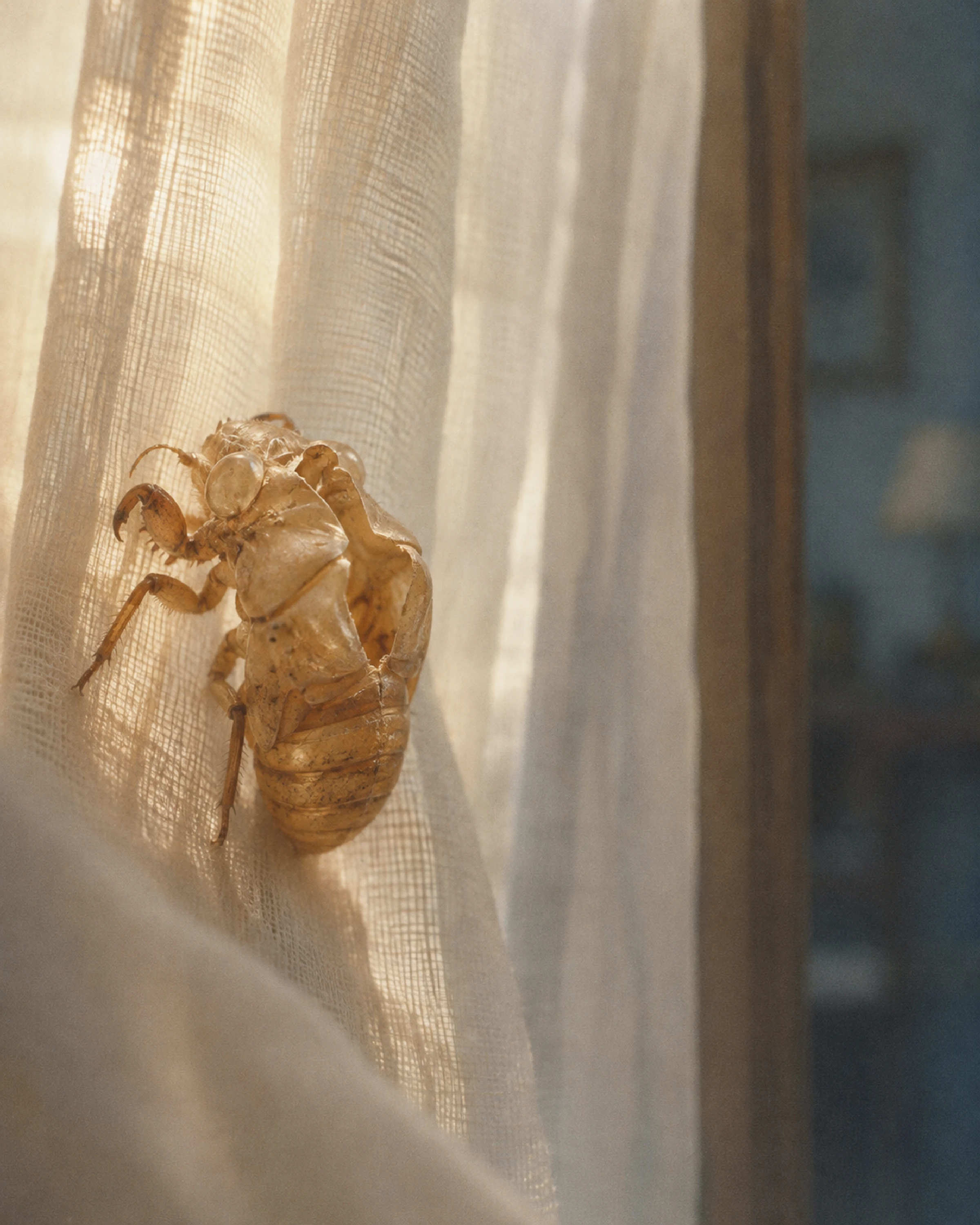
A Cicada Shell on a Curtain
An intimate analog photograph of an empty cicada shell against a pleated curtain. Its split back and hollow body catch soft window light against a room dissolving into expressive photographic depth.
Remix this referenceA Cicada Shell on a Curtain
- Form language
- Use observational photographic forms, preserving incidental irregularity while allowing defocused shapes to merge into broad masses.
- Contour
- Keep edges optically crisp only within a narrow plane; let adjacent boundaries dissolve gradually without drawn outlines.
- Mark-making
- Fine irregular film grain clusters naturally through midtones and shadows, with occasional soft emulsion flecks rather than uniform noise.
- Surface rendering
- Render as a scanned color negative with supple tonal transitions, restrained highlight bloom and open, softly compressed shadows.
Priority
The analog photographic treatment must remain visible in edge falloff, grain and tonal response.
What to avoid & what to check
Exact prompt for this example
MODULE OWNERSHIP
subject: Subject count, type, stable proportions and landmarks, resting face geometry, hair shape, physical materials, garment construction and permanent marks. No emotion, movement, color assignment or rendering recipe.
expression: Facial soft-tissue displacement and pupil direction, muscle coordination, regional intensity, asymmetry and onset/peak/release. No head/body pose, stable appearance, skin color or rendering.
gesture: Head/neck/body/limb orientation, joint movement, support, contact and pose-caused occlusion using existing anatomy. No eye/pupil movement, emotion, identity, props inventory or camera.
props: Prop count, type, construction, physical material and scale relative to the subject. Holding/contact belongs to gesture, position to composition, color to palette.
scene: Environment elements, terrain, backdrop/floor presence and structural detail. No canvas positions, camera, lighting, assigned colors or render texture.
camera: Projection, focal-length impression, camera elevation/yaw/roll, viewing distance and crop. No actor pose, world placement, lighting or canvas aspect ratio.
composition: Normalized 0-100% canvas positions, scale in frame, depth/overlap, focal hierarchy and margins. No joint pose, camera projection, rendering, subject/prop inventory or emotion.
palette: Color anchors, hue/saturation/value ranges, colors assigned to parts and approximate color coverage. No illumination direction, shading algorithm, physical material or layout.
lighting: Light-source direction/softness/intensity, ambient illumination, physical shadow direction/length and highlight position. Absence of directional illumination is allowed. No shading technique, palette or material changes.
style: Reusable form abstraction, contour weight/taper/edge quality, medium and mark scale/density/direction, surface rendering and tonal transition technique. No fixed subject proportions, anatomy, identity, expression, pose, palette, light-source direction, camera or layout.
output: Image count, aspect ratio, size, file/alpha requirements and global lettering/logo/watermark restrictions. No background scenery, crop, style, identity or pose.

SUBJECT
inventory: One empty cicada exoskeleton; no living insect or person.
geometry: Preserve the recognizable squat thorax, segmented hollow abdomen and opened dorsal seam.
resting-face: The empty eye cases remain rigid anatomical shells.
appearance: Thin translucent chitin with naturally chipped margins; minor irregularities may vary.

PRIORITY


AVOID


CHECK


PROPS
inventory: No separate props.
construction: No prop construction applies.

PRIORITY


AVOID


CHECK


SCENE
inventory: A pleated gauze curtain, a narrow window reveal and an indistinct domestic interior; no visible floor.
structure: Broad hanging folds alternate with thin translucent panels; the window reveal supplies one firm architectural edge.

PRIORITY


AVOID


CHECK


CAMERA
projection: Photographic perspective with a short telephoto macro-lens impression and gentle spatial compression.
viewpoint: View from shell height, slightly oblique to the curtain, at intimate detail distance; keep the camera level.
crop: Retain the complete shell while letting the curtain folds and window reveal continue beyond the frame.

PRIORITY


AVOID


CHECK


COMPOSITION
placement: Place the shell near 30% canvas width, slightly below mid-height, occupying roughly half the image height.
depth: The dorsal opening leads attention, followed by overlapping curtain folds and the distant interior.
spacing: Leave a generous quiet field to the right; one broad foreground fold partially veils the lower corner.

PRIORITY


AVOID


CHECK


PALETTE
colors: Use honey amber, warm ivory, muted tobacco and a restrained smoky blue.
assignment: Amber belongs to the shell, ivory to the curtain, tobacco to the window reveal and smoky blue to the distant room.
balance: Ivory dominates; amber provides the concentrated warm accent, with subdued darker colors retaining depth.

PRIORITY


AVOID


CHECK


LIGHTING
sources: Broad soft daylight enters from behind and upper left, with faint room fill.
shadows: Curtain folds cast soft elongated shadows toward the lower right; the shell interior remains gently shaded.
highlights: Small transmitted highlights trace the shell's thin upper margins; the curtain carries broad luminous passages.

PRIORITY


AVOID


CHECK


STYLE GUIDE
form-language: Use observational photographic forms, preserving incidental irregularity while allowing defocused shapes to merge into broad masses.
contour: Keep edges optically crisp only within a narrow plane; let adjacent boundaries dissolve gradually without drawn outlines.
mark-making: Fine irregular film grain clusters naturally through midtones and shadows, with occasional soft emulsion flecks rather than uniform noise.
surface-rendering: Render as a scanned color negative with supple tonal transitions, restrained highlight bloom and open, softly compressed shadows.

PRIORITY
The analog photographic treatment must remain visible in edge falloff, grain and tonal response.

AVOID


CHECK


OUTPUT
format: One finished image, portrait 4:5, 2400 × 3000 pixels, opaque PNG.
restrictions: No lettering, logos, signatures or watermarks.

PRIORITY


AVOID


CHECK


FINAL INTEGRATION
camera + composition + style: Let optical depth and edge variation reinforce the composition's passage from intimate detail into quiet space.
Model information comes from image provenance. The same prompt may produce a different result.