Text to imageArt stylesStyle guide
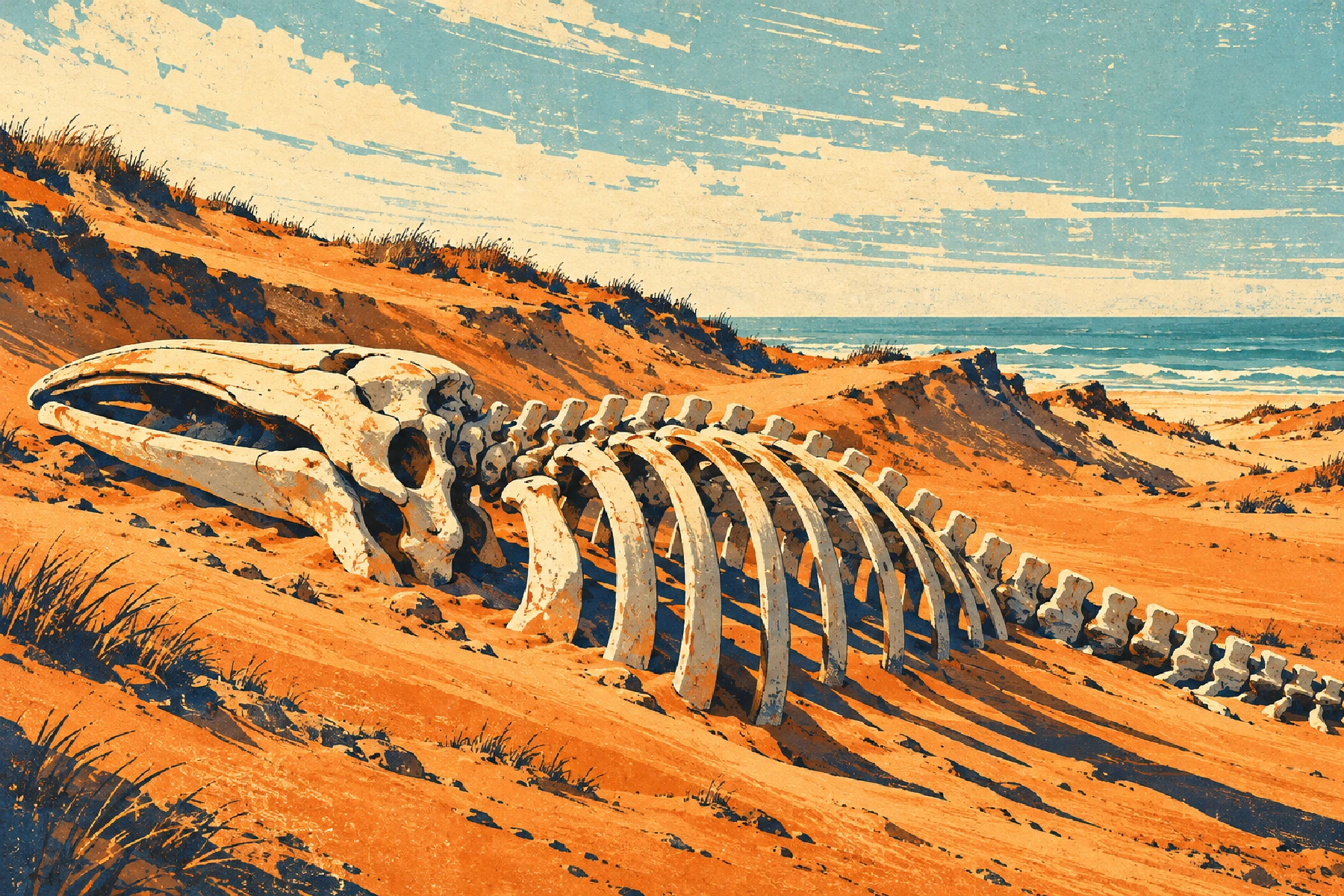
Whale Bones in Wind-Carved Dunes
A screen-printed illustration of whale bones half buried in dunes, built from broad ink masses and repeating open ribs. Spacious sky and overlapping ink passes create a dry, monumental rhythm.
Remix this referenceWhale Bones in Wind-Carved Dunes
- Form language
- Translate complex volumes into interlocking broad wedges and open crescents; decisive changes in shape carry the detail.
- Contour
- Let printed shape edges define contours, alternating crisp stencil cuts with occasional broken edges rather than uniform outlines.
- Mark-making
- Use sparse squeegee-drag streaks inside broad masses and irregular ink skips near selected edges; vary marks naturally between passes.
- Surface rendering
- Build tones from opaque ink planes and selective translucent overprints, retaining slight ink pooling and exposed paper between passages.
Priority
Make graphic screen printing visible through decisive shape rhythms and distinct overlapping ink passes.
What to avoid & what to check
Exact prompt for this example
MODULE OWNERSHIP
subject: Subject count, type, stable proportions and landmarks, resting face geometry, hair shape, physical materials, garment construction and permanent marks. No emotion, movement, color assignment or rendering recipe.
expression: Facial soft-tissue displacement and pupil direction, muscle coordination, regional intensity, asymmetry and onset/peak/release. No head/body pose, stable appearance, skin color or rendering.
gesture: Head/neck/body/limb orientation, joint movement, support, contact and pose-caused occlusion using existing anatomy. No eye/pupil movement, emotion, identity, props inventory or camera.
props: Prop count, type, construction, physical material and scale relative to the subject. Holding/contact belongs to gesture, position to composition, color to palette.
scene: Environment elements, terrain, backdrop/floor presence and structural detail. No canvas positions, camera, lighting, assigned colors or render texture.
camera: Projection, focal-length impression, camera elevation/yaw/roll, viewing distance and crop. No actor pose, world placement, lighting or canvas aspect ratio.
composition: Normalized 0-100% canvas positions, scale in frame, depth/overlap, focal hierarchy and margins. No joint pose, camera projection, rendering, subject/prop inventory or emotion.
palette: Color anchors, hue/saturation/value ranges, colors assigned to parts and approximate color coverage. No illumination direction, shading algorithm, physical material or layout.
lighting: Light-source direction/softness/intensity, ambient illumination, physical shadow direction/length and highlight position. Absence of directional illumination is allowed. No shading technique, palette or material changes.
style: Reusable form abstraction, contour weight/taper/edge quality, medium and mark scale/density/direction, surface rendering and tonal transition technique. No fixed subject proportions, anatomy, identity, expression, pose, palette, light-source direction, camera or layout.
output: Image count, aspect ratio, size, file/alpha requirements and global lettering/logo/watermark restrictions. No background scenery, crop, style, identity or pose.

SUBJECT
inventory: One weathered whale skeleton with a skull, connected spine, and partially preserved rib cage; no living characters.
geometry: A broad, tapering skull anchors a long spine; sweeping paired ribs form a recognizable open cage.
resting-face: No soft-tissue face remains; the skull has open sockets and an exposed jaw structure.
appearance: Exposed bone has worn ends, shallow cracks, and porous patches; minor weathering may vary naturally.

PRIORITY


AVOID


CHECK


GESTURE
head: No independent head movement is prescribed.
torso: The skeleton lies lengthwise in the dune hollow.
limbs: No limb-joint control targets apply.
contact: Sand supports the skeleton and partially buries its base.

PRIORITY


AVOID


CHECK


PROPS
inventory: No separate props.
construction: No prop construction applies.

PRIORITY


AVOID


CHECK


SCENE
inventory: A coastal dune hollow, wind-cut sand ridges, a narrow sea beyond the dunes, and open sky.
structure: Shallow channels and a broken dune crest articulate the hollow.

PRIORITY


AVOID


CHECK


CAMERA
projection: Use restrained perspective with a normal-lens impression and little foreground exaggeration.
viewpoint: Look obliquely across the hollow from slightly above the rib cage, with a level camera.
crop: Use an environmental view that includes the skull and rib arches; allow the nearest spine end to leave the frame.

PRIORITY


AVOID


CHECK


COMPOSITION
placement: The rib cage dominates the lower middle, the skull extends left, and the spine leads toward the bottom right.
depth: Near ribs overlap farther arches; dune ridges separate the skeleton from the small distant sea.
spacing: Make the open rib intervals the focal rhythm, with a generous uninterrupted sky area above and to the right.

PRIORITY


AVOID


CHECK


PALETTE
colors: Use warm ivory, burnt orange, deep indigo, and muted turquoise as the compact color anchors.
assignment: Assign ivory to bones and sky, orange to sand, indigo to dark recesses and shadows, and turquoise to the sea.
balance: Let ivory and orange occupy broad areas; keep indigo assertive but limited and turquoise a small cool accent.

PRIORITY


AVOID


CHECK


LIGHTING
sources: Broad sunlight enters from the upper left, with gentle ambient fill from the open sky.
shadows: Ribs cast long, clearly separated shadows toward the lower right, softening across the sand.
highlights: Keep the strongest highlights along the upper-left shoulders of the exposed bones.

PRIORITY


AVOID


CHECK


STYLE GUIDE
form-language: Translate complex volumes into interlocking broad wedges and open crescents; decisive changes in shape carry the detail.
contour: Let printed shape edges define contours, alternating crisp stencil cuts with occasional broken edges rather than uniform outlines.
mark-making: Use sparse squeegee-drag streaks inside broad masses and irregular ink skips near selected edges; vary marks naturally between passes.
surface-rendering: Build tones from opaque ink planes and selective translucent overprints, retaining slight ink pooling and exposed paper between passages.

PRIORITY
Make graphic screen printing visible through decisive shape rhythms and distinct overlapping ink passes.

AVOID


CHECK


OUTPUT
format: Create one finished landscape illustration, 3:2 aspect ratio, 1800 × 1200 pixels, opaque PNG.
restrictions: No lettering, logos, signatures, or watermarks.

PRIORITY


AVOID


CHECK


FINAL INTEGRATION
composition + style: Let the spacing remain readable through the print's simplification, while allowing incidental edge and mark variation.
Model information comes from image provenance. The same prompt may produce a different result.