Text to imageCharacterStyle guide
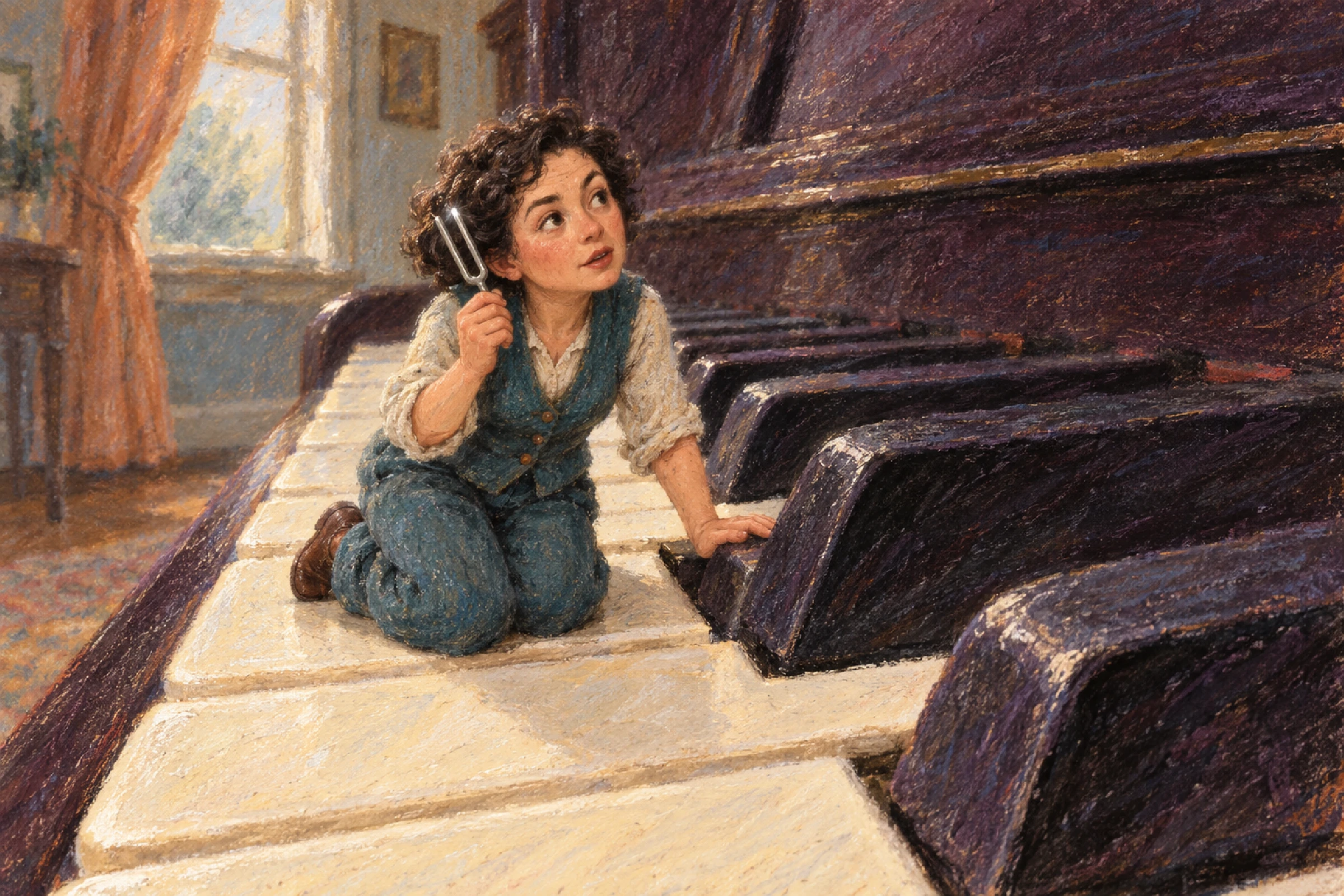
Tuner on a Piano Key
A palm-sized tuner kneels on an enormous piano key, listening to a tuning fork. Rubbed and scratched oil pastel turns a familiar sitting room into a dream of resonance.
Remix this referenceTuner on a Piano Key
- Form language
- Simplify forms into yielding, slightly swollen masses; preserve recognizable objects while allowing dreamlike irregularity.
- Contour
- Use broken waxy contours that thicken, disappear and rejoin; sharpen only a few edges with scratched incisions.
- Mark-making
- Lay oil pastel in broad pressure-varied strokes, rub passages with a soft smear, and scratch through selected layers.
- Surface rendering
- Blend rubbed veils with stubborn wax ridges and exposed underlayers; tonal transitions remain mottled and tactile.
Priority
Make rubbed and scratched oil pastel visibly shape the dreamlike finish.
What to avoid & what to check
Exact prompt for this example
MODULE OWNERSHIP
subject: Subject count, type, stable proportions and landmarks, resting face geometry, hair shape, physical materials, garment construction and permanent marks. No emotion, movement, color assignment or rendering recipe.
expression: Facial soft-tissue displacement and pupil direction, muscle coordination, regional intensity, asymmetry and onset/peak/release. No head/body pose, stable appearance, skin color or rendering.
gesture: Head/neck/body/limb orientation, joint movement, support, contact and pose-caused occlusion using existing anatomy. No eye/pupil movement, emotion, identity, props inventory or camera.
props: Prop count, type, construction, physical material and scale relative to the subject. Holding/contact belongs to gesture, position to composition, color to palette.
scene: Environment elements, terrain, backdrop/floor presence and structural detail. No canvas positions, camera, lighting, assigned colors or render texture.
camera: Projection, focal-length impression, camera elevation/yaw/roll, viewing distance and crop. No actor pose, world placement, lighting or canvas aspect ratio.
composition: Normalized 0-100% canvas positions, scale in frame, depth/overlap, focal hierarchy and margins. No joint pose, camera projection, rendering, subject/prop inventory or emotion.
palette: Color anchors, hue/saturation/value ranges, colors assigned to parts and approximate color coverage. No illumination direction, shading algorithm, physical material or layout.
lighting: Light-source direction/softness/intensity, ambient illumination, physical shadow direction/length and highlight position. Absence of directional illumination is allowed. No shading technique, palette or material changes.
style: Reusable form abstraction, contour weight/taper/edge quality, medium and mark scale/density/direction, surface rendering and tonal transition technique. No fixed subject proportions, anatomy, identity, expression, pose, palette, light-source direction, camera or layout.
output: Image count, aspect ratio, size, file/alpha requirements and global lettering/logo/watermark restrictions. No background scenery, crop, style, identity or pose.

SUBJECT
inventory: A is one original adult woman, a miniature piano tuner.
geometry: Keep ordinary adult proportions; her entire body fits on one piano key, with broad hands and a compact head.
resting-face: Her resting face has a broad forehead, a short straight nose, softly squared jaw and a narrow upper lip.
appearance: Short loose curls, a wool waistcoat over a collarless shirt, wide trousers and soft leather shoes define her.

PRIORITY


AVOID


CHECK


EXPRESSION — ACTOR A
brows: One brow lifts slightly while the other remains nearly resting.
lids: Upper lids open a little; lower lids stay soft.
cheeks: Cheeks remain relaxed, with no smile-driven lift.
nose: The nose remains unwrinkled and the nostrils unflared.
mouth: Lips part slightly, with relaxed and nearly level corners.
jaw: The jaw releases just enough to accompany the parted lips.
gaze: Pupils aim along the raised black key beyond her supporting hand.
coordination: The small brow asymmetry leads; the relaxed lower face keeps the response restrained.
timing: Capture the onset of attentive curiosity before a fuller reaction develops.

PRIORITY


AVOID


CHECK


GESTURE
head: A tips her head toward the tuning fork while turning her face outward from the piano.
torso: Her torso leans gently sideways over the planted supporting arm.
limbs: She kneels with legs folded beneath her; one arm braces while the other lifts the fork beside her ear.
contact: Her knees rest on a white key, one palm presses a black key's side, and the other hand grips the fork stem.

PRIORITY


AVOID


CHECK


PROPS
inventory: One tuning fork is the only separate prop.
construction: The steel fork has two plain tines and a short stem, sized for A's hand.

PRIORITY


AVOID


CHECK


SCENE
inventory: A domestic upright piano stands in a sitting room with a curtained window and a narrow glimpse of floor.
structure: The uncovered keyboard, tall wooden case and simple window surround keep the room immediately recognizable.

PRIORITY


AVOID


CHECK


CAMERA
projection: Use moderate perspective with a natural focal-length impression and no wide-angle distortion.
viewpoint: Look three-quarter along the keyboard from just above key height, with a slight downward pitch and no roll.
crop: Include A's complete figure and a substantial keyboard stretch; crop foreground keys, the piano case and room at the image edges.

PRIORITY


AVOID


CHECK


COMPOSITION
placement: Place A near 35% canvas width and 60% height; the keyboard recedes toward the upper-right region.
depth: Her face and fork form the first focus; oversized keys establish scale, while the distant window remains subordinate.
spacing: Leave breathing room around her face and fork; foreground keys create an enveloping, uneven frame.

PRIORITY


AVOID


CHECK


PALETTE
colors: Use butter cream, smoky aubergine, dusty teal and muted apricot, with restrained saturation.
assignment: Cream fills white keys; aubergine fills black keys and piano case; teal dresses A; apricot colors skin and curtain.
balance: Broad dark piano areas balance the pale keyboard; the small teal figure and warm face provide concise accents.

PRIORITY


AVOID


CHECK


LIGHTING
sources: Soft window light enters from upper left, supported by gentle room ambience.
shadows: Short, soft shadows fall to the lower right; contact shadows remain visible beneath her knees and palm.
highlights: Broad highlights touch upper-left-facing planes, with a small glint along the fork's window-facing tine.

PRIORITY


AVOID


CHECK


STYLE GUIDE
form-language: Simplify forms into yielding, slightly swollen masses; preserve recognizable objects while allowing dreamlike irregularity.
contour: Use broken waxy contours that thicken, disappear and rejoin; sharpen only a few edges with scratched incisions.
mark-making: Lay oil pastel in broad pressure-varied strokes, rub passages with a soft smear, and scratch through selected layers.
surface-rendering: Blend rubbed veils with stubborn wax ridges and exposed underlayers; tonal transitions remain mottled and tactile.

PRIORITY
Make rubbed and scratched oil pastel visibly shape the dreamlike finish.

AVOID


CHECK


OUTPUT
format: Deliver one finished 3:2 image, 2400 × 1600 pixels, as an opaque PNG.
restrictions: No lettering, logos, signatures or watermarks.

PRIORITY


AVOID


CHECK


FINAL INTEGRATION
subject + scene + camera + composition: A familiar room and readable keyboard make the miniature character's scale immediately meaningful.
expression + gesture + props: The quiet facial response and listening action cooperate around the tuning fork.
lighting + style: Visible illumination remains legible through the pastel's softened edges and tactile transitions.
Model information comes from image provenance. The same prompt may produce a different result.