Text to imageIllustrationStyle guide
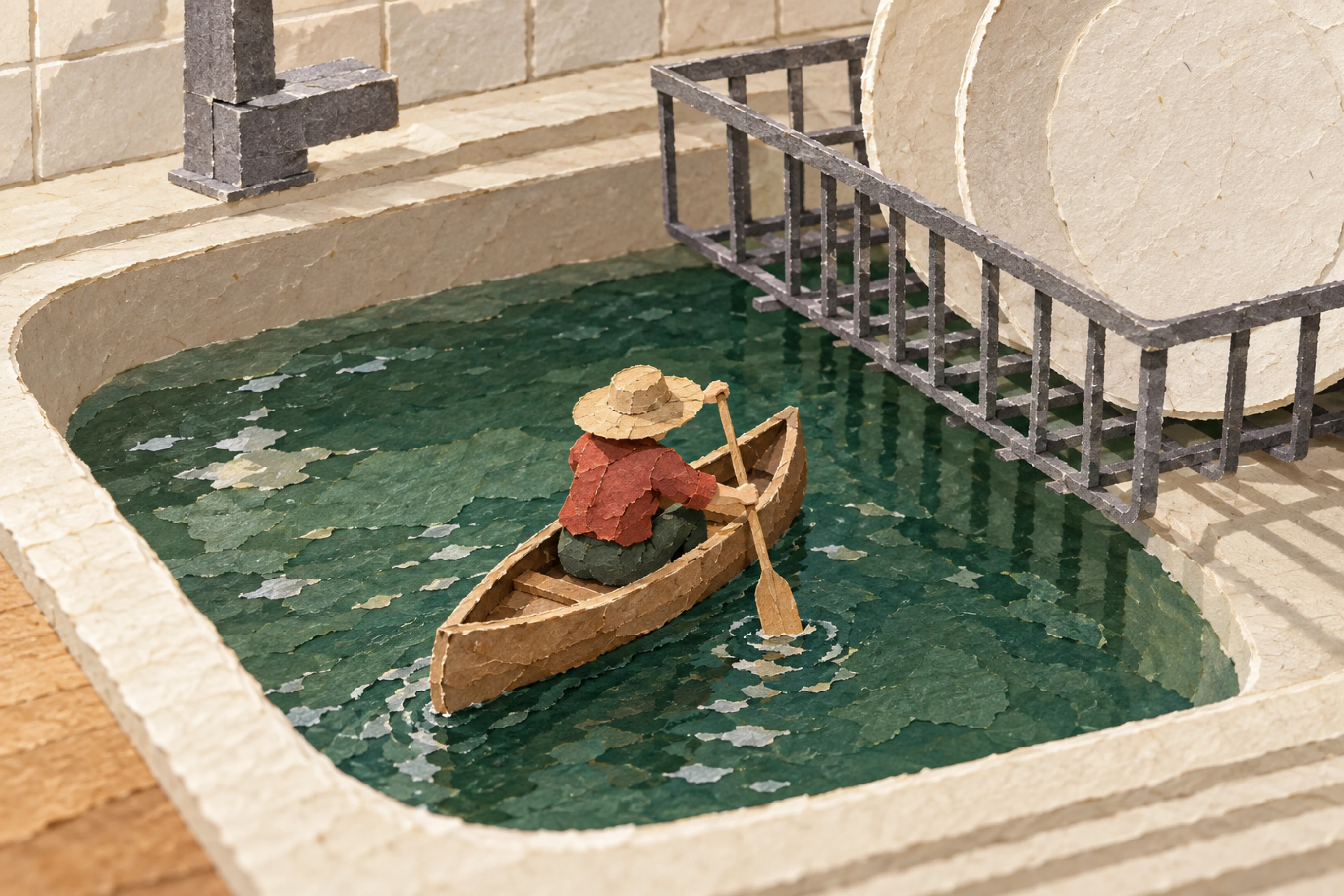
A Canoe Beneath the Dish Rack
A miniature paddler guides a canoe beneath a dish rack in a kitchen sink. Layered cut paper gives the plates and narrow water passage a handmade depth.
Remix this referenceA Canoe Beneath the Dish Rack
- Form language
- Construct forms from interlocking paper silhouettes and a few inset plane pieces; simplify small details while retaining distinctive openings.
- Contour
- Combine decisive scissor-cut edges with selected fibrous tears; allow slight unevenness and offset joins without drawn outlines.
- Mark-making
- Use sparse rubbed pigment and visible handmade-paper fibers within pieces, varying their direction naturally between fragments.
- Surface rendering
- Preserve tactile pasted overlaps and slightly lifted edges; build tone through stacked opaque pieces and rubbed patches.
Priority
Make layered cut-paper construction visibly tangible through overlaps and varied handmade edges.
What to avoid & what to check
Exact prompt for this example
MODULE OWNERSHIP
subject: Subject count, type, stable proportions and landmarks, resting face geometry, hair shape, physical materials, garment construction and permanent marks. No emotion, movement, color assignment or rendering recipe.
expression: Facial soft-tissue displacement and pupil direction, muscle coordination, regional intensity, asymmetry and onset/peak/release. No head/body pose, stable appearance, skin color or rendering.
gesture: Head/neck/body/limb orientation, joint movement, support, contact and pose-caused occlusion using existing anatomy. No eye/pupil movement, emotion, identity, props inventory or camera.
props: Prop count, type, construction, physical material and scale relative to the subject. Holding/contact belongs to gesture, position to composition, color to palette.
scene: Environment elements, terrain, backdrop/floor presence and structural detail. No canvas positions, camera, lighting, assigned colors or render texture.
camera: Projection, focal-length impression, camera elevation/yaw/roll, viewing distance and crop. No actor pose, world placement, lighting or canvas aspect ratio.
composition: Normalized 0-100% canvas positions, scale in frame, depth/overlap, focal hierarchy and margins. No joint pose, camera projection, rendering, subject/prop inventory or emotion.
palette: Color anchors, hue/saturation/value ranges, colors assigned to parts and approximate color coverage. No illumination direction, shading algorithm, physical material or layout.
lighting: Light-source direction/softness/intensity, ambient illumination, physical shadow direction/length and highlight position. Absence of directional illumination is allowed. No shading technique, palette or material changes.
style: Reusable form abstraction, contour weight/taper/edge quality, medium and mark scale/density/direction, surface rendering and tonal transition technique. No fixed subject proportions, anatomy, identity, expression, pose, palette, light-source direction, camera or layout.
output: Image count, aspect ratio, size, file/alpha requirements and global lettering/logo/watermark restrictions. No background scenery, crop, style, identity or pose.

SUBJECT
inventory: Actor A is one miniature adult woman, the only person in the image.
geometry: Use an ordinary adult build with a compact silhouette and recognizable human proportions at miniature scale.
resting-face: No specific resting facial geometry is prescribed.
appearance: She wears a plain woven broad-brim hat, a loose cotton shirt and simple trousers; her hair is tucked inside the hat.

PRIORITY


AVOID


CHECK


EXPRESSION — ACTOR A
brows: No brow action is prescribed.
lids: No lid displacement is prescribed.
cheeks: No cheek displacement is prescribed.
nose: No nostril action is prescribed.
mouth: No lip action is prescribed.
jaw: No jaw displacement is prescribed.
gaze: Gaze direction remains unprescribed.
coordination: No visible facial muscle action or asymmetry is requested.
timing: Hold neutral rest at the selected instant; no visible onset or release.

PRIORITY


AVOID


CHECK


GESTURE
head: A inclines her head toward the route ahead, keeping her face concealed beneath the hat brim.
torso: A sits low and turns her torso gently toward the working paddle.
limbs: One hand caps the paddle grip while the other draws its lower shaft back through a single steady stroke.
contact: Her weight rests on the canoe seat; both hands grip the paddle, whose blade enters the water beside the hull.

PRIORITY


AVOID


CHECK


PROPS
inventory: One open canoe, one single-bladed paddle, one household dish rack and two dinner plates.
construction: The wooden canoe and paddle fit A; the wire rack and ceramic plates retain household scale, much larger than her.

PRIORITY


AVOID


CHECK


SCENE
inventory: A domestic kitchen sink contains shallow water, with a countertop, draining board, tiled backsplash and plain tap.
structure: A rounded rectangular basin has a raised rim; parallel draining grooves and square tile joints establish the everyday setting.

PRIORITY


AVOID


CHECK


CAMERA
projection: Use moderately wide perspective that keeps the sink legible while allowing clear differences in depth.
viewpoint: Look obliquely downward from above the near sink corner, viewing A from behind with facial landmarks out of view and no camera roll.
crop: Include the basin and enough countertop to identify the kitchen; crop the distant backsplash and outer draining board.

PRIORITY


AVOID


CHECK


COMPOSITION
placement: Place the canoe below the middle, just before the rack extending from the right edge toward the upper center.
depth: Rack wires overlap the canoe bow; plates rise behind them, while the paddler and narrow opening share focal emphasis.
spacing: Keep open water around the stern and a readable gap beneath the rack; let the sink rim frame the lower edge asymmetrically.

PRIORITY


AVOID


CHECK


PALETTE
colors: Use chalk cream, bottle green, tomato red and graphite gray, with a small warm tan accent.
assignment: Assign cream to sink and plates, green to water, red to A's shirt, gray to rack and tap, and tan to canoe, paddle and hat.
balance: Let pale household surfaces occupy most of the image; contrast the small saturated shirt with darker water.

PRIORITY


AVOID


CHECK


LIGHTING
sources: Broad window light enters from the upper left, supported by soft room ambience.
shadows: The rack casts narrow shadows toward the lower right; the sink recess remains softly shaded.
highlights: Keep highlights broad on the plate rims and sink lip, with only a few small glints on the water.

PRIORITY


AVOID


CHECK


STYLE GUIDE
form-language: Construct forms from interlocking paper silhouettes and a few inset plane pieces; simplify small details while retaining distinctive openings.
contour: Combine decisive scissor-cut edges with selected fibrous tears; allow slight unevenness and offset joins without drawn outlines.
mark-making: Use sparse rubbed pigment and visible handmade-paper fibers within pieces, varying their direction naturally between fragments.
surface-rendering: Preserve tactile pasted overlaps and slightly lifted edges; build tone through stacked opaque pieces and rubbed patches.

PRIORITY
Make layered cut-paper construction visibly tangible through overlaps and varied handmade edges.

AVOID


CHECK


OUTPUT
format: One finished image, landscape 3:2, 3000 × 2000 pixels, opaque PNG.
restrictions: No lettering, logos, signatures or watermarks.

PRIORITY


AVOID


CHECK


FINAL INTEGRATION
props + scene + composition: Let familiar household structures make the miniature journey immediately understandable.
gesture + style: Preserve readable action when simplifying the figure into separate paper pieces.
Model information comes from image provenance. The same prompt may produce a different result.