Text to imageCafe & brandStyle guide
Local Tea Shop · Two-Color Overprint
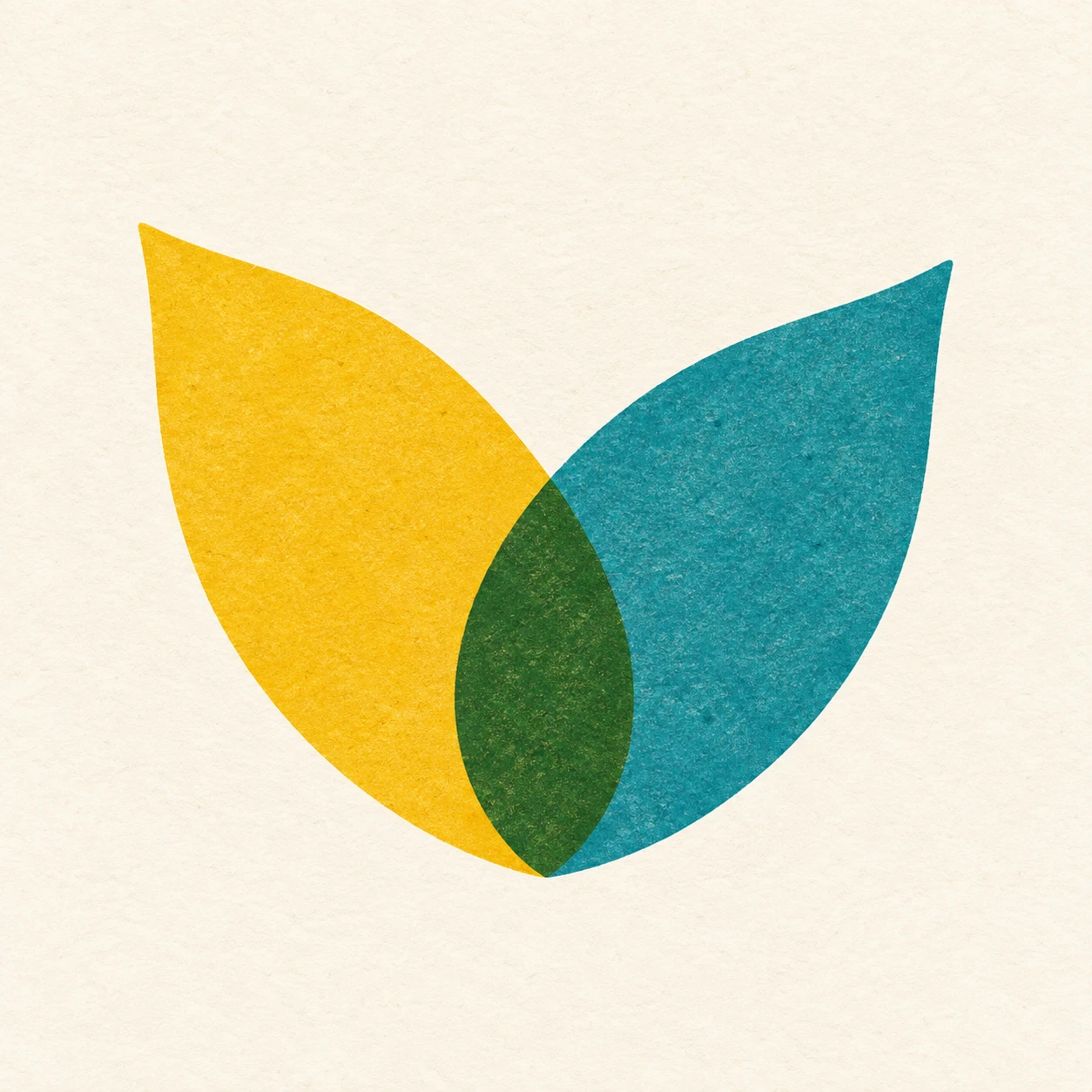
A simple tea-shop symbol demonstrates two-color overprinting through a third color formed only where two leaves overlap.
Local Tea Shop · Two-Color Overprint
- Shape & line
- Draw two broad, pointed oval leaves with smooth closed contours and slightly asymmetric curved sides. Tilt the image-left leaf upward toward the left and the image-right leaf upward toward the right, overlapping their lower inner halves into one clearly bounded shared shape; omit veins so the ink interaction stays readable.
- Color & light
- Print the image-left leaf in golden yellow and the image-right leaf in teal blue. Render only their intersection as a darker green made by the apparent layering of those inks, keeping all three color regions flat and clearly separated; use no directional lighting or shaded volume.
- Texture & material
- Give the symbol the appearance of thin ink printed on matte uncoated ivory paper. Add a faint paper grain across the background and restrained ink mottling within the leaves, while keeping the overlap boundary crisp enough that texture never disguises the third-color region.
- Composition
- Arrange the two leaves as one compact upright emblem occupying roughly the middle half of the canvas. Keep their outward tips separate and their shared green area broad enough to read at a glance, with balanced ivory margins and no border or surrounding decorative elements.
Priority
Make the third color visibly result from the overlap of the two complete leaf shapes.
What to avoid & what to check
Avoid a separately outlined green insert, gradient blending, and three-dimensional leaf rendering.
Confirm that yellow remains on the left, teal blue remains on the right, and darker green appears only in their shared area.
Exact prompt for this example
SUBJECT
An original brand symbol for a neighborhood loose-leaf tea shop, consisting of exactly two overlapping leaf silhouettes. Each leaf remains individually recognizable, and their shared area visibly demonstrates two-color ink overprinting.

COMPOSITION
Present a flat, front-facing identity study on a warm ivory square. Center one large two-leaf symbol with generous empty space around it; show the complete silhouettes without cropping or additional applications.

STYLE GUIDE
1. Shape & line
Draw two broad, pointed oval leaves with smooth closed contours and slightly asymmetric curved sides. Tilt the image-left leaf upward toward the left and the image-right leaf upward toward the right, overlapping their lower inner halves into one clearly bounded shared shape; omit veins so the ink interaction stays readable.

2. Color & light
Print the image-left leaf in golden yellow and the image-right leaf in teal blue. Render only their intersection as a darker green made by the apparent layering of those inks, keeping all three color regions flat and clearly separated; use no directional lighting or shaded volume.

3. Texture & material
Give the symbol the appearance of thin ink printed on matte uncoated ivory paper. Add a faint paper grain across the background and restrained ink mottling within the leaves, while keeping the overlap boundary crisp enough that texture never disguises the third-color region.

4. Composition
Arrange the two leaves as one compact upright emblem occupying roughly the middle half of the canvas. Keep their outward tips separate and their shared green area broad enough to read at a glance, with balanced ivory margins and no border or surrounding decorative elements.

PRIORITY
Preserve the requested identity, count, action, composition and output settings. Apply the style rules within those constraints; a style reference must not replace the subject or layout. Within the style: Make the third color visibly result from the overlap of the two complete leaf shapes.

AVOID
Avoid a separately outlined green insert, gradient blending, and three-dimensional leaf rendering.

OUTPUT
Create one square image with a 1:1 aspect ratio. Include no lettering, numbers, captions, watermarks, or explanatory diagrams.

SELF-CHECK
Confirm that yellow remains on the left, teal blue remains on the right, and darker green appears only in their shared area.
Model information comes from image provenance. The same prompt may produce a different result.