Text to imageArt stylesStyle guide
Hands Mending a Drumhead
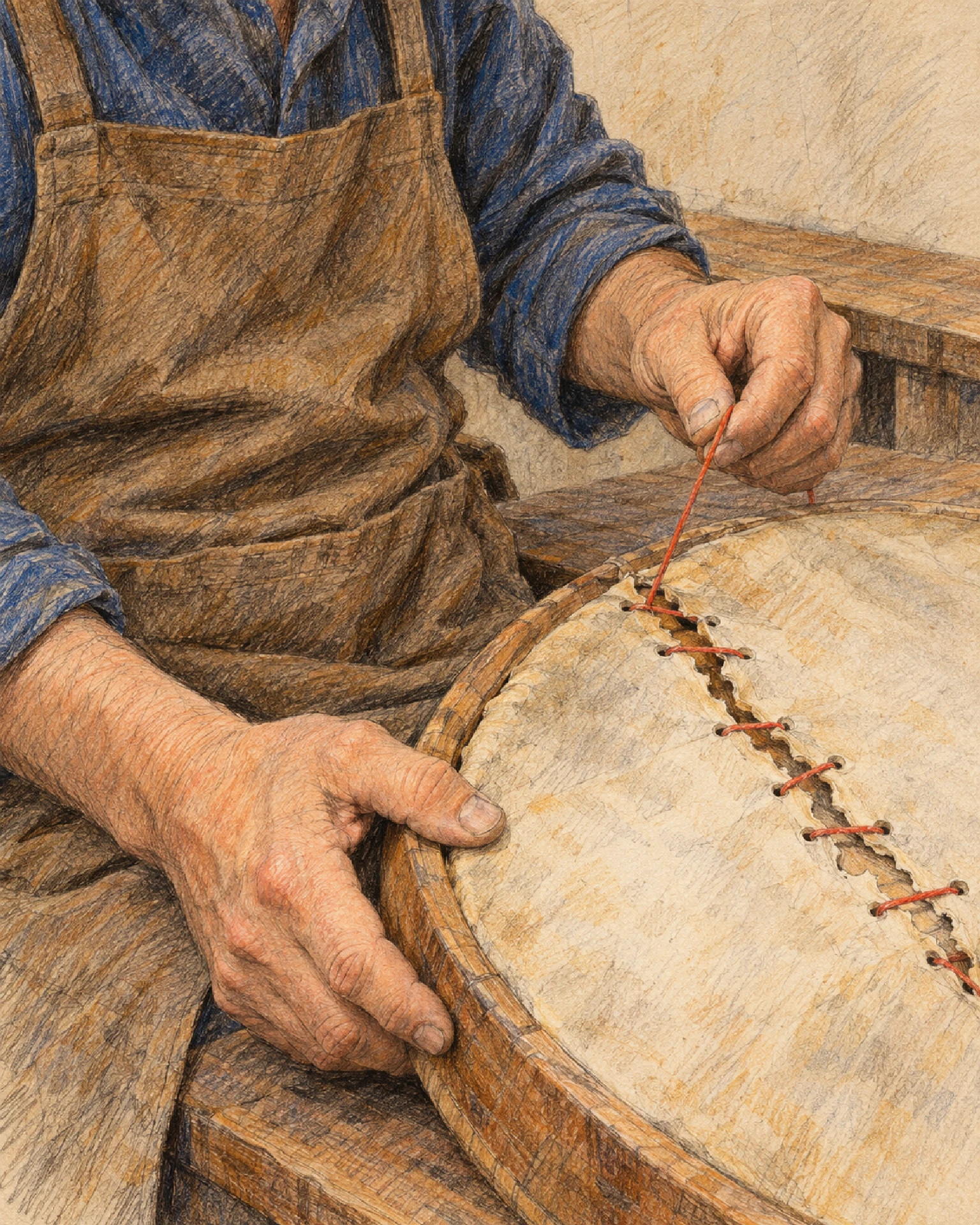
An intimate view of hands drawing repair cord across a torn drumhead. Rough pencil lines and open colored-pencil layers give the worn drum and working hands a tactile presence.
Remix this referenceHands Mending a Drumhead
- Form language
- Simplify observed forms into loose interlocking masses and broken planes; retain small irregularities without resolving every edge.
- Contour
- Use searching graphite contours with occasional doubled lines, pressure-darkened turns and edges dissolving into unfinished passages.
- Mark-making
- Combine quick pencil hatching with broad side-of-lead colored-pencil strokes; vary stroke length and cross directions imperfectly.
- Surface rendering
- Build tones with porous overlapping strokes, selective graphite rubbing and exposed paper; alternate rubbed softness with open scratchiness.
Priority
Make the rough pencil and colored-pencil sketchbook medium visible through the marks themselves.
What to avoid & what to check
Exact prompt for this example
MODULE OWNERSHIP
subject: Subject count, type, stable proportions and landmarks, resting face geometry, hair shape, physical materials, garment construction and permanent marks. No emotion, movement, color assignment or rendering recipe.
expression: Facial soft-tissue displacement and pupil direction, muscle coordination, regional intensity, asymmetry and onset/peak/release. No head/body pose, stable appearance, skin color or rendering.
gesture: Head/neck/body/limb orientation, joint movement, support, contact and pose-caused occlusion using existing anatomy. No eye/pupil movement, emotion, identity, props inventory or camera.
props: Prop count, type, construction, physical material and scale relative to the subject. Holding/contact belongs to gesture, position to composition, color to palette.
scene: Environment elements, terrain, backdrop/floor presence and structural detail. No canvas positions, camera, lighting, assigned colors or render texture.
camera: Projection, focal-length impression, camera elevation/yaw/roll, viewing distance and crop. No actor pose, world placement, lighting or canvas aspect ratio.
composition: Normalized 0-100% canvas positions, scale in frame, depth/overlap, focal hierarchy and margins. No joint pose, camera projection, rendering, subject/prop inventory or emotion.
palette: Color anchors, hue/saturation/value ranges, colors assigned to parts and approximate color coverage. No illumination direction, shading algorithm, physical material or layout.
lighting: Light-source direction/softness/intensity, ambient illumination, physical shadow direction/length and highlight position. Absence of directional illumination is allowed. No shading technique, palette or material changes.
style: Reusable form abstraction, contour weight/taper/edge quality, medium and mark scale/density/direction, surface rendering and tonal transition technique. No fixed subject proportions, anatomy, identity, expression, pose, palette, light-source direction, camera or layout.
output: Image count, aspect ratio, size, file/alpha requirements and global lettering/logo/watermark restrictions. No background scenery, crop, style, identity or pose.

SUBJECT
inventory: One adult drum repairer.
geometry: Ordinary adult proportions, broad palms, blunt fingertips and short nails; small anatomical differences may vary naturally.
resting-face: No resting facial geometry is prescribed.
appearance: A woven work shirt beneath a canvas apron, with softened cuffs and a plain folded apron edge.

PRIORITY


AVOID


CHECK


GESTURE
head: Head and neck pose remain unprescribed.
torso: The torso inclines slightly toward the work, with relaxed shoulders.
limbs: One hand cups the drum rim while the other draws a short length of cord taut between thumb and forefinger.
contact: The drum rests against the apron and bench edge; the bracing fingers curl around the rim and partly conceal it.

PRIORITY


AVOID


CHECK


PROPS
inventory: One damaged frame drum with an attached repair cord, broad enough to span the repairer's torso.
construction: A shallow wooden hoop carries a thin hide head; cotton cord bridges a ragged split through holes along its edges.

PRIORITY


AVOID


CHECK


SCENE
inventory: A small repair workshop with a wooden bench and a plain plaster wall.
structure: A simple bench lip and uninterrupted wall establish the room; incidental workshop clutter is absent.

PRIORITY


AVOID


CHECK


CAMERA
projection: Natural perspective with a normal-lens impression and restrained foreshortening.
viewpoint: An intimate working-distance view from slightly above and obliquely across the bench, with no camera roll.
crop: Crop tightly around torso, hands and drum; exclude the head, lower body and floor, cutting through the drum's outer edge.

PRIORITY


AVOID


CHECK


COMPOSITION
placement: The repaired split leads just right of center; the drum spreads toward the lower right and the apron occupies the left.
depth: The nearer hand overlaps the rim, the drum obscures much of the torso, and the bench recedes behind this compact group.
spacing: Leave a narrow breathing space above the pulling hand; let the interrupted drum circle carry the arrangement beyond the frame.

PRIORITY


AVOID


CHECK


PALETTE
colors: Warm oat, bone, graphite gray, warm brown, faded indigo and a restrained vermilion accent.
assignment: Oat for paper and wall, bone for hide, indigo for shirt, brown for hoop and apron, vermilion for cord, gray for drawn marks.
balance: Pale warm neutrals dominate; muted indigo provides a broad counterweight and the cord supplies a small saturated accent.

PRIORITY


AVOID


CHECK


LIGHTING
sources: Broad, soft daylight enters from the upper left, with gentle ambient illumination throughout the workshop.
shadows: Short shadows fall toward the lower right; contact shadows beneath fingers and cord remain more distinct.
highlights: Broad highlights sit on the upper-left surfaces of the knuckles and wooden rim.

PRIORITY


AVOID


CHECK


STYLE GUIDE
form-language: Simplify observed forms into loose interlocking masses and broken planes; retain small irregularities without resolving every edge.
contour: Use searching graphite contours with occasional doubled lines, pressure-darkened turns and edges dissolving into unfinished passages.
mark-making: Combine quick pencil hatching with broad side-of-lead colored-pencil strokes; vary stroke length and cross directions imperfectly.
surface-rendering: Build tones with porous overlapping strokes, selective graphite rubbing and exposed paper; alternate rubbed softness with open scratchiness.

PRIORITY
Make the rough pencil and colored-pencil sketchbook medium visible through the marks themselves.

AVOID


CHECK


OUTPUT
format: One finished illustration, portrait 4:5, 1536 × 1920 pixels, opaque PNG.
restrictions: No lettering, logos, signatures or watermarks.

PRIORITY


AVOID


CHECK
Model information comes from image provenance. The same prompt may produce a different result.