Text to imageIllustrationStyle guide
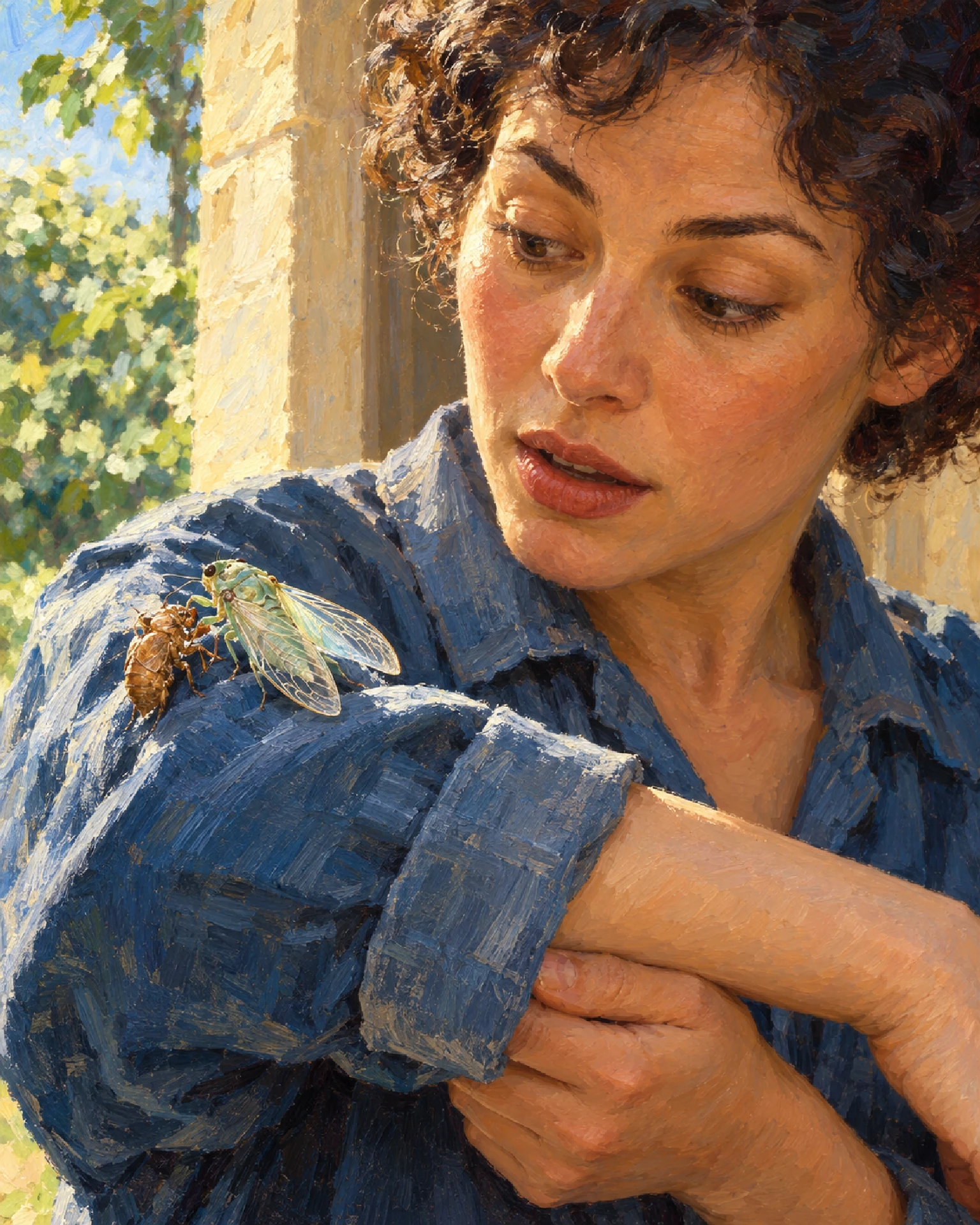
A Cicada Unfolding on Her Sleeve
A woman watches a newly emerged cicada on her sleeve. Translucent wings and slightly parted lips share an intimate crop, with softly layered oil color illuminating this small moment of emergence.
Remix this referenceA Cicada Unfolding on Her Sleeve
- Form language
- Simplify forms into generous interlocking volumes, allowing small irregularities rather than mechanically perfect repetition.
- Contour
- Build edges from adjacent paint masses: dissolve some passages and recover others with thin, broken brush accents.
- Mark-making
- Use broad, lightly dragged oil strokes with occasional fine wet lines; let stroke width and density vary naturally.
- Surface rendering
- Create luminous continuous tone through translucent oil glazes over softly scumbled body color, retaining traces of earlier layers.
Priority
Preserve luminous painterly continuity while allowing visible brushwork to interrupt polished passages.
What to avoid & what to check
Exact prompt for this example
MODULE OWNERSHIP
subject: Subject count, type, stable proportions and landmarks, resting face geometry, hair shape, physical materials, garment construction and permanent marks. No emotion, movement, color assignment or rendering recipe.
expression: Facial soft-tissue displacement and pupil direction, muscle coordination, regional intensity, asymmetry and onset/peak/release. No head/body pose, stable appearance, skin color or rendering.
gesture: Head/neck/body/limb orientation, joint movement, support, contact and pose-caused occlusion using existing anatomy. No eye/pupil movement, emotion, identity, props inventory or camera.
props: Prop count, type, construction, physical material and scale relative to the subject. Holding/contact belongs to gesture, position to composition, color to palette.
scene: Environment elements, terrain, backdrop/floor presence and structural detail. No canvas positions, camera, lighting, assigned colors or render texture.
camera: Projection, focal-length impression, camera elevation/yaw/roll, viewing distance and crop. No actor pose, world placement, lighting or canvas aspect ratio.
composition: Normalized 0-100% canvas positions, scale in frame, depth/overlap, focal hierarchy and margins. No joint pose, camera projection, rendering, subject/prop inventory or emotion.
palette: Color anchors, hue/saturation/value ranges, colors assigned to parts and approximate color coverage. No illumination direction, shading algorithm, physical material or layout.
lighting: Light-source direction/softness/intensity, ambient illumination, physical shadow direction/length and highlight position. Absence of directional illumination is allowed. No shading technique, palette or material changes.
style: Reusable form abstraction, contour weight/taper/edge quality, medium and mark scale/density/direction, surface rendering and tonal transition technique. No fixed subject proportions, anatomy, identity, expression, pose, palette, light-source direction, camera or layout.
output: Image count, aspect ratio, size, file/alpha requirements and global lettering/logo/watermark restrictions. No background scenery, crop, style, identity or pose.

SUBJECT
inventory: One adult woman, actor A, one newly emerged cicada and its empty nymphal shell.
geometry: A has a broad oval face and a substantial straight nose; the cicada has a compact body and long, veined wings.
resting-face: A has gently arched brows, deep upper-lid folds and a full lower lip beneath a defined upper-lip bow.
appearance: A has short clustered curls and a cotton work shirt with broad sleeves and turned-back cuffs; the insect has soft membranous wings and a brittle shell.

PRIORITY


AVOID


CHECK


EXPRESSION — ACTOR A
brows: Both brows lift slightly, with the nearer brow a little higher.
lids: Upper lids open gently; lower lids remain relaxed.
cheeks: Cheeks stay loose, without the upward bunching of a smile.
nose: Nostrils remain relaxed and the nose bridge stays unwrinkled.
mouth: Lips part narrowly, with neither corner pulled upward.
jaw: The jaw releases just enough to separate the lips.
gaze: Both pupils turn downward toward the cicada's wings.
coordination: A small brow lift leads the quieter mouth response; preserve the slight asymmetry.
timing: Catch the onset of attention, just as the lips begin to separate.

PRIORITY


AVOID


CHECK


GESTURE
head: A inclines her head toward the raised sleeve, keeping her neck comfortably extended.
torso: Her upper body bends slightly forward over the forearm.
limbs: One forearm crosses her chest with a loose wrist; the opposite hand supports it from below.
contact: The cicada grips the cuff beside the shell attached to the cloth; its wings separate without touching her face.

PRIORITY


AVOID


CHECK


PROPS
inventory: No separate props.
construction: No prop construction applies.

PRIORITY


AVOID


CHECK


SCENE
inventory: A sheltered garden doorway, with a plaster jamb and a few distant leaves; no floor is visible.
structure: The thick doorway separates the sheltered threshold from the garden beyond; leave incidental details open.

PRIORITY


AVOID


CHECK


CAMERA
projection: Use natural perspective with a short portrait-lens impression and restrained depth exaggeration.
viewpoint: View closely from slightly below eye level and a modest three-quarter angle, without camera roll.
crop: Crop through the crown and below the chest, retaining both eyes, the mouth, the cuff and its supporting hand.

PRIORITY


AVOID


CHECK


COMPOSITION
placement: Place the face in the upper-right half and the cicada near 40% across, 65% down; their relationship is the focus.
depth: The cuff overlaps the lower face silhouette; keep the wings clear of the lips and the doorway behind both.
spacing: Give the wings a small breathing space against the doorway; let the sleeve exit the lower-left edge.

PRIORITY


AVOID


CHECK


PALETTE
colors: Use petrol blue, pale celadon, apricot and muted honey, with deep plum as the darkest anchor.
assignment: Assign petrol blue to the shirt, apricot to skin, celadon to the cicada and honey to its shell and doorway.
balance: Let blue occupy the largest area; keep celadon pale and concentrated, with plum reserved for the deepest accents.

PRIORITY


AVOID


CHECK


LIGHTING
sources: Broad garden daylight enters from the upper left and slightly behind, balanced by gentle ambient fill.
shadows: Soft shadows fall down and right beneath the cuff and chin; the insect casts a tiny shadow onto the cloth.
highlights: Light passes through the thin wings; restrained highlights touch the upper cheek and the cuff's raised folds.

PRIORITY


AVOID


CHECK


STYLE GUIDE
form-language: Simplify forms into generous interlocking volumes, allowing small irregularities rather than mechanically perfect repetition.
contour: Build edges from adjacent paint masses: dissolve some passages and recover others with thin, broken brush accents.
mark-making: Use broad, lightly dragged oil strokes with occasional fine wet lines; let stroke width and density vary naturally.
surface-rendering: Create luminous continuous tone through translucent oil glazes over softly scumbled body color, retaining traces of earlier layers.

PRIORITY
Preserve luminous painterly continuity while allowing visible brushwork to interrupt polished passages.

AVOID


CHECK


OUTPUT
format: One finished illustration, portrait 4:5, 1536 × 1920 pixels, opaque PNG.
restrictions: No lettering, logos, signatures or watermarks.

PRIORITY


AVOID


CHECK
Model information comes from image provenance. The same prompt may produce a different result.