Text to imagePortraitStyle guide
A Giant Man Resting on a Bus Shelter
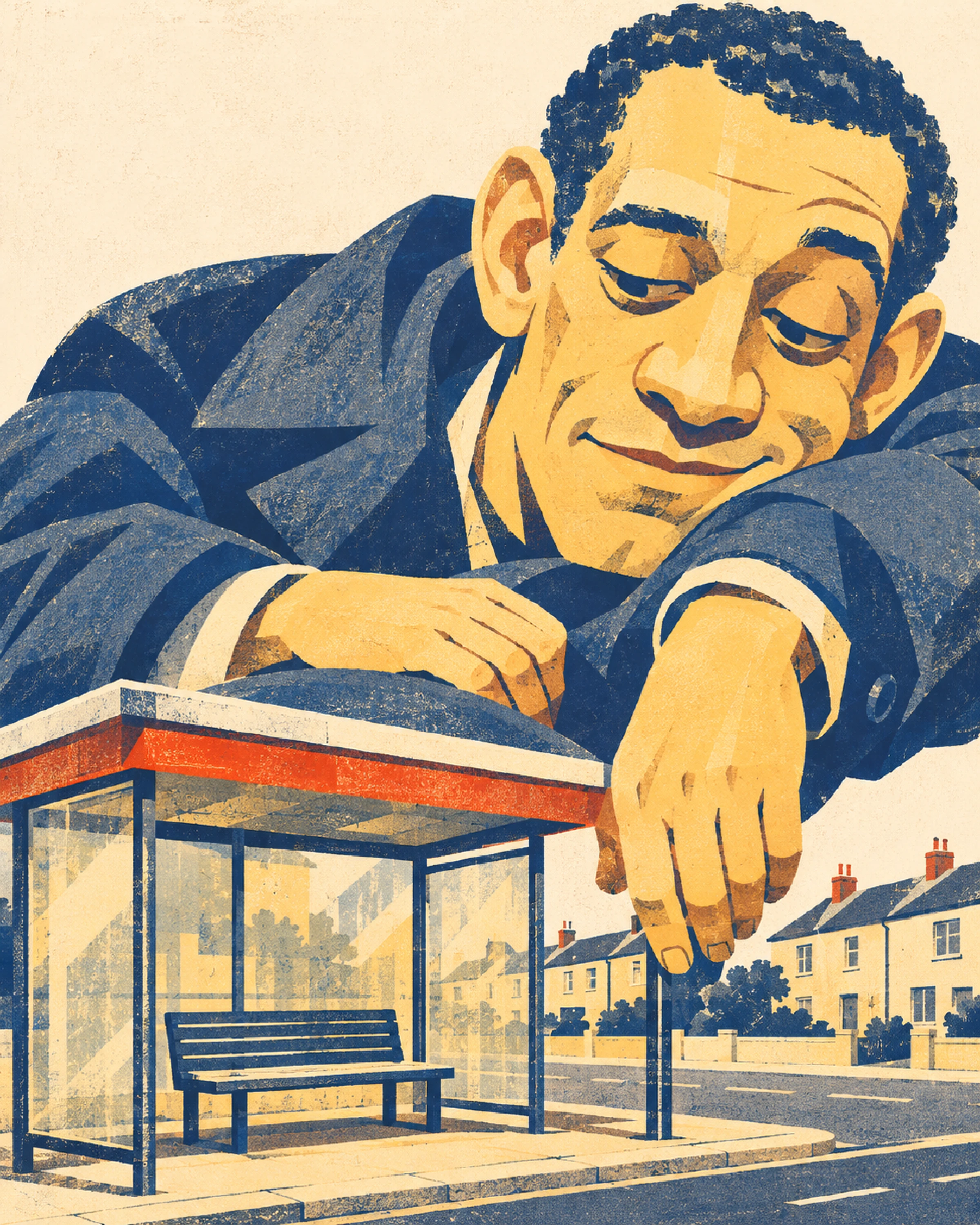
A giant man rests his cheek and arms on an ordinary bus shelter with a faint smile. Decisive screenprinted shapes and diminutive street architecture make an affectionate, gently absurd portrait.
Remix this referenceA Giant Man Resting on a Bus Shelter
- Form language
- Build interlocking wedges, broad arcs and interrupted bands into decisive graphic shape rhythms.
- Contour
- Let cut shape edges carry most boundaries; use a few blunt, tapering strokes for interior distinctions.
- Mark-making
- Allow dry ink skips, occasional rubbed patches and slight registration drift, varying the marks naturally.
- Surface rendering
- Separate tones into a few bold screenprinted plates; translucent overprints produce occasional denser intersections.
Priority
Preserve graphic screen printing's decisive shape rhythm and visible ink overlap.
What to avoid & what to check
Exact prompt for this example
MODULE OWNERSHIP
subject: Subject count, type, stable proportions and landmarks, resting face geometry, hair shape, physical materials, garment construction and permanent marks. No emotion, movement, color assignment or rendering recipe.
expression: Facial soft-tissue displacement and pupil direction, muscle coordination, regional intensity, asymmetry and onset/peak/release. No head/body pose, stable appearance, skin color or rendering.
gesture: Head/neck/body/limb orientation, joint movement, support, contact and pose-caused occlusion using existing anatomy. No eye/pupil movement, emotion, identity, props inventory or camera.
props: Prop count, type, construction, physical material and scale relative to the subject. Holding/contact belongs to gesture, position to composition, color to palette.
scene: Environment elements, terrain, backdrop/floor presence and structural detail. No canvas positions, camera, lighting, assigned colors or render texture.
camera: Projection, focal-length impression, camera elevation/yaw/roll, viewing distance and crop. No actor pose, world placement, lighting or canvas aspect ratio.
composition: Normalized 0-100% canvas positions, scale in frame, depth/overlap, focal hierarchy and margins. No joint pose, camera projection, rendering, subject/prop inventory or emotion.
palette: Color anchors, hue/saturation/value ranges, colors assigned to parts and approximate color coverage. No illumination direction, shading algorithm, physical material or layout.
lighting: Light-source direction/softness/intensity, ambient illumination, physical shadow direction/length and highlight position. Absence of directional illumination is allowed. No shading technique, palette or material changes.
style: Reusable form abstraction, contour weight/taper/edge quality, medium and mark scale/density/direction, surface rendering and tonal transition technique. No fixed subject proportions, anatomy, identity, expression, pose, palette, light-source direction, camera or layout.
output: Image count, aspect ratio, size, file/alpha requirements and global lettering/logo/watermark restrictions. No background scenery, crop, style, identity or pose.

SUBJECT
inventory: One original adult man of colossal human scale, actor A.
geometry: Ordinary adult proportions, a long face, prominent ears and broad hands.
resting-face: A broad nose bridge, heavy upper lids, a shallow chin cleft and a narrow upper lip define the resting face.
appearance: Close-cropped curls and a wool overcoat with broad overlapping lapels; minor garment details may vary naturally.

PRIORITY


AVOID


CHECK


EXPRESSION — ACTOR A
brows: One brow retains a slight lift as the other settles.
lids: Upper lids relax; the lower lids lift only slightly.
cheeks: A modest cheek lift lingers on the smiling side.
nose: Nostrils remain relaxed without wrinkling.
mouth: Closed lips retain a small, uneven upward curl.
jaw: The jaw rests loosely with no clenching.
gaze: Pupils look down toward the shelter bench.
coordination: The uneven mouth and faint cheek lift carry more amusement than the relaxed eyes.
timing: Catch the release just after a private chuckle.

PRIORITY


AVOID


CHECK


GESTURE
head: The neck bends sideways so one cheek rests on the nearer forearm.
torso: The upper body inclines forward over the shelter.
limbs: Both forearms lie across the roof; one relaxed hand hangs beyond its edge.
contact: The roof supports the forearms, and the nearer forearm supports the cheek.

PRIORITY


AVOID


CHECK


PROPS
inventory: No separate props.
construction: No prop construction applies.

PRIORITY


AVOID


CHECK


SCENE
inventory: An ordinary city bus shelter, an empty bench, a curb and a quiet street with simple house fronts.
structure: The shelter has a shallow flat roof, slender metal posts and transparent side panels.

PRIORITY


AVOID


CHECK


CAMERA
projection: Restrained perspective with a normal-lens impression.
viewpoint: View slightly above the shelter roof from a gentle three-quarter angle, with no roll.
crop: An environmental bust portrait includes the full shelter while the man's lower torso leaves the frame.

PRIORITY


AVOID


CHECK


COMPOSITION
placement: The face dominates the upper right; the small shelter stretches across the lower left.
depth: The arms overlap the roof; distant house fronts provide a much smaller scale reference.
spacing: Make the face primary and the bench secondary; leave open sky beside the head and space below the shelter.

PRIORITY


AVOID


CHECK


PALETTE
colors: Ink blue, pale butter yellow, hot vermilion and warm ivory.
assignment: Blue anchors hair and coat, butter yellow carries skin, vermilion accents the shelter fascia, and ivory opens the sky.
balance: Ivory and butter dominate, with substantial blue masses and a concentrated vermilion accent.

PRIORITY


AVOID


CHECK


LIGHTING
sources: Broad daylight arrives softly from the upper left with generous ambient fill.
shadows: Short shadows fall beneath the forearms and roof, extending gently rightward.
highlights: Broad highlights sit on the upper cheek, forehead and exposed knuckles.

PRIORITY


AVOID


CHECK


STYLE GUIDE
form-language: Build interlocking wedges, broad arcs and interrupted bands into decisive graphic shape rhythms.
contour: Let cut shape edges carry most boundaries; use a few blunt, tapering strokes for interior distinctions.
mark-making: Allow dry ink skips, occasional rubbed patches and slight registration drift, varying the marks naturally.
surface-rendering: Separate tones into a few bold screenprinted plates; translucent overprints produce occasional denser intersections.

PRIORITY
Preserve graphic screen printing's decisive shape rhythm and visible ink overlap.

AVOID


CHECK


OUTPUT
format: One finished image, portrait 4:5, 2400 × 3000 pixels, opaque PNG.
restrictions: No lettering, logos or watermarks.

PRIORITY


AVOID


CHECK


FINAL INTEGRATION
subject + scene + composition: The familiar architecture makes the human scale change immediately legible.
expression + gesture + style: Let economical printed shapes retain the nuances of the quiet performance.
Model information comes from image provenance. The same prompt may produce a different result.