Text to imageIllustrationStyle guide
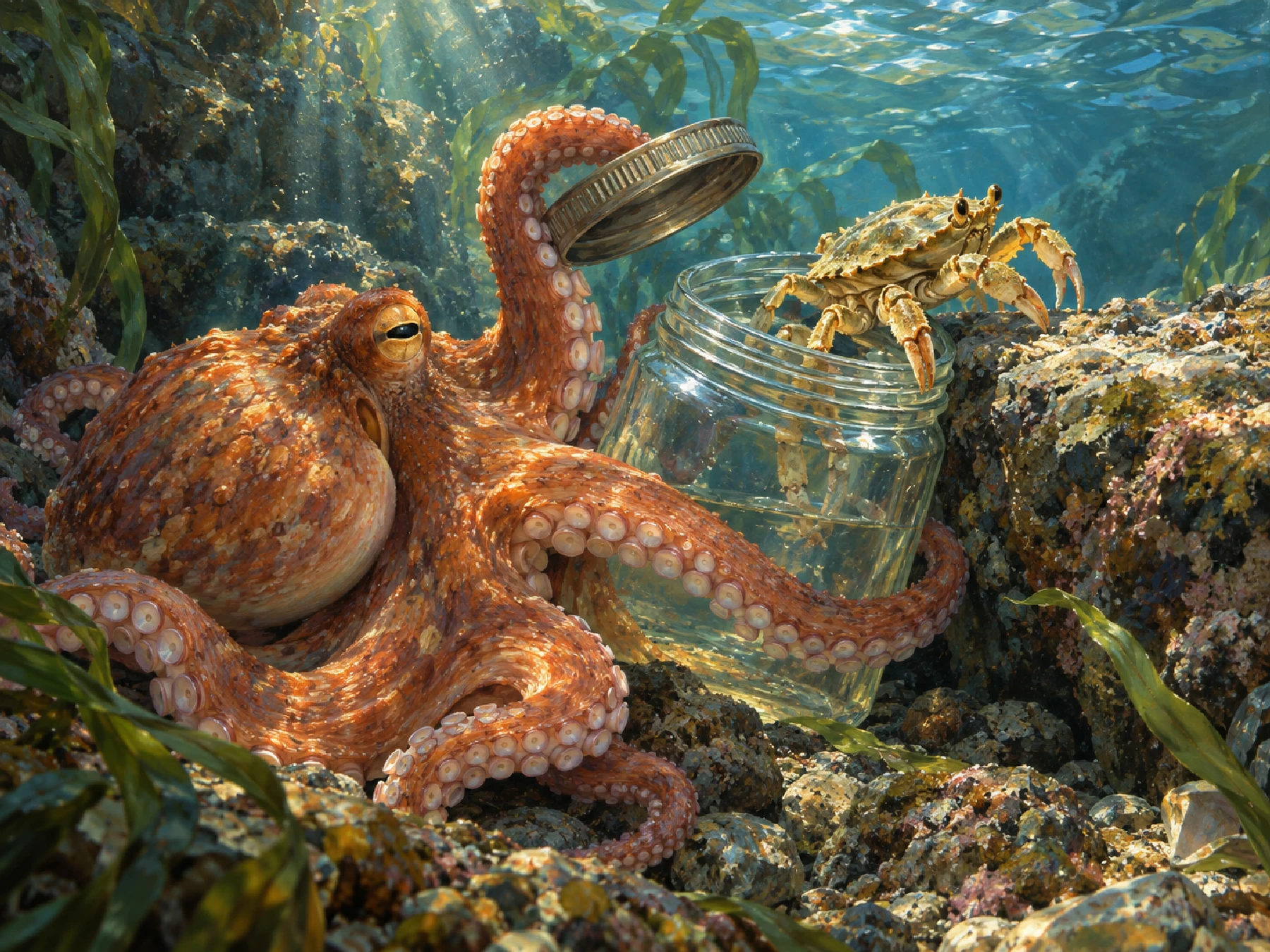
An Octopus Opening a Jar
As an octopus twists open a glass jar, a small crab clambers over its rim. Overlapping arms and eelgrass animate an underwater moment painted in luminous, continuous tones.
Remix this referenceAn Octopus Opening a Jar
- Form language
- Build flowing, unequal masses with gently swelling transitions; simplify small details while retaining irregular silhouettes.
- Contour
- Use lost-and-found painted edges, alternating soft mergers with brief crisp accents rather than enclosing outlines.
- Mark-making
- Use fluid oil-brush sweeps with occasional broken bristle strokes; vary width and direction naturally through broad and intricate passages.
- Surface rendering
- Layer translucent veils over softly blended body color for luminous continuous tones, interrupted selectively by scumbled passages.
Priority
Maintain luminous continuous-tone painting with visibly varied brushwork.
What to avoid & what to check
Exact prompt for this example
MODULE OWNERSHIP
subject: Subject count, type, stable proportions and landmarks, resting face geometry, hair shape, physical materials, garment construction and permanent marks. No emotion, movement, color assignment or rendering recipe.
expression: Facial soft-tissue displacement and pupil direction, muscle coordination, regional intensity, asymmetry and onset/peak/release. No head/body pose, stable appearance, skin color or rendering.
gesture: Head/neck/body/limb orientation, joint movement, support, contact and pose-caused occlusion using existing anatomy. No eye/pupil movement, emotion, identity, props inventory or camera.
props: Prop count, type, construction, physical material and scale relative to the subject. Holding/contact belongs to gesture, position to composition, color to palette.
scene: Environment elements, terrain, backdrop/floor presence and structural detail. No canvas positions, camera, lighting, assigned colors or render texture.
camera: Projection, focal-length impression, camera elevation/yaw/roll, viewing distance and crop. No actor pose, world placement, lighting or canvas aspect ratio.
composition: Normalized 0-100% canvas positions, scale in frame, depth/overlap, focal hierarchy and margins. No joint pose, camera projection, rendering, subject/prop inventory or emotion.
palette: Color anchors, hue/saturation/value ranges, colors assigned to parts and approximate color coverage. No illumination direction, shading algorithm, physical material or layout.
lighting: Light-source direction/softness/intensity, ambient illumination, physical shadow direction/length and highlight position. Absence of directional illumination is allowed. No shading technique, palette or material changes.
style: Reusable form abstraction, contour weight/taper/edge quality, medium and mark scale/density/direction, surface rendering and tonal transition technique. No fixed subject proportions, anatomy, identity, expression, pose, palette, light-source direction, camera or layout.
output: Image count, aspect ratio, size, file/alpha requirements and global lettering/logo/watermark restrictions. No background scenery, crop, style, identity or pose.

SUBJECT
inventory: A is one octopus; B is one small shore crab. No other animals.
geometry: A has a pear-shaped mantle and eight tapering, sucker-lined arms; B has a broad shell, jointed legs and compact claws.
resting-face: A has raised eyes with horizontal pupil slits; B has short eyestalks. Neither has human facial features.
appearance: A has supple skin with scattered papillae; B has a hard shell with uneven edges. Minor surface variation is welcome.

PRIORITY


AVOID


CHECK


EXPRESSION — ACTOR A
brows: No brow action applies.
lids: Keep the visible eye aperture relaxed, without an emphatic squint.
cheeks: No cheek displacement is prescribed.
nose: No nasal action applies.
mouth: Leave mouth action unprescribed.
jaw: No visible jaw action is prescribed.
gaze: Direct the visible pupil toward the jar mouth.
coordination: Let pupil direction carry attention while visible facial tissue stays at rest.
timing: At the captured apex, hold steady attention without a facial reaction.

PRIORITY


AVOID


CHECK


EXPRESSION — ACTOR B
brows: No brow action applies.
lids: No eyelid action is prescribed.
cheeks: No cheek displacement applies.
nose: No nasal action applies.
mouth: Leave mouthpart action unprescribed.
jaw: No visible jaw action is prescribed.
gaze: No independent pupil-direction control applies.
coordination: Keep facial action at rest without humanlike contractions.
timing: At the captured apex, maintain the resting facial state.

PRIORITY


AVOID


CHECK


GESTURE
head: A's mantle inclines toward the jar opening; B's front body and eyestalks orient toward the rock beyond the rim.
torso: A settles low against the rock; B lifts its shell above the rim midway through climbing out.
limbs: A curls one arm around the lid and twists it aside; other visible arms brace or trail. B reaches outward with its front legs.
contact: A steadies the jar against the rock with another arm and holds the unscrewed lid clear of the mouth. B's rear legs grip the rim while its front legs find the rock.

PRIORITY


AVOID


CHECK


PROPS
inventory: One preserving jar and its removable screw lid; the jar is mantle-sized, with a mouth wide enough for B.
construction: Thick transparent glass, rounded shoulders and a threaded mouth; a shallow metal lid with a ribbed edge.

PRIORITY


AVOID


CHECK


SCENE
inventory: A fully submerged tidal rock hollow with eelgrass, small pebbles and an overhead water surface.
structure: A shallow rock shelf borders a deeper crevice; eelgrass roots in gaps and sediment gathers in depressions.

PRIORITY


AVOID


CHECK


CAMERA
projection: Natural perspective with a moderate wide-lens impression and restrained near-to-far enlargement.
viewpoint: Underwater, just above the shelf, looking slightly down and obliquely across the jar mouth, without roll.
crop: A close environmental view includes the entire jar and crab; distant arm tips may continue beyond the frame.

PRIORITY


AVOID


CHECK


COMPOSITION
placement: The octopus fills the lower left; the jar rises right of center, with the crab at its mouth as the first focal point.
depth: Near arms overlap the jar base; the lid overlaps distant eelgrass. Open water separates the crab from rear forms.
spacing: Interlock forms densely below, leave the upper right spacious, and let arm curves lead toward the jar mouth.

PRIORITY


AVOID


CHECK


PALETTE
colors: Deep petrol teal, warm terracotta, muted sea green and pale honey, with restrained saturation.
assignment: A is terracotta with peach undersides; B is pale honey, eelgrass sea green, and water and rock petrol-teal variations.
balance: Cool low-to-middle values dominate; warm forms and a few pale glass accents provide a smaller counterweight.

PRIORITY


AVOID


CHECK


LIGHTING
sources: Broad sunlight enters through the water from above left; gentle ambient light keeps the crevice visible.
shadows: Soft, short shadows fall lower right and deepen at contacts between arms, jar and rock.
highlights: Broad highlights catch upper-left arm ridges and the crab shell; narrow glints catch the jar rim and lid edge.

PRIORITY


AVOID


CHECK


STYLE GUIDE
form-language: Build flowing, unequal masses with gently swelling transitions; simplify small details while retaining irregular silhouettes.
contour: Use lost-and-found painted edges, alternating soft mergers with brief crisp accents rather than enclosing outlines.
mark-making: Use fluid oil-brush sweeps with occasional broken bristle strokes; vary width and direction naturally through broad and intricate passages.
surface-rendering: Layer translucent veils over softly blended body color for luminous continuous tones, interrupted selectively by scumbled passages.

PRIORITY
Maintain luminous continuous-tone painting with visibly varied brushwork.

AVOID


CHECK


OUTPUT
format: One finished illustration, landscape 4:3, 1800 × 1350 pixels, opaque PNG.
restrictions: No lettering, logos, signatures or watermarks.

PRIORITY


AVOID


CHECK


FINAL INTEGRATION
expression + gesture: Let the gaze controls complement the physical action without adding human facial acting.
gesture + props + composition: Let contact and overlap cooperate so the opening action remains understandable among layered forms.
Model information comes from image provenance. The same prompt may produce a different result.