Text to imageCharacterStyle guide
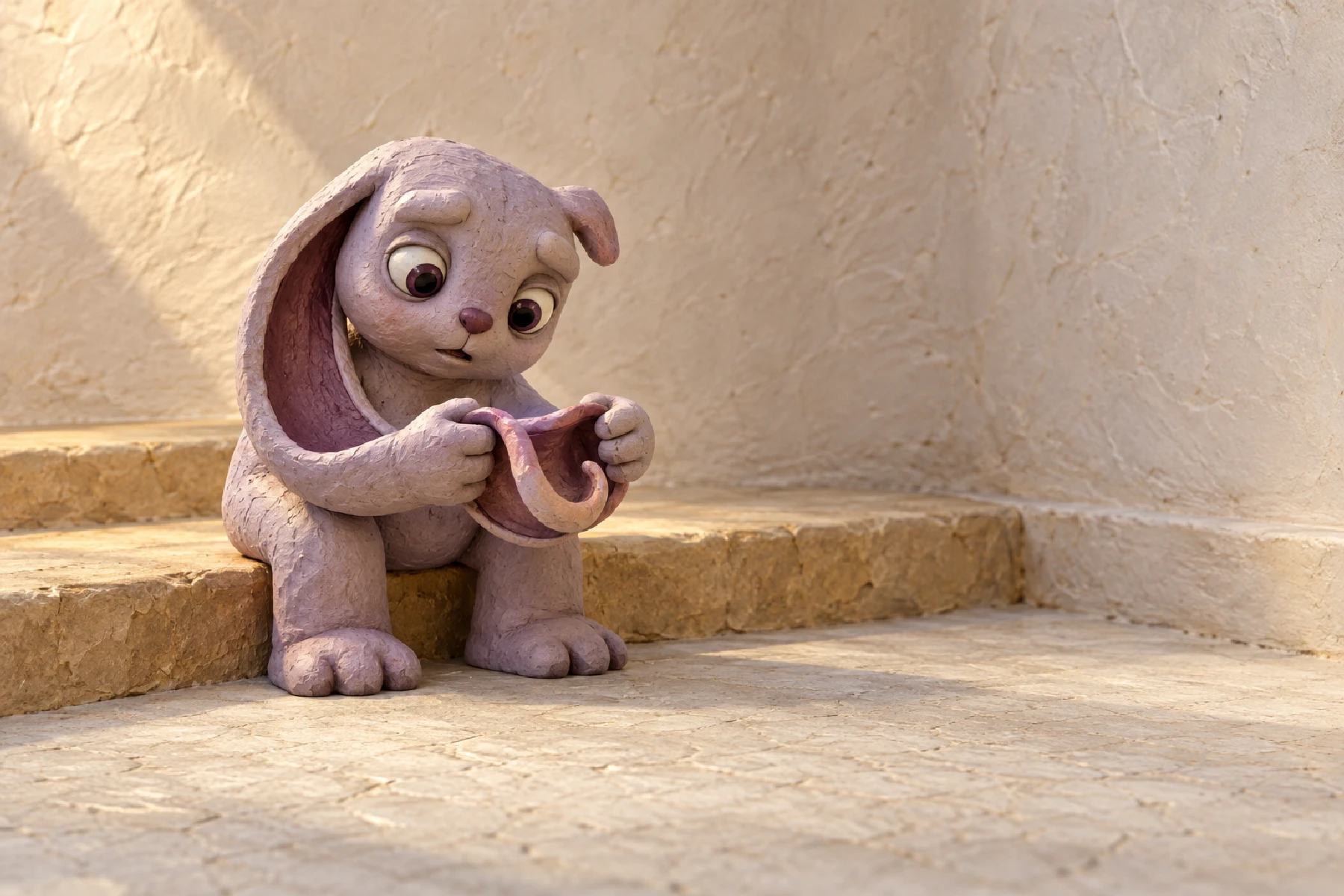
A Creature Unrolling Its Ear
A little creature sits on a low step, carefully unrolling its own long ear. Pressed clay surfaces and ample empty space give the miniature a quiet comic rhythm.
Remix this referenceA Creature Unrolling Its Ear
- Form language
- Build forms from softly compressed sculptural masses; slight asymmetry and uneven swelling keep the miniature hand-shaped.
- Contour
- Unoutlined silhouettes have rounded, subtly dented edges; narrow creases interrupt otherwise soft transitions.
- Mark-making
- Let thumb drags and a few blunt tool impressions follow the shaping process, varying naturally across worked surfaces.
- Surface rendering
- Dry matte clay carries gently mottled tonal transitions; shallow depressions remain visible instead of being polished away.
Priority
The finished image must visibly read as a tactile handbuilt clay miniature.
What to avoid & what to check
Exact prompt for this example
MODULE OWNERSHIP
subject: Subject count, type, stable proportions and landmarks, resting face geometry, hair shape, physical materials, garment construction and permanent marks. No emotion, movement, color assignment or rendering recipe.
expression: Facial soft-tissue displacement and pupil direction, muscle coordination, regional intensity, asymmetry and onset/peak/release. No head/body pose, stable appearance, skin color or rendering.
gesture: Head/neck/body/limb orientation, joint movement, support, contact and pose-caused occlusion using existing anatomy. No eye/pupil movement, emotion, identity, props inventory or camera.
props: Prop count, type, construction, physical material and scale relative to the subject. Holding/contact belongs to gesture, position to composition, color to palette.
scene: Environment elements, terrain, backdrop/floor presence and structural detail. No canvas positions, camera, lighting, assigned colors or render texture.
camera: Projection, focal-length impression, camera elevation/yaw/roll, viewing distance and crop. No actor pose, world placement, lighting or canvas aspect ratio.
composition: Normalized 0-100% canvas positions, scale in frame, depth/overlap, focal hierarchy and margins. No joint pose, camera projection, rendering, subject/prop inventory or emotion.
palette: Color anchors, hue/saturation/value ranges, colors assigned to parts and approximate color coverage. No illumination direction, shading algorithm, physical material or layout.
lighting: Light-source direction/softness/intensity, ambient illumination, physical shadow direction/length and highlight position. Absence of directional illumination is allowed. No shading technique, palette or material changes.
style: Reusable form abstraction, contour weight/taper/edge quality, medium and mark scale/density/direction, surface rendering and tonal transition technique. No fixed subject proportions, anatomy, identity, expression, pose, palette, light-source direction, camera or layout.
output: Image count, aspect ratio, size, file/alpha requirements and global lettering/logo/watermark restrictions. No background scenery, crop, style, identity or pose.

SUBJECT
inventory: One original small creature, physically sculpted from unglazed clay.
geometry: A squat wedge-shaped body, blunt head, short legs and feet, broad hands, one long strap-like ear, and one short tab ear.
resting-face: Deep-set round eyes, raised brow ridges, a button nose, and a short wide mouth.
appearance: The long ear has a thick rounded rim; all features are integral clay, with no garments or permanent marks.

PRIORITY


AVOID


CHECK


EXPRESSION — ACTOR A
brows: One brow ridge rises while the other stays nearly level.
lids: Upper lids lift slightly; lower lids stay relaxed.
cheeks: Cheeks remain loose without a smile lift.
nose: The nose remains unwrinkled with relaxed nostrils.
mouth: Lips make a tiny uneven opening, wider on one side.
jaw: The jaw lowers only enough to support the small opening.
gaze: Both pupils look down toward the ear curl.
coordination: The uneven brows and slightly open mouth suggest attentive puzzlement.
timing: Hold the apex of curiosity while the ear's curl is being inspected.

PRIORITY


AVOID


CHECK


GESTURE
head: Bow the head slightly over the hands without burying the face.
torso: Sit on the step with a rounded forward lean and the body supported by the seat.
limbs: Both hands gently open the ear's loose curl; feet rest apart on the lower floor.
contact: The ear remains attached to the head, drapes over one forearm, and rests against the step as its tip is freed.

PRIORITY


AVOID


CHECK


PROPS
inventory: No separate props.
construction: No prop construction applies.

PRIORITY


AVOID


CHECK


SCENE
inventory: A miniature landing with one low step, a bare floor, and a gently curved enclosing wall.
structure: The step has a broad tread and softened corners; the wall meets the floor without added architectural decoration.

PRIORITY


AVOID


CHECK


CAMERA
projection: Gentle photographic perspective with sufficient depth of field for the face, hands, and ear.
viewpoint: View the miniature from a low three-quarter angle, just above the step, without roll.
crop: Show the complete creature and ear with a generous span of the landing.

PRIORITY


AVOID


CHECK


COMPOSITION
placement: Place the creature well left of center; the ear curl extends toward the middle, leaving the right side spacious.
depth: Face and hands form the first focal group, the ear loop the second, with the wall held behind both.
spacing: Preserve open gaps within the ear curl and between the feet; let the step continue through the empty field.

PRIORITY


AVOID


CHECK


PALETTE
colors: Dusty lilac, deep mulberry, muted ochre, and pale chalk.
assignment: Lilac body and outer ear, mulberry ear interior and eyes, ochre step, and chalk floor and wall.
balance: Pale surroundings occupy most of the image; lilac forms a compact accent with small dark mulberry passages.

PRIORITY


AVOID


CHECK


LIGHTING
sources: A large soft source shines from upper left with gentle ambient fill.
shadows: Short soft shadows extend rightward, with deeper contact shadows beneath the feet and ear.
highlights: Broad restrained highlights sit on the brow ridges, knuckles, and upper ear rim.

PRIORITY


AVOID


CHECK


STYLE GUIDE
form-language: Build forms from softly compressed sculptural masses; slight asymmetry and uneven swelling keep the miniature hand-shaped.
contour: Unoutlined silhouettes have rounded, subtly dented edges; narrow creases interrupt otherwise soft transitions.
mark-making: Let thumb drags and a few blunt tool impressions follow the shaping process, varying naturally across worked surfaces.
surface-rendering: Dry matte clay carries gently mottled tonal transitions; shallow depressions remain visible instead of being polished away.

PRIORITY
The finished image must visibly read as a tactile handbuilt clay miniature.

AVOID


CHECK


OUTPUT
format: One image, landscape 3:2, 1800 × 1200 pixels, opaque PNG; no lettering, logos, or watermarks.
restrictions: One image, landscape 3:2, 1800 × 1200 pixels, opaque PNG; no lettering, logos, or watermarks.

PRIORITY


AVOID


CHECK


FINAL INTEGRATION
subject + gesture + composition: Keep the ear's attachment readable as its changing shape carries the action across the surrounding space.
Model information comes from image provenance. The same prompt may produce a different result.