Text to imageCharacterStyle guide
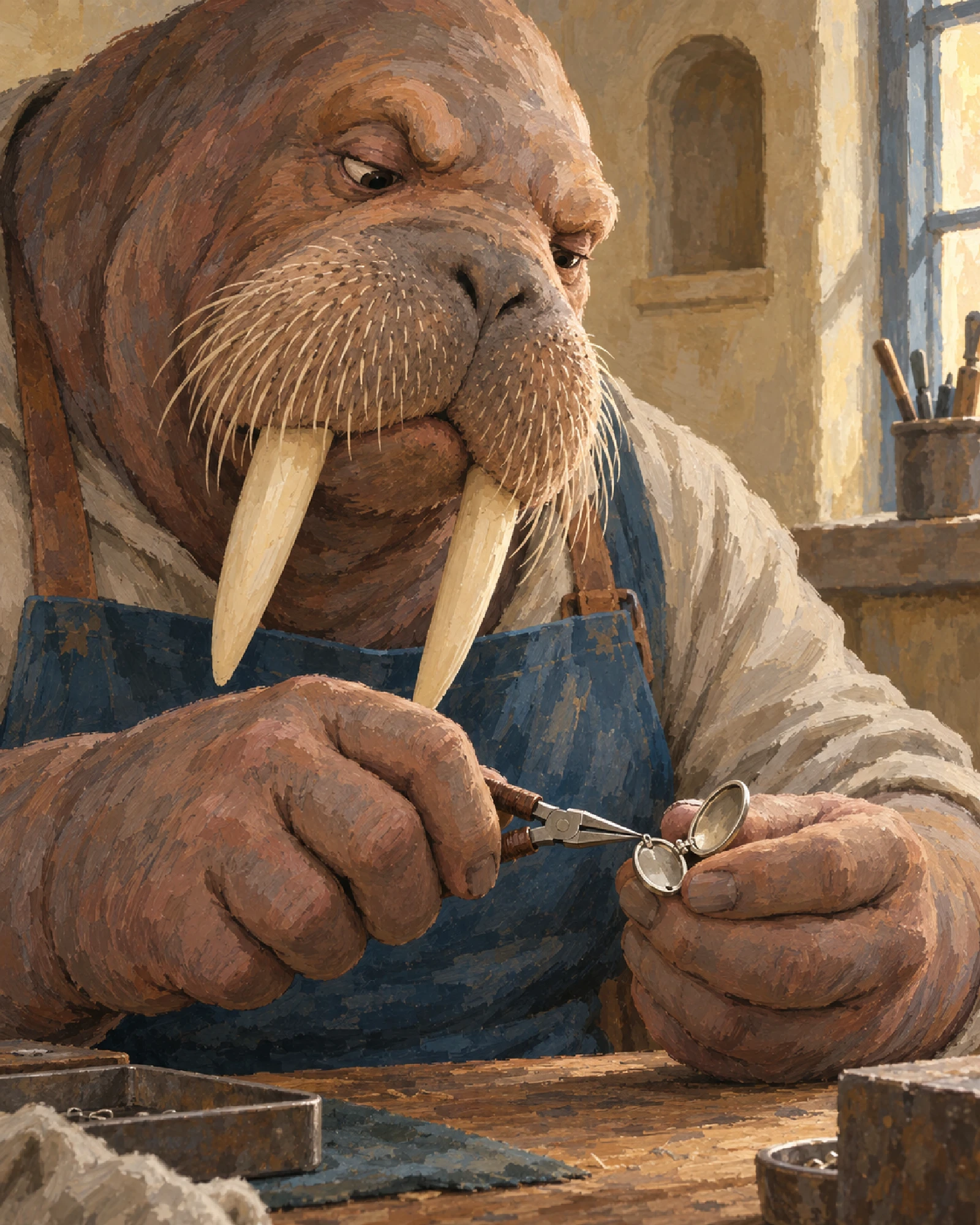
Walrus Inspecting a Tiny Locket
A walrus jeweler examines a tiny locket hinge between broad fingertips. An intimate, loosely painted gouache portrait brings substantial presence and delicate workmanship together.
Remix this referenceWalrus Inspecting a Tiny Locket
- Form language
- Build forms from broad, softly irregular painted planes, simplifying small detail while preserving expressive silhouettes.
- Contour
- Let edges alternate between blunt brush-cut boundaries and lost transitions; reserve a few thin accents for precise separations.
- Mark-making
- Lay loose opaque strokes with visible bristle drag and occasional dry skips; vary stroke breadth without polishing away their starts.
- Surface rendering
- Use matte gouache layers, broken scumbles, and overlapping value patches; soften selected transitions through wet paint mixing.
Priority
Loose gouache must retain visibly opaque brushwork and naturally uneven painted edges.
What to avoid & what to check
Exact prompt for this example
MODULE OWNERSHIP
subject: Subject count, type, stable proportions and landmarks, resting face geometry, hair shape, physical materials, garment construction and permanent marks. No emotion, movement, color assignment or rendering recipe.
expression: Facial soft-tissue displacement and pupil direction, muscle coordination, regional intensity, asymmetry and onset/peak/release. No head/body pose, stable appearance, skin color or rendering.
gesture: Head/neck/body/limb orientation, joint movement, support, contact and pose-caused occlusion using existing anatomy. No eye/pupil movement, emotion, identity, props inventory or camera.
props: Prop count, type, construction, physical material and scale relative to the subject. Holding/contact belongs to gesture, position to composition, color to palette.
scene: Environment elements, terrain, backdrop/floor presence and structural detail. No canvas positions, camera, lighting, assigned colors or render texture.
camera: Projection, focal-length impression, camera elevation/yaw/roll, viewing distance and crop. No actor pose, world placement, lighting or canvas aspect ratio.
composition: Normalized 0-100% canvas positions, scale in frame, depth/overlap, focal hierarchy and margins. No joint pose, camera projection, rendering, subject/prop inventory or emotion.
palette: Color anchors, hue/saturation/value ranges, colors assigned to parts and approximate color coverage. No illumination direction, shading algorithm, physical material or layout.
lighting: Light-source direction/softness/intensity, ambient illumination, physical shadow direction/length and highlight position. Absence of directional illumination is allowed. No shading technique, palette or material changes.
style: Reusable form abstraction, contour weight/taper/edge quality, medium and mark scale/density/direction, surface rendering and tonal transition technique. No fixed subject proportions, anatomy, identity, expression, pose, palette, light-source direction, camera or layout.
output: Image count, aspect ratio, size, file/alpha requirements and global lettering/logo/watermark restrictions. No background scenery, crop, style, identity or pose.

SUBJECT
inventory: A is one original anthropomorphic adult walrus jeweler.
geometry: A has a broad barrel torso, heavy muzzle, paired long tusks, and broad hands with short, distinct fingers.
resting-face: Small eyes sit beneath fleshy brow ridges; rounded whisker pads flank broad nostrils and a low mouth.
appearance: Short fur covers thick hide; stiff whiskers surround ivory tusks; a leather bib apron has a folded upper edge.

PRIORITY


AVOID


CHECK


EXPRESSION — ACTOR A
brows: One brow ridge lifts slightly while the other draws inward.
lids: One eye narrows more than the other, leaving both pupils visible.
cheeks: Whisker pads rise only faintly, without a broad cheek squeeze.
nose: Nostril rims tighten subtly without a nose wrinkle.
mouth: The visible lip line presses lightly together beneath the whiskers.
jaw: The jaw stays gently closed without visible clenching.
gaze: Both pupils look down toward the locket hinge.
coordination: Unequal brow and lid tension carries the scrutiny; the lower face stays quiet.
timing: Hold the apex of a brief inspection, before the face relaxes.

PRIORITY


AVOID


CHECK


GESTURE
head: A lowers the head slightly toward the hands, with a small sideways neck tilt.
torso: The upper torso inclines over the bench while the shoulders remain loose.
limbs: Both elbows bend; one hand cups the locket while the other brings the pliers to its hinge.
contact: A forearm rests on the bench; fingertips support the locket rim and plier jaws touch the hinge.

PRIORITY


AVOID


CHECK


PROPS
inventory: One open oval locket smaller than A's fingertip, and one pair of short jeweler's pliers.
construction: The metal locket has two shallow hinged shells; steel pliers have narrow jaws and plain wrapped handles.

PRIORITY


AVOID


CHECK


SCENE
inventory: A small repair room with a wooden workbench, a plaster wall, a shallow wall recess, and a floor.
structure: The bench has a worn solid top; the wall recess is empty.

PRIORITY


AVOID


CHECK


CAMERA
projection: Natural perspective with a mild portrait-lens compression.
viewpoint: View at muzzle height from a slight three-quarter yaw, with no camera roll.
crop: An intimate upper-body crop trims the crown and outer shoulders, retains both hands and the locket, and excludes the floor.

PRIORITY


AVOID


CHECK


COMPOSITION
placement: A's face occupies the upper-left area; the locket near 65% width and 72% height forms the secondary focus.
depth: Hands overlap the apron below the muzzle; separate the tiny hinge silhouette from the pliers and tusks.
spacing: Let the large face press against the crop while a narrow breathing gap surrounds the delicate repair.

PRIORITY


AVOID


CHECK


PALETTE
colors: Warm mushroom gray, dusty rose, petrol blue, pale butter yellow, and a small silver accent.
assignment: Gray and rose belong to A; petrol blue to the apron; butter yellow to wall and tusks; silver to the tools and locket.
balance: Muted warm colors dominate; the apron supplies one substantial cool area and silver remains a tiny accent.

PRIORITY


AVOID


CHECK


LIGHTING
sources: Soft window light enters from the upper right, balanced by gentle room ambient light.
shadows: Broad soft shadows fall left beneath the muzzle and hands; contact shadows stay short.
highlights: Light catches the right muzzle pad, upper fingers, tusk edges, and a small point on the locket rim.

PRIORITY


AVOID


CHECK


STYLE GUIDE
form-language: Build forms from broad, softly irregular painted planes, simplifying small detail while preserving expressive silhouettes.
contour: Let edges alternate between blunt brush-cut boundaries and lost transitions; reserve a few thin accents for precise separations.
mark-making: Lay loose opaque strokes with visible bristle drag and occasional dry skips; vary stroke breadth without polishing away their starts.
surface-rendering: Use matte gouache layers, broken scumbles, and overlapping value patches; soften selected transitions through wet paint mixing.

PRIORITY
Loose gouache must retain visibly opaque brushwork and naturally uneven painted edges.

AVOID


CHECK


OUTPUT
format: One finished image, 4:5 aspect ratio, 1600 × 2000 pixels, opaque PNG.
restrictions: No lettering, logos, signatures, or watermarks.

PRIORITY


AVOID


CHECK


FINAL INTEGRATION
expression + gesture + composition + style: Facial scrutiny and careful contact should read together; painterly edge variation must preserve their small visible cues.
Model information comes from image provenance. The same prompt may produce a different result.