Text to imageProductStyle guide
Frosted Glass Bottle · Transmitted Edge Diffusion
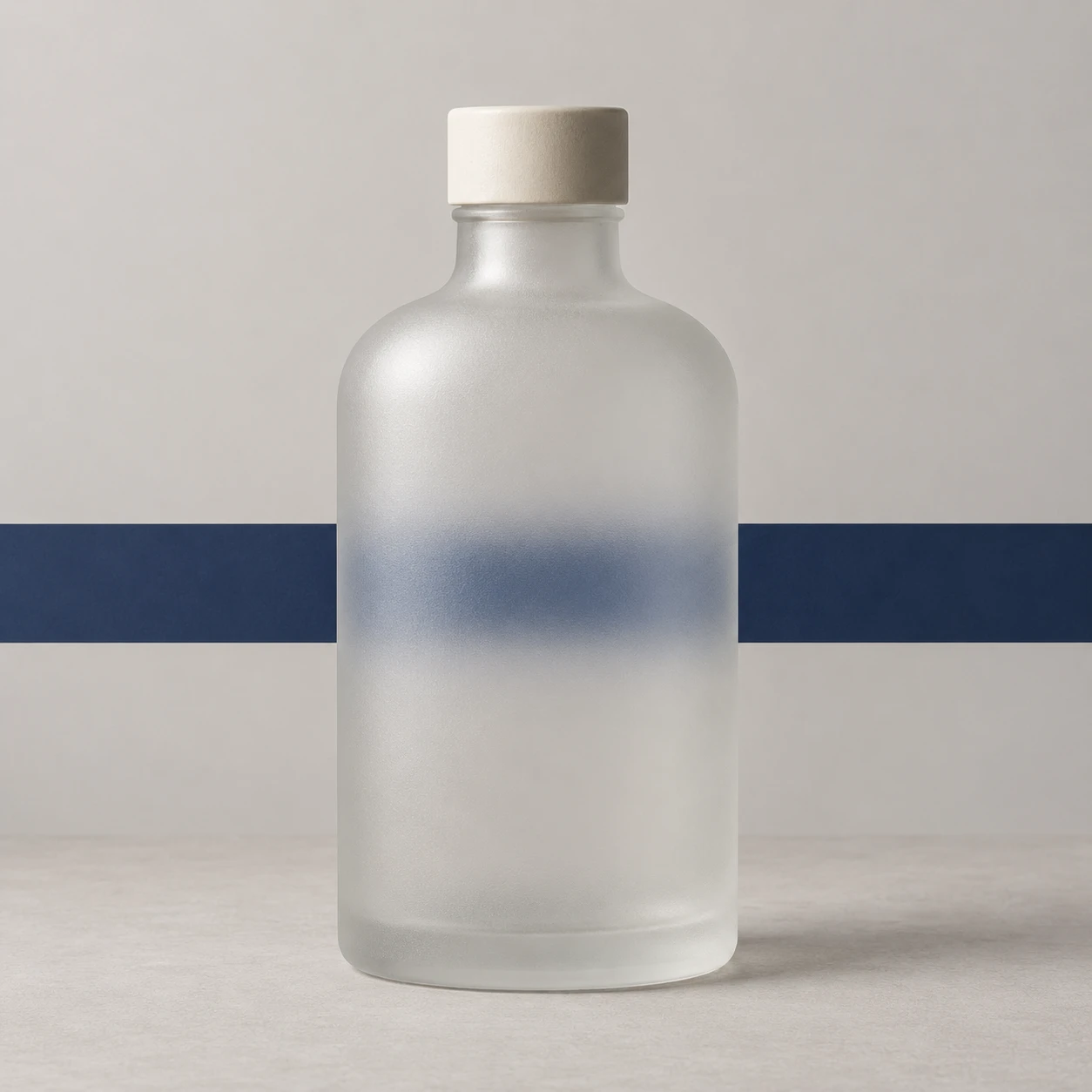
A product study showing how frosted glass diffuses light by softening a crisp band seen through the bottle.
Frosted Glass Bottle · Transmitted Edge Diffusion
- Shape & line
- Give the bottle a broad cylindrical body, rounded shoulders, and a short straight neck; keep its outer contour crisp while allowing the navy band's boundaries to soften only where they are seen through the frosted body.
- Color & light
- Use a pale warm-gray backdrop and a muted navy band. Light the bottle with a large soft source from image-left so its left shoulder carries a broad pale highlight and its right side gently darkens; let the transmitted band become lighter and less saturated inside the bottle.
- Texture & material
- Render the glass as an evenly frosted, softly luminous surface with restrained fine grain. Through the central body, spread the band's upper and lower edges into broad fuzzy transitions while retaining a recognizable darker middle; keep the cream stopper opaque and matte.
- Composition
- Place the band level across the backdrop, visibly entering behind the bottle's image-left edge and emerging beyond its image-right edge at the same height. Keep both exposed sections sharp, and use a quiet tabletop with a soft grounding shadow so the sharp-to-diffuse comparison remains the focal point.
Priority
Make the band's sharp exterior edges and diffused transmitted edges immediately distinguishable.
What to avoid & what to check
Avoid fogging the entire image or making the bottle fully opaque.
Confirm that the band stays level across both sides and becomes softer and paler through the bottle.
Exact prompt for this example
SUBJECT
One empty, unlabelled frosted glass bottle with a short neck and a fitted matte cream stopper. A single horizontal navy band on a backdrop passes behind the bottle at mid-body height and remains visible on both image-plane sides.

COMPOSITION
Use a straight-on studio product view in a square frame. Center the upright bottle, show its complete silhouette and base, and leave enough space on the left and right to compare the exposed band with its appearance through the glass.

STYLE GUIDE
1. Shape & line
Give the bottle a broad cylindrical body, rounded shoulders, and a short straight neck; keep its outer contour crisp while allowing the navy band's boundaries to soften only where they are seen through the frosted body.

2. Color & light
Use a pale warm-gray backdrop and a muted navy band. Light the bottle with a large soft source from image-left so its left shoulder carries a broad pale highlight and its right side gently darkens; let the transmitted band become lighter and less saturated inside the bottle.

3. Texture & material
Render the glass as an evenly frosted, softly luminous surface with restrained fine grain. Through the central body, spread the band's upper and lower edges into broad fuzzy transitions while retaining a recognizable darker middle; keep the cream stopper opaque and matte.

4. Composition
Place the band level across the backdrop, visibly entering behind the bottle's image-left edge and emerging beyond its image-right edge at the same height. Keep both exposed sections sharp, and use a quiet tabletop with a soft grounding shadow so the sharp-to-diffuse comparison remains the focal point.

PRIORITY
Preserve the requested identity, count, action, composition and output settings. Apply the style rules within those constraints; a style reference must not replace the subject or layout. Within the style: Make the band's sharp exterior edges and diffused transmitted edges immediately distinguishable.

AVOID
Avoid fogging the entire image or making the bottle fully opaque.

OUTPUT
Create one square product photograph with no lettering, logos, captions, or watermark.

SELF-CHECK
Confirm that the band stays level across both sides and becomes softer and paler through the bottle.
Model information comes from image provenance. The same prompt may produce a different result.