Text to imageCalligraphyStyle guide
Weight of Water in Sculptural Lettering
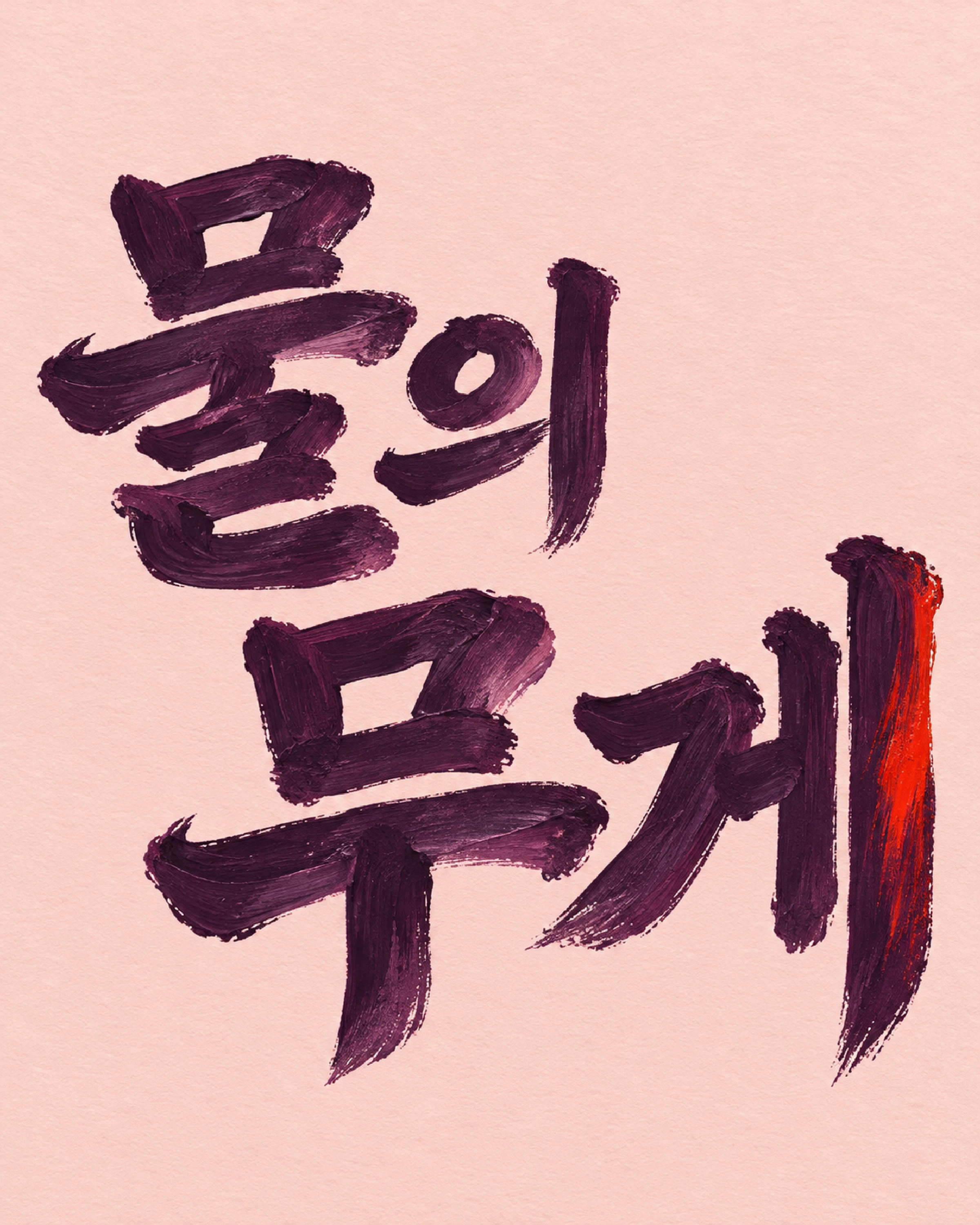
Inflated Hangul strokes and taut connections embrace an open interval. Weighty aubergine paint carries a brief vermilion accent.
Remix this referenceWeight of Water in Sculptural Lettering
- Form language
- Translate broad-nib pressure into inflated, scooped masses and taut narrow connections; allow coherent handmade variation.
- Contour
- Alternate clean knife-cut edges with softly crumbled paint lips; finish strokes with decisive tapers.
- Mark-making
- Drag opaque gouache in broad, short sweeps, leaving occasional ridges along stroke travel and sparse dry skips.
- Surface rendering
- Suggest shallow sculptural volume through a few brushed value planes and blunt, softened transitions; retain visible paint handling.
Priority
Sculptural force comes from bold masses and visibly worked paint.
What to avoid & what to check
Exact prompt for this example
MODULE OWNERSHIP
subject: Subject count, type, stable proportions and landmarks, resting face geometry, hair shape, physical materials, garment construction and permanent marks. No emotion, movement, color assignment or rendering recipe.
expression: Facial soft-tissue displacement and pupil direction, muscle coordination, regional intensity, asymmetry and onset/peak/release. No head/body pose, stable appearance, skin color or rendering.
gesture: Head/neck/body/limb orientation, joint movement, support, contact and pose-caused occlusion using existing anatomy. No eye/pupil movement, emotion, identity, props inventory or camera.
props: Prop count, type, construction, physical material and scale relative to the subject. Holding/contact belongs to gesture, position to composition, color to palette.
scene: Environment elements, terrain, backdrop/floor presence and structural detail. No canvas positions, camera, lighting, assigned colors or render texture.
camera: Projection, focal-length impression, camera elevation/yaw/roll, viewing distance and crop. No actor pose, world placement, lighting or canvas aspect ratio.
composition: Normalized 0-100% canvas positions, scale in frame, depth/overlap, focal hierarchy and margins. No joint pose, camera projection, rendering, subject/prop inventory or emotion.
palette: Color anchors, hue/saturation/value ranges, colors assigned to parts and approximate color coverage. No illumination direction, shading algorithm, physical material or layout.
lighting: Light-source direction/softness/intensity, ambient illumination, physical shadow direction/length and highlight position. Absence of directional illumination is allowed. No shading technique, palette or material changes.
style: Reusable form abstraction, contour weight/taper/edge quality, medium and mark scale/density/direction, surface rendering and tonal transition technique. No fixed subject proportions, anatomy, identity, expression, pose, palette, light-source direction, camera or layout.
output: Image count, aspect ratio, size, file/alpha requirements and global lettering/logo/watermark restrictions. No background scenery, crop, style, identity or pose.

SUBJECT
inventory: One original Hangul lettering work; no people, creatures, or faces.
geometry: The phrase is "물의 무게"; retain recognizable consonant and vowel structures with open internal spaces.
resting-face: No facial geometry applies.
appearance: Opaque pigment on heavyweight paper forms the lettering work.

PRIORITY


AVOID


CHECK


PROPS
inventory: No separate props.
construction: No prop construction applies.

PRIORITY


AVOID


CHECK


SCENE
inventory: An uninterrupted graphic ground without environmental objects.
structure: No floor, horizon, enclosing room, or scenic depth.

PRIORITY


AVOID


CHECK


CAMERA
projection: Orthographic reproduction with no lens distortion or perspective convergence.
viewpoint: Face the paper directly, with a level view and no roll.
crop: Show the complete phrase and surrounding paper, with every stroke ending inside the image.

PRIORITY


AVOID


CHECK


COMPOSITION
placement: Set the first word toward the upper left; give the larger second word a lower, rightward reach.
depth: The lower word leads the hierarchy; keep both words on one plane with clearly separated silhouettes.
spacing: An irregular diagonal inlet of empty space separates the tiers; leave generous outer margins.

PRIORITY


AVOID


CHECK


PALETTE
colors: Use deep aubergine, pale shell pink, and a concentrated vermilion accent.
assignment: Aubergine carries the lettering, shell pink fills the ground, and vermilion touches one stroke face.
balance: Keep the field pale and quiet, the lettering dark and rich, and the warm accent brief.

PRIORITY


AVOID


CHECK


LIGHTING
sources: Broad, soft frontal illumination keeps the painted work evenly visible.
shadows: No directional cast shadows appear on the ground.
highlights: Keep highlights broad and subdued, without sharp reflective points.

PRIORITY


AVOID


CHECK


STYLE GUIDE
form-language: Translate broad-nib pressure into inflated, scooped masses and taut narrow connections; allow coherent handmade variation.
contour: Alternate clean knife-cut edges with softly crumbled paint lips; finish strokes with decisive tapers.
mark-making: Drag opaque gouache in broad, short sweeps, leaving occasional ridges along stroke travel and sparse dry skips.
surface-rendering: Suggest shallow sculptural volume through a few brushed value planes and blunt, softened transitions; retain visible paint handling.

PRIORITY
Sculptural force comes from bold masses and visibly worked paint.

AVOID


CHECK


OUTPUT
format: One image, portrait 4:5 aspect ratio, 2400 × 3000 pixels, opaque PNG.
restrictions: Allow readable primary lettering; forbid additional text, logos, and watermarks.

PRIORITY


AVOID


CHECK


FINAL INTEGRATION
subject + output: Subject defines "물의 무게" as the exact lettering; output permits this phrase as the primary lettering.
Model information comes from image provenance. The same prompt may produce a different result.