Text to imagePortraitStyle guide
Adult in Profile · Facial Contour Projection and Recession
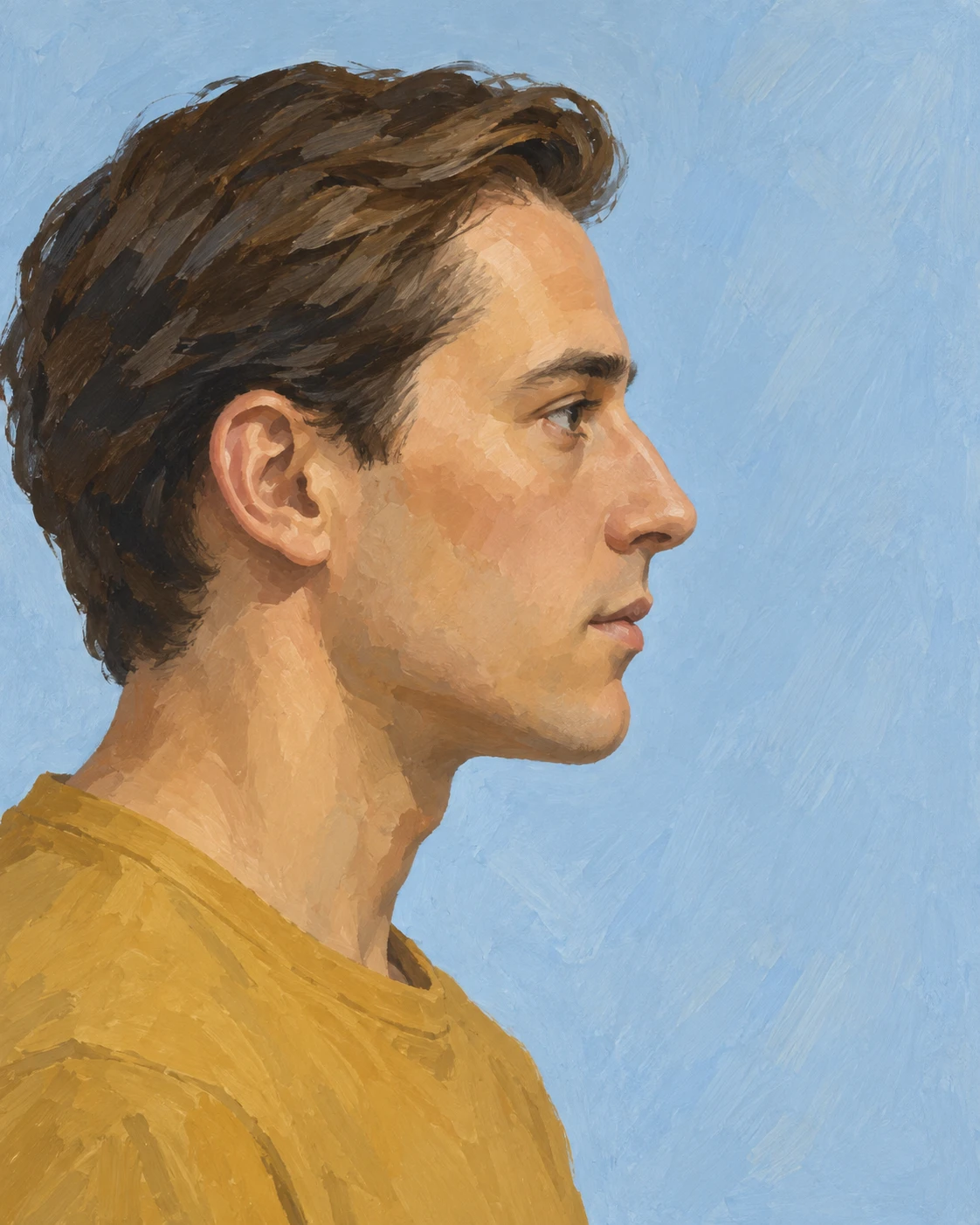
A portrait reference that makes one adult’s profile readable through distinct projections and recesses between the nose, lips, and chin.
Adult in Profile · Facial Contour Projection and Recession
- Shape & line
- Construct the image-right facial boundary as a continuous, varied contour: slope from forehead into the recessed nose root, project to the nose tip, step inward beneath the nose, project modestly at the closed lips, then recess beneath the lower lip before rounding outward into the chin. Keep these changes unequal and anatomically connected.
- Color & light
- Use warm muted skin against a cool pale blue background, keeping a clear value difference along the nose, lips, and chin. Apply broad soft light from the upper image-left so interior facial shading remains gentle and the profile boundary carries the strongest readable shape.
- Texture & material
- Paint with matte opaque gouache, using broad joined patches on the cheek and neck and faint brush texture within them. Resolve the facial boundary with clean paint edges rather than a dark outline; simplify hair into a few solid masses and keep shirt texture quieter than the face.
- Composition
- Hold the head in a true profile facing image-right, showing only the near eye and keeping the far eye concealed. Leave generous uninterrupted blue space beyond the nose and lips, separate the chin from the neck with a readable inward turn, and crop below the shoulders so the contour remains the focal point.
Priority
Prioritize the distinct outward and inward turns of the facial profile.
What to avoid & what to check
Avoid a three-quarter turn or a uniformly scalloped facial contour.
Check that the nose, closed lips, and chin remain individually readable in silhouette.
Exact prompt for this example
SUBJECT
One adult with short swept-back hair and a plain ochre shirt, shown in a true right-facing profile. The visible eye, nose, closed lips, and chin belong to one coherent head; the hair leaves the facial silhouette exposed.

COMPOSITION
Frame the head and upper shoulders in a vertical portrait. Place the head slightly left of center, with open background on image-right in front of the face. Keep the entire forehead-to-chin contour visible.

STYLE GUIDE
1. Shape & line
Construct the image-right facial boundary as a continuous, varied contour: slope from forehead into the recessed nose root, project to the nose tip, step inward beneath the nose, project modestly at the closed lips, then recess beneath the lower lip before rounding outward into the chin. Keep these changes unequal and anatomically connected.

2. Color & light
Use warm muted skin against a cool pale blue background, keeping a clear value difference along the nose, lips, and chin. Apply broad soft light from the upper image-left so interior facial shading remains gentle and the profile boundary carries the strongest readable shape.

3. Texture & material
Paint with matte opaque gouache, using broad joined patches on the cheek and neck and faint brush texture within them. Resolve the facial boundary with clean paint edges rather than a dark outline; simplify hair into a few solid masses and keep shirt texture quieter than the face.

4. Composition
Hold the head in a true profile facing image-right, showing only the near eye and keeping the far eye concealed. Leave generous uninterrupted blue space beyond the nose and lips, separate the chin from the neck with a readable inward turn, and crop below the shoulders so the contour remains the focal point.

PRIORITY
Preserve the requested identity, count, action, composition and output settings. Apply the style rules within those constraints; a style reference must not replace the subject or layout. Within the style: Prioritize the distinct outward and inward turns of the facial profile.

AVOID
Avoid a three-quarter turn or a uniformly scalloped facial contour.

OUTPUT
Create one 4:5 portrait reference image rendered as a restrained opaque-gouache study, with no lettering, captions, signature, or watermark.

SELF-CHECK
Check that the nose, closed lips, and chin remain individually readable in silhouette.
Model information comes from image provenance. The same prompt may produce a different result.