Text to imagePortraitStyle guide
Thick-Browed Adult · Directional Eyebrow Growth
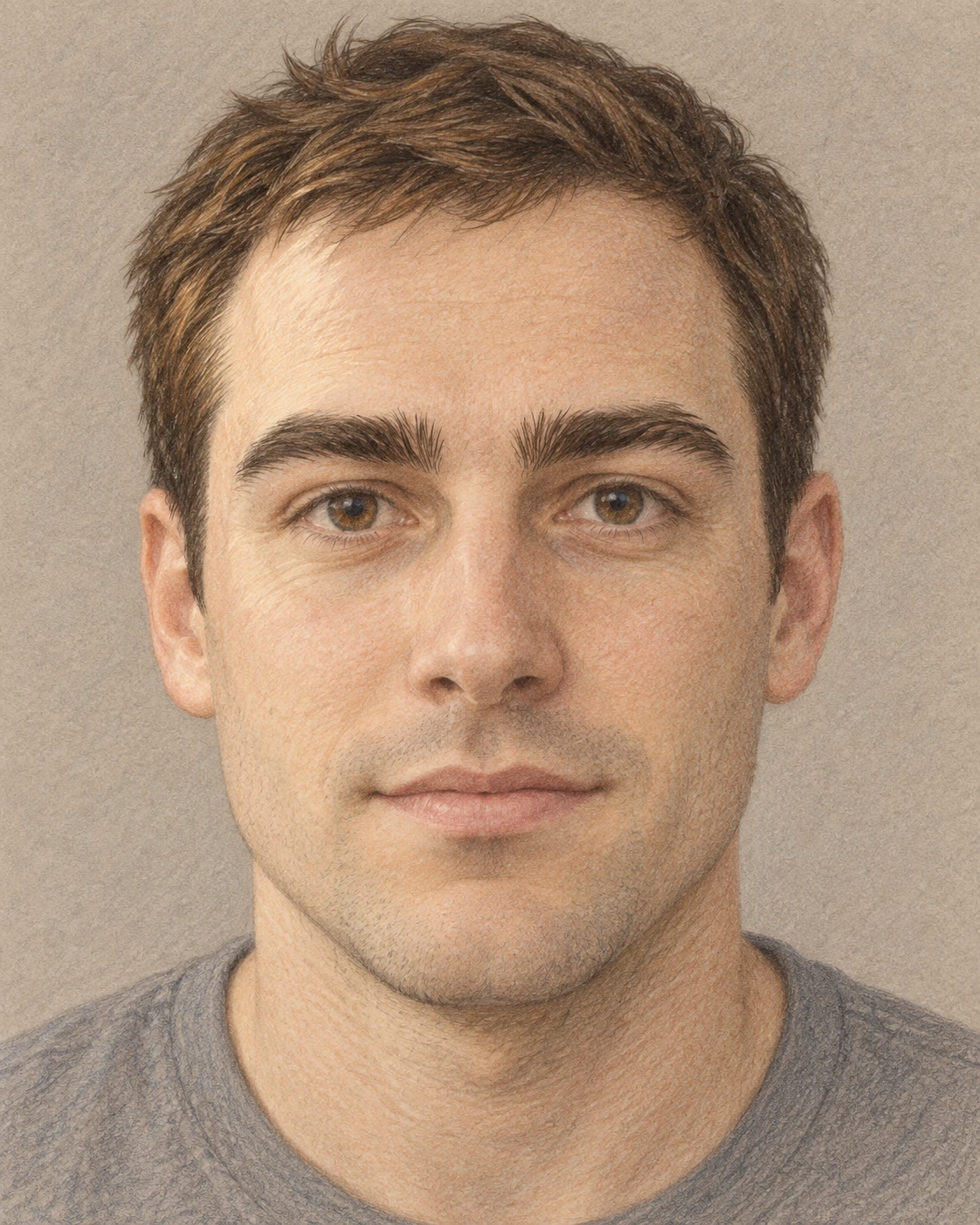
A portrait that builds facial form through eyebrow hairs transitioning from upright inner strokes to outward-slanting tails.
Thick-Browed Adult · Directional Eyebrow Growth
- Shape & line
- Build each eyebrow as a tapered curved mass, then draw short hairs rising almost vertically at the inner end nearest the nose. Gradually turn the strokes upward and outward across the middle, and flatten them toward the temple at the narrow tail; mirror these outward directions across the face.
- Color & light
- Use soft light from the upper image-left to brighten the forehead and image-left brow ridge, with gentle shading beneath both brows. Keep the eyebrows dark brown rather than solid black, allowing the lighter skin between hairs to remain visible.
- Texture & material
- Layer colored-pencil strokes lightly over visible paper grain to give the skin a quiet, matte surface. Sharpen selected eyebrow hairs with tapered pencil marks, overlapping them unevenly while preserving small gaps; soften their roots into the underlying brow tone.
- Composition
- Place the paired eyebrows just above the image center and keep both equally readable. Use a plain warm-gray background and simplify the shirt and scalp hair so the viewer can trace the inner-to-outer stroke transition without competing fine detail.
Priority
Make the gradual change in eyebrow hair direction the clearest fine detail.
What to avoid & what to check
Avoid uniform parallel hairs or eyebrows filled into opaque graphic bars.
Both brows should show upright inner hairs, slanted middle hairs, and flatter tapered tails.
Exact prompt for this example
SUBJECT
One adult with thick dark eyebrows, short brown hair, and a relaxed closed mouth, wearing a plain gray shirt. Both eyebrows follow the brow ridges above the eyes; individual hairs belong to coherent brow masses.

COMPOSITION
A vertical head-and-shoulders portrait viewed straight on at eye level, with the entire hairline and chin visible. Keep the face large enough to read the changing eyebrow directions and leave a modest margin above the head.

STYLE GUIDE
1. Shape & line
Build each eyebrow as a tapered curved mass, then draw short hairs rising almost vertically at the inner end nearest the nose. Gradually turn the strokes upward and outward across the middle, and flatten them toward the temple at the narrow tail; mirror these outward directions across the face.

2. Color & light
Use soft light from the upper image-left to brighten the forehead and image-left brow ridge, with gentle shading beneath both brows. Keep the eyebrows dark brown rather than solid black, allowing the lighter skin between hairs to remain visible.

3. Texture & material
Layer colored-pencil strokes lightly over visible paper grain to give the skin a quiet, matte surface. Sharpen selected eyebrow hairs with tapered pencil marks, overlapping them unevenly while preserving small gaps; soften their roots into the underlying brow tone.

4. Composition
Place the paired eyebrows just above the image center and keep both equally readable. Use a plain warm-gray background and simplify the shirt and scalp hair so the viewer can trace the inner-to-outer stroke transition without competing fine detail.

PRIORITY
Preserve the requested identity, count, action, composition and output settings. Apply the style rules within those constraints; a style reference must not replace the subject or layout. Within the style: Make the gradual change in eyebrow hair direction the clearest fine detail.

AVOID
Avoid uniform parallel hairs or eyebrows filled into opaque graphic bars.

OUTPUT
One image in a 4:5 aspect ratio, rendered as a naturalistic colored-pencil portrait on warm paper, without text, captions, logos, or watermarks.

SELF-CHECK
Both brows should show upright inner hairs, slanted middle hairs, and flatter tapered tails.
Model information comes from image provenance. The same prompt may produce a different result.