Text to imagePortraitStyle guide
Turning Adult · Nose Occlusion of the Far Eye
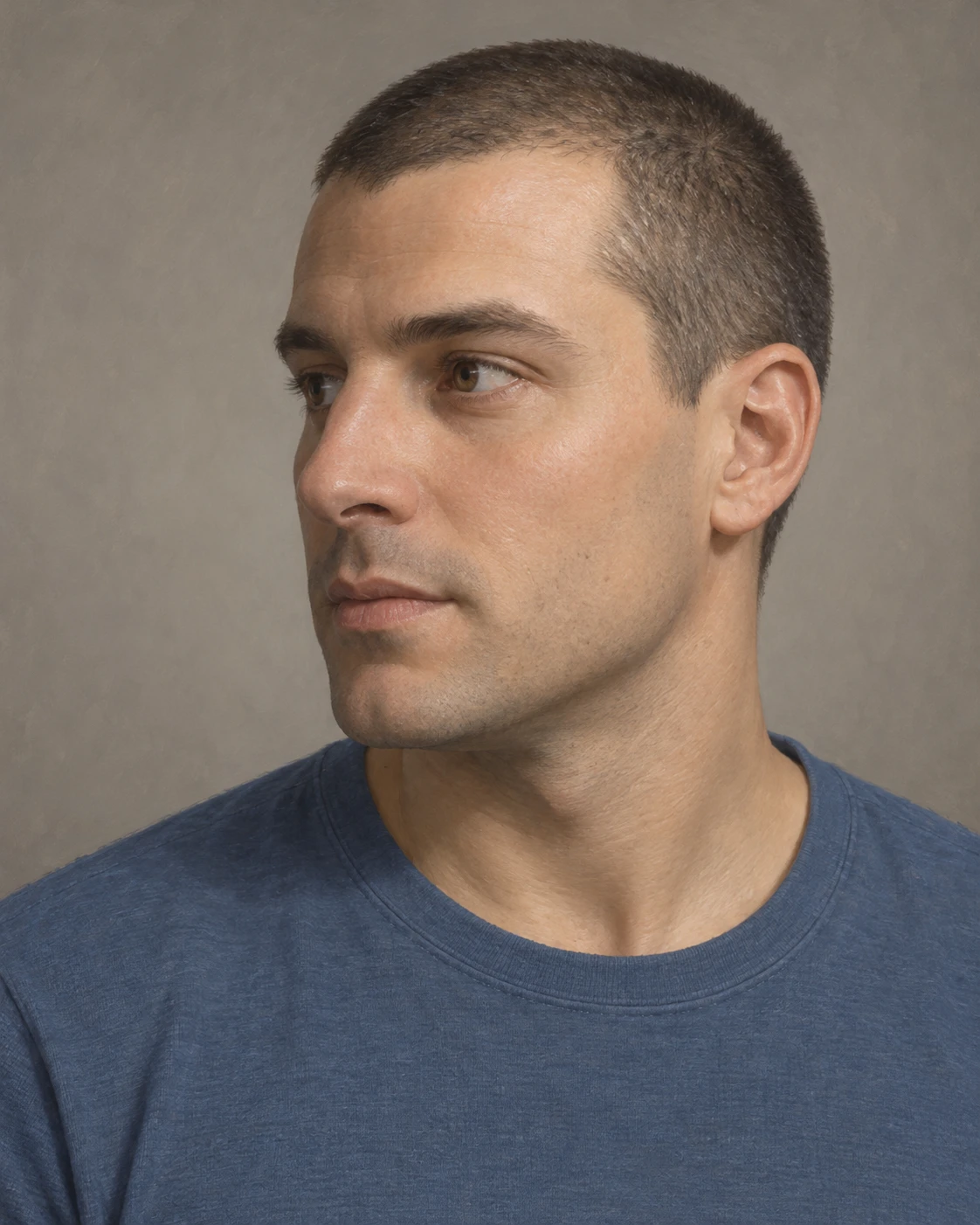
A portrait reference that shows facial rotation and depth through the nose partially concealing the inner corner of the far eye.
Turning Adult · Nose Occlusion of the Far Eye
- Shape & line
- Build the turned face with a broad near cheek on image-right and a narrow far cheek on image-left. Let the nose bridge overlap the inner corner of the far eye, retaining a shorter visible eyelid and iris segment there; keep the near eye fully readable and avoid outlining the hidden corner through the nose.
- Color & light
- Use a large soft light from above and image-right so the broad near cheek receives gentle illumination and the far cheek falls into a quieter midtone. Give the nose a soft shadow toward image-left while preserving enough light around the far eye to distinguish actual overlap from simple darkness.
- Texture & material
- Render skin with restrained matte brushwork and subtle tonal variation across the cheek and nose. Describe the cropped hair as a close, fine texture following the scalp, and keep the shirt softly woven; reserve sharper painted edges for the visible eyelids and the nose boundary that conceals the far eye.
- Composition
- Keep the camera level with the eyes and frame the head large enough to read the unequal visible widths of the two eyes. Leave a clear margin in front of the image-left-facing nose, separate the head silhouette from the background, and keep background contrast lower than the eye-and-nose overlap.
Priority
Make the nose visibly conceal part of the far eye so the facial turn reads immediately.
What to avoid & what to check
Avoid equal-width frontal eyes, a fully hidden far eye, or a dark patch that substitutes for overlap.
Confirm that the image-left far eye remains partly visible behind the nose and the image-right near eye stays unobstructed.
Exact prompt for this example
SUBJECT
One adult with closely cropped hair, wearing a plain muted-blue crewneck shirt, with a relaxed closed mouth. The face turns toward image-left while the shoulders remain nearly frontal. The near eye sits on image-right; the far eye sits on image-left, with its inner corner partly concealed behind the nose bridge.

COMPOSITION
An eye-level head-and-shoulders portrait in a strong three-quarter view, with both eyes still visible. Place the head slightly right of center, leaving open space toward image-left in the direction of the nose. Keep the entire scalp and chin inside the frame against a plain warm-gray background.

STYLE GUIDE
1. Shape & line
Build the turned face with a broad near cheek on image-right and a narrow far cheek on image-left. Let the nose bridge overlap the inner corner of the far eye, retaining a shorter visible eyelid and iris segment there; keep the near eye fully readable and avoid outlining the hidden corner through the nose.

2. Color & light
Use a large soft light from above and image-right so the broad near cheek receives gentle illumination and the far cheek falls into a quieter midtone. Give the nose a soft shadow toward image-left while preserving enough light around the far eye to distinguish actual overlap from simple darkness.

3. Texture & material
Render skin with restrained matte brushwork and subtle tonal variation across the cheek and nose. Describe the cropped hair as a close, fine texture following the scalp, and keep the shirt softly woven; reserve sharper painted edges for the visible eyelids and the nose boundary that conceals the far eye.

4. Composition
Keep the camera level with the eyes and frame the head large enough to read the unequal visible widths of the two eyes. Leave a clear margin in front of the image-left-facing nose, separate the head silhouette from the background, and keep background contrast lower than the eye-and-nose overlap.

PRIORITY
Preserve the requested identity, count, action, composition and output settings. Apply the style rules within those constraints; a style reference must not replace the subject or layout. Within the style: Make the nose visibly conceal part of the far eye so the facial turn reads immediately.

AVOID
Avoid equal-width frontal eyes, a fully hidden far eye, or a dark patch that substitutes for overlap.

OUTPUT
One realistic painted portrait reference image in a 4:5 vertical aspect ratio, with no lettering, captions, logos, or watermark.

SELF-CHECK
Confirm that the image-left far eye remains partly visible behind the nose and the image-right near eye stays unobstructed.
Model information comes from image provenance. The same prompt may produce a different result.