Text to imageCharacterStyle guide
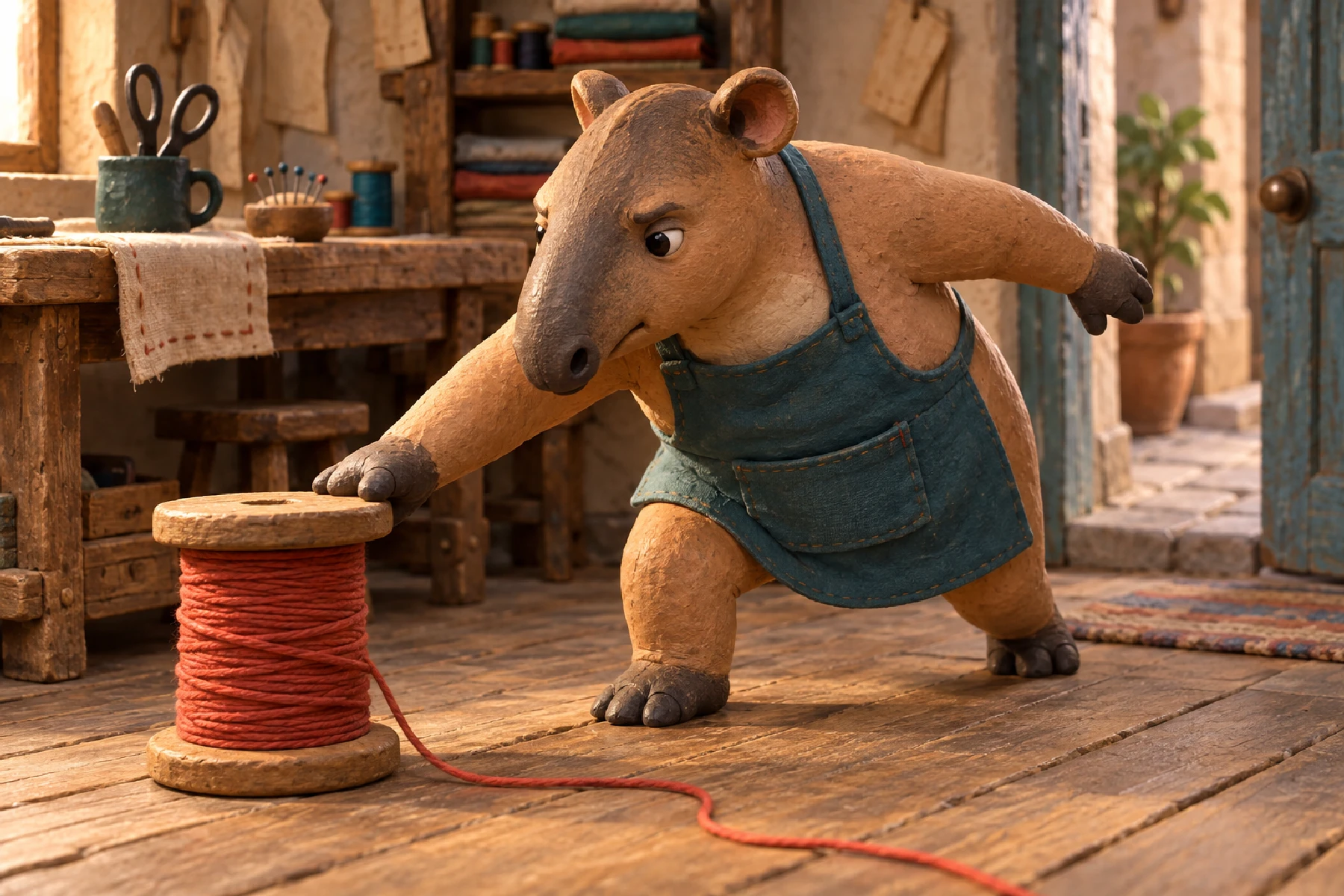
Tapir Tailor Catching a Spool
A tapir tailor reaches past unwinding thread to catch a large spool. Pressed clay surfaces and overlapping volumes bring a small workshop moment to life.
Remix this referenceTapir Tailor Catching a Spool
- Form language
- Build forms from rounded, hand-compressed clay masses with gently unequal joins; incidental shapes may vary coherently.
- Contour
- Use tangible sculptural edges rather than ink lines, allowing pinched rims, softened corners and slight silhouette irregularity.
- Mark-making
- Leave selective thumb presses, dragged tool grooves and uneven applied ridges; vary their strength instead of stamping a uniform texture.
- Surface rendering
- Matte clay surfaces show softly modeled tonal transitions and occasional rubbed or chipped paint, retaining the handmade object quality.
Priority
The image must read as a sculptural clay miniature with visibly handmade surfaces.
What to avoid & what to check
Exact prompt for this example
MODULE OWNERSHIP
subject: Subject count, type, stable proportions and landmarks, resting face geometry, hair shape, physical materials, garment construction and permanent marks. No emotion, movement, color assignment or rendering recipe.
expression: Facial soft-tissue displacement and pupil direction, muscle coordination, regional intensity, asymmetry and onset/peak/release. No head/body pose, stable appearance, skin color or rendering.
gesture: Head/neck/body/limb orientation, joint movement, support, contact and pose-caused occlusion using existing anatomy. No eye/pupil movement, emotion, identity, props inventory or camera.
props: Prop count, type, construction, physical material and scale relative to the subject. Holding/contact belongs to gesture, position to composition, color to palette.
scene: Environment elements, terrain, backdrop/floor presence and structural detail. No canvas positions, camera, lighting, assigned colors or render texture.
camera: Projection, focal-length impression, camera elevation/yaw/roll, viewing distance and crop. No actor pose, world placement, lighting or canvas aspect ratio.
composition: Normalized 0-100% canvas positions, scale in frame, depth/overlap, focal hierarchy and margins. No joint pose, camera projection, rendering, subject/prop inventory or emotion.
palette: Color anchors, hue/saturation/value ranges, colors assigned to parts and approximate color coverage. No illumination direction, shading algorithm, physical material or layout.
lighting: Light-source direction/softness/intensity, ambient illumination, physical shadow direction/length and highlight position. Absence of directional illumination is allowed. No shading technique, palette or material changes.
style: Reusable form abstraction, contour weight/taper/edge quality, medium and mark scale/density/direction, surface rendering and tonal transition technique. No fixed subject proportions, anatomy, identity, expression, pose, palette, light-source direction, camera or layout.
output: Image count, aspect ratio, size, file/alpha requirements and global lettering/logo/watermark restrictions. No background scenery, crop, style, identity or pose.

SUBJECT
inventory: One original anthropomorphic adult tapir tailor, actor A.
geometry: A barrel torso, compact limbs, round ears and a short flexible snout create a recognizable tapir build.
resting-face: Small oval eye openings, short brow ridges and a broad mouth sit above a rounded lower jaw.
appearance: The character depicts short fur and a canvas wrap apron with a broad neck loop and one large patch pocket.

PRIORITY


AVOID


CHECK


EXPRESSION — ACTOR A
brows: Brow ridges draw inward and slightly down.
lids: Upper lids lower slightly; lower lids firm without closing the eyes.
cheeks: Cheeks tighten subtly beside the mouth.
nose: Nostrils open slightly without wrinkling the snout.
mouth: Lips press together, with one corner pulled slightly sideways.
jaw: Jaw remains closed with modest muscular tension.
gaze: Pupils aim down-left at the spool rim.
coordination: Focused lids and compressed lips coordinate without turning into a scowl.
timing: Hold the apex of concentration at the first successful touch.

PRIORITY


AVOID


CHECK


GESTURE
head: Head inclines down and forward, with the snout following the reaching arm.
torso: Torso leans diagonally forward with a gentle twist through the shoulders.
limbs: One arm reaches low; the other extends behind for balance, with one knee bent and the rear foot planted.
contact: The reaching palm meets the spool rim while both feet support the forward lean.

PRIORITY


AVOID


CHECK


PROPS
inventory: One waist-high thread spool with a continuous loose thread tail.
construction: A wooden core and broad circular flanges contain thick wound thread; the loose tail keeps the same strand thickness.

PRIORITY


AVOID


CHECK


SCENE
inventory: A small tailoring workshop with a plank floor, a low workbench and an open doorway.
structure: The workbench has an open lower brace; a shallow threshold separates the room from the adjoining passage.

PRIORITY


AVOID


CHECK


CAMERA
projection: A natural normal-lens perspective keeps the miniature volumes substantial.
viewpoint: A slightly elevated three-quarter view looks across the floor, with no roll.
crop: A full-body view includes the complete spool and enough workshop floor to read the action.

PRIORITY


AVOID


CHECK


COMPOSITION
placement: The tailor fills the right half; the spool anchors the lower-left, with the workbench crossing behind.
depth: The face leads into the hand-spool junction; overlapping forearm, flange and bench create a compact narrative.
spacing: Loose thread curves through the foreground gap; retain clear openings around the face and trailing arm.

PRIORITY


AVOID


CHECK


PALETTE
colors: Apricot, deep teal, vermilion and warm putty make a small expressive palette.
assignment: Apricot body, teal apron, vermilion thread, putty walls and ochre wood.
balance: Warm muted colors occupy most surfaces; teal provides weight and vermilion supplies a concentrated accent.

PRIORITY


AVOID


CHECK


LIGHTING
sources: A broad soft source shines from upper left, supported by gentle ambient illumination.
shadows: Short soft shadows extend rightward; contact shadows remain visible beneath feet and spool.
highlights: Soft highlights sit on the upper snout, shoulder and left-facing spool rim.

PRIORITY


AVOID


CHECK


STYLE GUIDE
form-language: Build forms from rounded, hand-compressed clay masses with gently unequal joins; incidental shapes may vary coherently.
contour: Use tangible sculptural edges rather than ink lines, allowing pinched rims, softened corners and slight silhouette irregularity.
mark-making: Leave selective thumb presses, dragged tool grooves and uneven applied ridges; vary their strength instead of stamping a uniform texture.
surface-rendering: Matte clay surfaces show softly modeled tonal transitions and occasional rubbed or chipped paint, retaining the handmade object quality.

PRIORITY
The image must read as a sculptural clay miniature with visibly handmade surfaces.

AVOID


CHECK


OUTPUT
format: One finished image, 3:2 aspect ratio, 1800 × 1200 pixels, opaque PNG.
restrictions: No lettering, logos or watermarks.

PRIORITY


AVOID


CHECK


FINAL INTEGRATION
gesture + props + composition + style: Coordinate contact and overlap before sculptural treatment so the handmade forms preserve the action.
Model information comes from image provenance. The same prompt may produce a different result.