Text to imageArt stylesStyle guide
One Pear · Velvety Mezzotint Tone
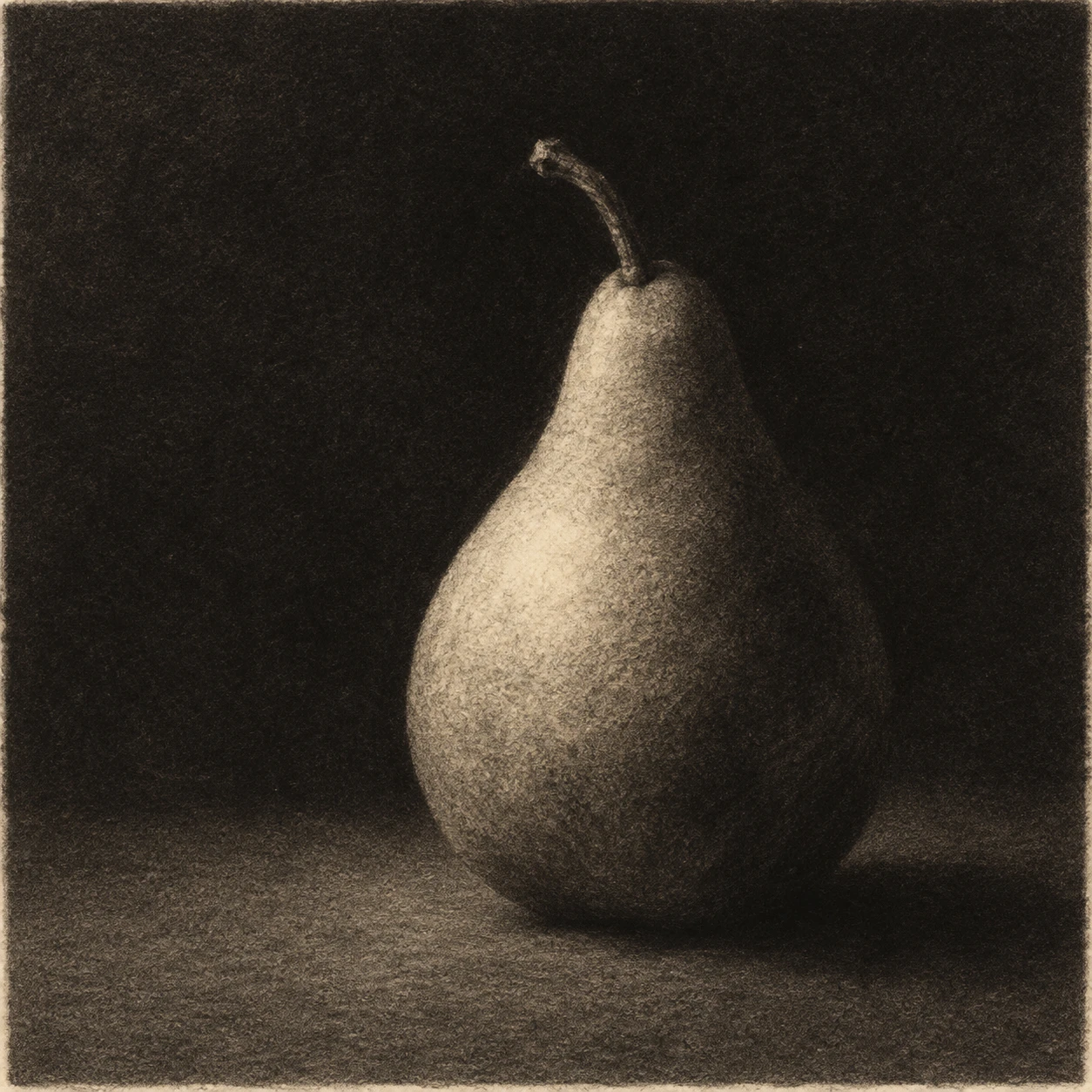
A mezzotint print study revealing a pear’s rounded volume through pale areas emerging from dense black grain.
One Pear · Velvety Mezzotint Tone
- Shape & line
- Build the pear’s contour from the meeting of tonal masses rather than an ink outline. Keep the narrow neck and stem distinct, round the lower body with gradual value changes, and let a short section of the lower-right edge merge into the surrounding dark.
- Color & light
- Use black ink and the warm ivory of the paper only. Light the pear from the image’s upper left, opening a broad pale area on its upper-left belly; roll this light through smoky gray into the dark right flank, and extend a soft cast shadow from the base toward the image’s lower right.
- Texture & material
- Render the dark field as dense, irregular mezzotint grain with a velvety surface. Make the pear’s middle tones visibly granular, then progressively reduce the dark grain toward the burnished highlight until a small pale area reads as exposed paper; avoid treating the grain as dots on the fruit’s skin.
- Composition
- Concentrate the strongest light-dark separation around the pear’s upper-left shoulder and keep the surrounding field quiet. Use the lower-right shadow to connect the fruit to its surface, leaving the left-side negative space uninterrupted so the single form remains the focal point.
Priority
Prioritize the velvety dark grain and its gradual clearing into luminous paper.
What to avoid & what to check
Avoid hard contour lines, glossy photographic highlights, and uniform digital noise.
Check that one pear reads clearly and that its brightest area contains less dark grain than its middle tones.
Exact prompt for this example
SUBJECT
Show exactly one upright pear with a short curved stem, a narrow neck, and an asymmetrical rounded base, resting on a plain surface. Keep its identity readable through the outer contour and the transition from neck to belly.

COMPOSITION
Use a square close still-life framing with the entire pear and stem visible. Place the pear slightly right of center, occupying roughly two-thirds of the image height, with generous dark space above and on the left. Show the resting surface through a subdued tonal change rather than a drawn horizon.

STYLE GUIDE
1. Shape & line
Build the pear’s contour from the meeting of tonal masses rather than an ink outline. Keep the narrow neck and stem distinct, round the lower body with gradual value changes, and let a short section of the lower-right edge merge into the surrounding dark.

2. Color & light
Use black ink and the warm ivory of the paper only. Light the pear from the image’s upper left, opening a broad pale area on its upper-left belly; roll this light through smoky gray into the dark right flank, and extend a soft cast shadow from the base toward the image’s lower right.

3. Texture & material
Render the dark field as dense, irregular mezzotint grain with a velvety surface. Make the pear’s middle tones visibly granular, then progressively reduce the dark grain toward the burnished highlight until a small pale area reads as exposed paper; avoid treating the grain as dots on the fruit’s skin.

4. Composition
Concentrate the strongest light-dark separation around the pear’s upper-left shoulder and keep the surrounding field quiet. Use the lower-right shadow to connect the fruit to its surface, leaving the left-side negative space uninterrupted so the single form remains the focal point.

PRIORITY
Preserve the requested identity, count, action, composition and output settings. Apply the style rules within those constraints; a style reference must not replace the subject or layout. Within the style: Prioritize the velvety dark grain and its gradual clearing into luminous paper.

AVOID
Avoid hard contour lines, glossy photographic highlights, and uniform digital noise.

OUTPUT
Produce one square image resembling a monochrome mezzotint impression on warm ivory paper, with no lettering, captions, signature, or watermark.

SELF-CHECK
Check that one pear reads clearly and that its brightest area contains less dark grain than its middle tones.
Model information comes from image provenance. The same prompt may produce a different result.