Text to imageArt stylesStyle guide
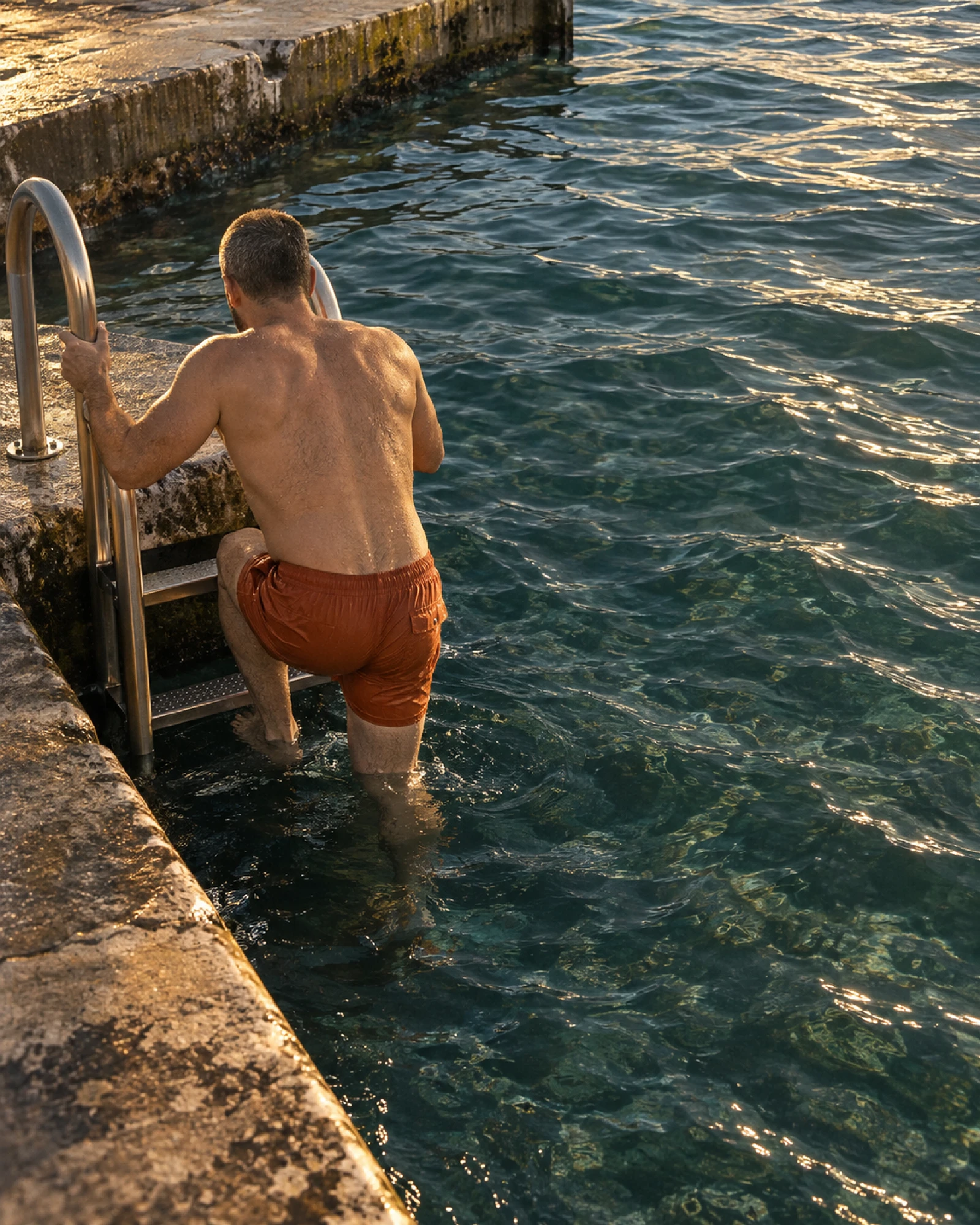
Swimmer on the Tidal Ladder
An analog photograph contrasts a swimmer emerging from a tidal pool with expansive empty water. A crisp ladder, deep shadows, and softly blooming reflections give the quiet scene expressive depth.
Remix this referenceSwimmer on the Tidal Ladder
- Form language
- Preserve photographic volumes while letting minor detail merge into larger tonal masses; abstraction comes through selective resolution rather than geometric reduction of forms or diagrammatic simplification.
- Contour
- Use unoutlined edges that alternate between precise definition, gentle softness, and disappearance into deep tones; keep transitions organic and allow neighboring edges to differ without synthetic sharpening.
- Mark-making
- Integrate fine irregular film grain, most apparent in middle tones, with natural local variation; its scale stays delicate enough to belong to the print rather than becoming a decorative noise layer.
- Surface rendering
- Use continuous tonal transitions, a gentle highlight shoulder, differentiated dense shadows, and restrained halation around strong highlights. Keep the print response softly compressed without flattening its tonal depth.
Priority
Make grain and tonal depth native to the print.
What to avoid & what to check
Avoid a uniform vintage filter over digital crispness.
Gentle bloom coexists with differentiated dark tones.
Exact prompt for this example
MODULE OWNERSHIP
subject: Subject count, type, stable proportions and landmarks, resting face geometry, hair shape, physical materials, garment construction and permanent marks. No emotion, movement, color assignment or rendering recipe.
expression: Facial soft-tissue displacement and pupil direction, muscle coordination, regional intensity, asymmetry and onset/peak/release. No head/body pose, stable appearance, skin color or rendering.
gesture: Head/neck/body/limb orientation, joint movement, support, contact and pose-caused occlusion using existing anatomy. No eye/pupil movement, emotion, identity, props inventory or camera.
props: Prop count, type, construction, physical material and scale relative to the subject. Holding/contact belongs to gesture, position to composition, color to palette.
scene: Environment elements, terrain, backdrop/floor presence and structural detail. No canvas positions, camera, lighting, assigned colors or render texture.
camera: Projection, focal-length impression, camera elevation/yaw/roll, viewing distance and crop. No actor pose, world placement, lighting or canvas aspect ratio.
composition: Normalized 0-100% canvas positions, scale in frame, depth/overlap, focal hierarchy and margins. No joint pose, camera projection, rendering, subject/prop inventory or emotion.
palette: Color anchors, hue/saturation/value ranges, colors assigned to parts and approximate color coverage. No illumination direction, shading algorithm, physical material or layout.
lighting: Light-source direction/softness/intensity, ambient illumination, physical shadow direction/length and highlight position. Absence of directional illumination is allowed. No shading technique, palette or material changes.
style: Reusable form abstraction, contour weight/taper/edge quality, medium and mark scale/density/direction, surface rendering and tonal transition technique. No fixed subject proportions, anatomy, identity, expression, pose, palette, light-source direction, camera or layout.
output: Image count, aspect ratio, size, file/alpha requirements and global lettering/logo/watermark restrictions. No background scenery, crop, style, identity or pose.

SUBJECT
inventory: One original adult swimmer is the sole human subject, with close-cropped hair and plain swimming trunks.
geometry: Use ordinary adult construction with broad shoulders, a narrower waist, and long limbs; individual bodily differences may vary naturally.
appearance: Keep the skin unadorned and the hair close to the scalp. The woven trunks have an elastic waistband and uncomplicated construction.

PRIORITY
Preserve an ordinary, unembellished swimmer.

AVOID
Avoid an idealized athletic advertising body.

CHECK
The swimmer has believable individual proportions.

GESTURE
head: The swimmer extends the neck naturally toward the upper landing, keeping the head aligned with the climbing effort.
torso: The torso inclines toward the rails as the chest clears the water, leaving the back exposed during the climb.
limbs: The elbows bend unevenly; one knee rises toward the next rung while the lower leg remains partly submerged.
contact: Both hands grip the rails and one foot bears weight on a rung. Water conceals the submerged anatomy without further specification.

PRIORITY
Make the climbing moment visibly weight-bearing.

AVOID
Avoid a symmetrical display pose.

CHECK
The visible grips and support explain the climb.

PROPS
inventory: Include one adult-sized pool ladder with paired tubular rails and broad rungs, comfortably proportioned for the swimmer.
construction: Build it from bent stainless-steel tubing, metal rung plates, and mounting sockets; minor wear may vary naturally.

PRIORITY
Keep the ladder functionally convincing.

AVOID
Avoid decorative additions to the equipment; omit resort furnishings.

CHECK
Rails and rungs form one continuous assembly.

SCENE
inventory: An outdoor tidal seawater pool contains a broad water surface, weathered concrete coping, and a narrow adjoining deck.
structure: A straight pool edge meets a short return wall. Small ripples interrupt the water near the pool's access point.

PRIORITY
Retain spare coastal bathing architecture.

AVOID
Avoid scenic embellishment.

CHECK
Water and concrete establish a tidal pool.

CAMERA
projection: Use photographic perspective with a normal-to-short-telephoto impression, preserving depth without stretching nearby structures.
viewpoint: Observe from a moderately elevated rear three-quarter viewpoint on the deck, looking gently downward with neutral roll.
crop: Use a medium-wide frame containing the swimmer and upper ladder structure; exclude the horizon and all facial features.

PRIORITY
Make the encounter feel quietly observed.

AVOID
Avoid extreme overhead or wide-angle views.

CHECK
The rear viewpoint keeps the face unseen.

COMPOSITION
placement: Group the swimmer and ladder in the left third; the swimmer occupies about a third of the frame height, beside an inward-leading pool edge.
depth: Layer the near deck, swimmer, and receding water. Limit rail overlaps so the back remains the first focal shape.
spacing: Leave the right half generously open, with the principal reflection separated from the human group and ample uninterrupted water between them.

PRIORITY
Balance the small human event against spacious water.

AVOID
Avoid centering the swimmer or filling every gap.

CHECK
Empty water carries substantial visual weight.

PALETTE
colors: Use petrol teal, ash gray, warm tan, and restrained burnt orange, spanning muted middle values and deep dark anchors.
assignment: Assign teal to water, ash gray to concrete and steel, tan to skin, and burnt orange to trunks; reflections may lean amber.
balance: Subdued teal dominates while warm colors remain compact. Permit subtle hue variation within the anchors at modest saturation.

PRIORITY
Distinguish the swimmer through compact warmth.

AVOID
Avoid bright holiday-pool blues.

CHECK
Warm accents remain subordinate to teal.

LIGHTING
sources: Broad low evening light enters from the upper left, supported by weak open-sky ambient illumination.
shadows: Soft shadows extend toward the lower right; inward-facing body surfaces and water beside the wall remain deeply shaded.
highlights: Place broad highlights on the upper back, narrow highlights along exposed rails, and broken reflected highlights on the water.

PRIORITY
Reveal depth through soft lateral illumination.

AVOID
Avoid uniform frontal illumination.

CHECK
Visible highlights share a broad light direction.

STYLE GUIDE
form-language: Preserve photographic volumes while letting minor detail merge into larger tonal masses; abstraction comes through selective resolution rather than geometric reduction of forms or diagrammatic simplification.
contour: Use unoutlined edges that alternate between precise definition, gentle softness, and disappearance into deep tones; keep transitions organic and allow neighboring edges to differ without synthetic sharpening.
mark-making: Integrate fine irregular film grain, most apparent in middle tones, with natural local variation; its scale stays delicate enough to belong to the print rather than becoming a decorative noise layer.
surface-rendering: Use continuous tonal transitions, a gentle highlight shoulder, differentiated dense shadows, and restrained halation around strong highlights. Keep the print response softly compressed without flattening its tonal depth.

PRIORITY
Make grain and tonal depth native to the print.

AVOID
Avoid a uniform vintage filter over digital crispness.

CHECK
Gentle bloom coexists with differentiated dark tones.

OUTPUT
format: Deliver one finished image as an opaque PNG, 4:5 portrait aspect ratio, at 1600 × 2000 pixels.
restrictions: Include no lettering, logos, watermarks, borders, or reference-sheet annotations anywhere in the delivered image.

PRIORITY
Deliver one finished reference image.

AVOID
Avoid multi-panel presentation.

CHECK
The opaque file contains one uninterrupted image.

FINAL INTEGRATION
gesture + props + composition: Functional support and selective overlap cooperate to make the brief climbing moment immediately legible.
camera + lighting + style: Observation, illumination, and print response cooperate to sustain expressive depth with restrained detail.
Model information comes from image provenance. The same prompt may produce a different result.