Text to imageCharacterStyle guide
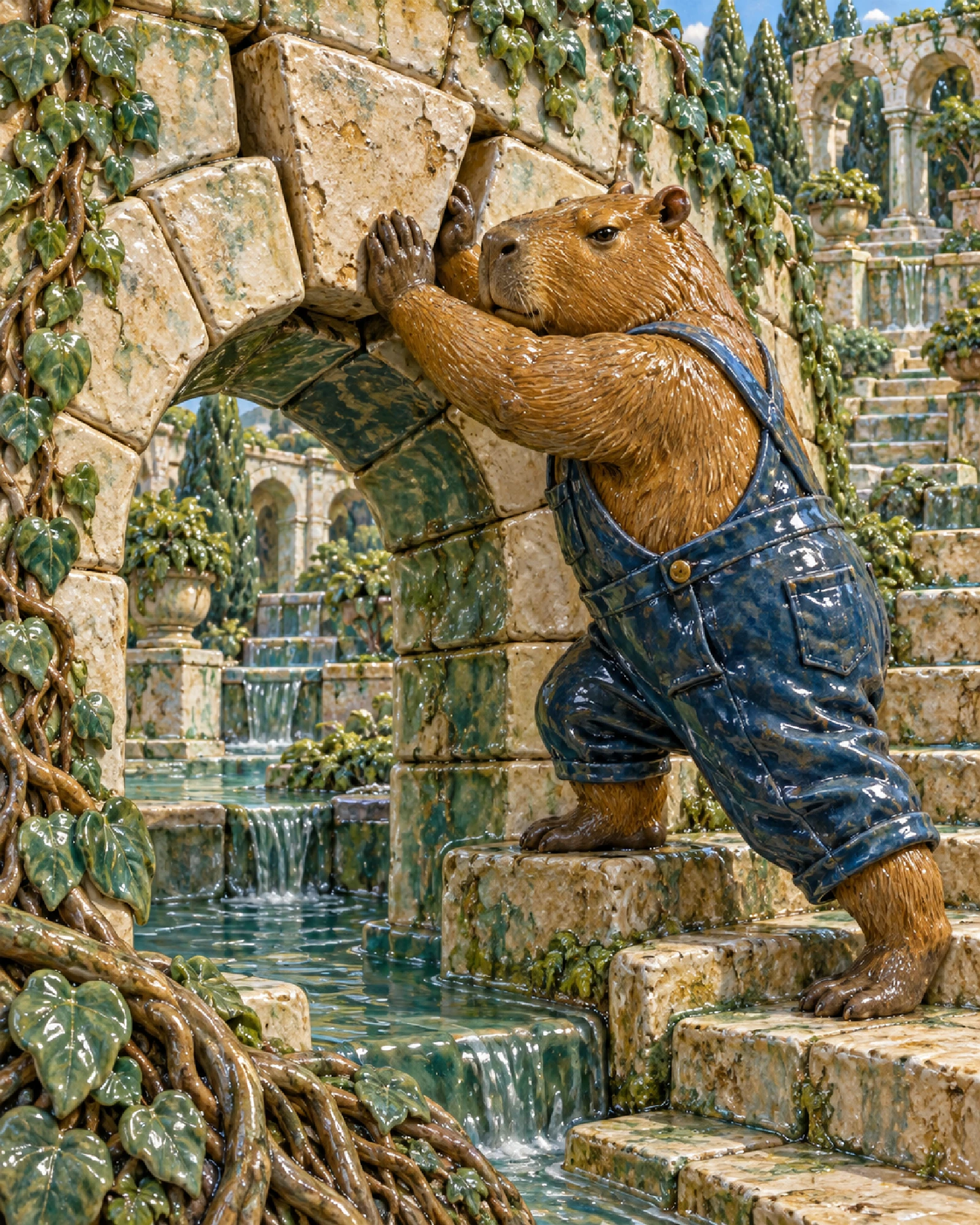
Capybara Resetting an Arch Stone
A capybara in work overalls pushes a displaced stone back into an arch in a flooded garden. Rounded ceramic relief and glaze pooled in recesses give presence to the two-handed effort and layered waterways.
Remix this referenceCapybara Resetting an Arch Stone
- Form language
- Translate forms into nested, softly bulging ceramic plaques with shallow undercuts; allow small details to vary within this modeled language.
- Contour
- Use rounded raised boundaries and fine incised separations instead of drawn outlines; occasional softened chips interrupt the edges.
- Mark-making
- Broad thumb compressions and sparse dragged-tool grooves retain uneven pressure; vary marks naturally rather than covering every surface.
- Surface rendering
- Model glossy glaze pooling in recesses and thinning over crests, with softly fused tonal transitions and small irregular kiln mottles.
Priority
Make the finished image read as modeled ceramic relief with visibly responsive glaze surfaces.
What to avoid & what to check
Exact prompt for this example
MODULE OWNERSHIP
subject: Subject count, type, stable proportions and landmarks, resting face geometry, hair shape, physical materials, garment construction and permanent marks. No emotion, movement, color assignment or rendering recipe.
expression: Facial soft-tissue displacement and pupil direction, muscle coordination, regional intensity, asymmetry and onset/peak/release. No head/body pose, stable appearance, skin color or rendering.
gesture: Head/neck/body/limb orientation, joint movement, support, contact and pose-caused occlusion using existing anatomy. No eye/pupil movement, emotion, identity, props inventory or camera.
props: Prop count, type, construction, physical material and scale relative to the subject. Holding/contact belongs to gesture, position to composition, color to palette.
scene: Environment elements, terrain, backdrop/floor presence and structural detail. No canvas positions, camera, lighting, assigned colors or render texture.
camera: Projection, focal-length impression, camera elevation/yaw/roll, viewing distance and crop. No actor pose, world placement, lighting or canvas aspect ratio.
composition: Normalized 0-100% canvas positions, scale in frame, depth/overlap, focal hierarchy and margins. No joint pose, camera projection, rendering, subject/prop inventory or emotion.
palette: Color anchors, hue/saturation/value ranges, colors assigned to parts and approximate color coverage. No illumination direction, shading algorithm, physical material or layout.
lighting: Light-source direction/softness/intensity, ambient illumination, physical shadow direction/length and highlight position. Absence of directional illumination is allowed. No shading technique, palette or material changes.
style: Reusable form abstraction, contour weight/taper/edge quality, medium and mark scale/density/direction, surface rendering and tonal transition technique. No fixed subject proportions, anatomy, identity, expression, pose, palette, light-source direction, camera or layout.
output: Image count, aspect ratio, size, file/alpha requirements and global lettering/logo/watermark restrictions. No background scenery, crop, style, identity or pose.

SUBJECT
inventory: One original anthropomorphic adult capybara mason, actor A; no additional figures.
geometry: A barrel-shaped trunk, blunt rectangular muzzle, small rounded ears and short sturdy limbs preserve capybara identity.
resting-face: Small oval eyes sit above a broad nose; the closed mouth forms a shallow horizontal line. Brow ridges have no human-shaped eyebrows.
appearance: Short coarse fur, broad paws and woven bib overalls with crossed back straps; garment folds may vary naturally.

PRIORITY


AVOID


CHECK


EXPRESSION — ACTOR A
brows: Brow ridges draw slightly inward and down.
lids: Upper lids lower slightly; lower lids tighten without closing the eyes.
cheeks: Cheek pads compress subtly toward the firm mouth.
nose: Nasal wings widen slightly, without a wrinkled nose bridge.
mouth: Lips press together, with the nearer corner slightly tighter.
jaw: The jaw stays closed with visible firmness beneath the muzzle.
gaze: Pupils fix on the stone's upper meeting edge.
coordination: Mild lid tension supports stronger mouth compression, avoiding an angry snarl.
timing: Hold the peak of concentrated facial effort.

PRIORITY


AVOID


CHECK


GESTURE
head: Lower the chin slightly toward the hands, keeping the muzzle clear of the arms.
torso: Lean the trunk into the push, with one shoulder advancing farther than the other.
limbs: Stand with feet braced on successive stair levels, rear knee flexed; both arms extend with softly bent elbows.
contact: Both palms press the stone's exposed face as it begins entering the socket; planted feet carry forward body weight.

PRIORITY


AVOID


CHECK


PROPS
inventory: One displaced arch stone, approximately as wide as A's chest.
construction: A wedge-shaped sandstone block with broad worn faces and a chipped outer corner.

PRIORITY


AVOID


CHECK


SCENE
inventory: A flooded garden aqueduct with a damaged masonry arch, shallow channels, descending steps, roots and trailing vines.
structure: The arch contains an open stone socket; water passes beneath it into connected channels and a recessed garden court.

PRIORITY


AVOID


CHECK


CAMERA
projection: Restrained perspective with a normal-lens impression, preserving readable relief depth.
viewpoint: View slightly above A's chest height, obliquely across the arch, with no camera roll.
crop: A full-body view includes the arch opening and supporting steps; outer garden structures may be cropped.

PRIORITY


AVOID


CHECK


COMPOSITION
placement: A occupies the area right of center near 62% width and fills roughly two-thirds of the height; the stone sits above the hands.
depth: Foreground roots overlap the lowest steps; A overlaps the arch pier, with the recessed court visible through the opening.
spacing: Hands and face form the focal pair; a clear gap beside the muzzle preserves readability amid the layered setting.

PRIORITY


AVOID


CHECK


PALETTE
colors: Honey ocher, celadon green, deep petrol blue and warm ivory, with rich darks and restrained bright accents.
assignment: Fur is honey ocher, overalls petrol blue, vegetation and water celadon, and masonry warm ivory.
balance: Celadon and ivory carry the environment, with the compact ocher and blue figure providing concentrated contrast.

PRIORITY


AVOID


CHECK


LIGHTING
sources: A broad soft source from upper left illuminates the relief, supported by moderate ambient light.
shadows: Raised forms cast short shadows toward lower right; the arch recess holds a deeper continuous shadow.
highlights: Soft highlights gather on upper-left ridges, the muzzle, knuckles and exposed stone edges.

PRIORITY


AVOID


CHECK


STYLE GUIDE
form-language: Translate forms into nested, softly bulging ceramic plaques with shallow undercuts; allow small details to vary within this modeled language.
contour: Use rounded raised boundaries and fine incised separations instead of drawn outlines; occasional softened chips interrupt the edges.
mark-making: Broad thumb compressions and sparse dragged-tool grooves retain uneven pressure; vary marks naturally rather than covering every surface.
surface-rendering: Model glossy glaze pooling in recesses and thinning over crests, with softly fused tonal transitions and small irregular kiln mottles.

PRIORITY
Make the finished image read as modeled ceramic relief with visibly responsive glaze surfaces.

AVOID


CHECK


OUTPUT
format: One finished image, 4:5 aspect ratio, 1600 × 2000 pixels, opaque PNG.
restrictions: No lettering, logos, signatures or watermarks.

PRIORITY


AVOID


CHECK


FINAL INTEGRATION
expression + gesture + props + scene: The pushing action connects the movable block to the architectural opening; the facial peak coincides with the block beginning to seat.
composition + style + lighting: Layered arrangement, modeled surfaces and physical illumination cooperate to make the setting immersive without obscuring the action.
Model information comes from image provenance. The same prompt may produce a different result.