Text to imageIllustrationStyle guide
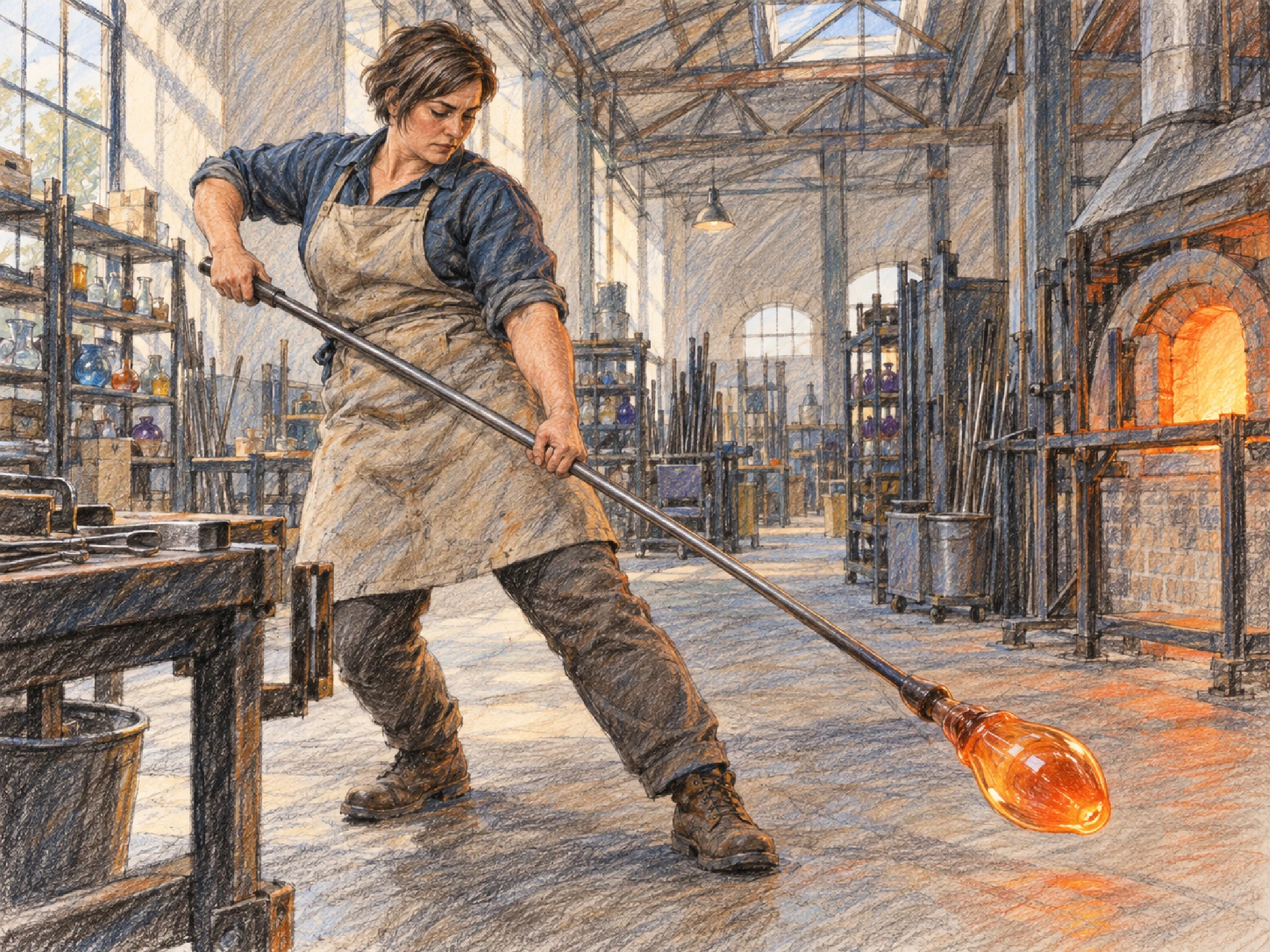
Glassblower Swinging a Glass Teardrop
Inside a layered glass workshop, a glassblower swings a long pipe to elongate a hot glass gather. Searching pencil lines and grainy colored-pencil strokes make her balance and the glass's weight tangible.
Remix this referenceGlassblower Swinging a Glass Teardrop
- Form language
- Build forms from blunt wedges and elastic arcs; simplify secondary structures into broken rhythms while allowing small irregularities.
- Contour
- Use searching graphite contours with doubled passages, tapered exits and occasional overshoots; vary pressure instead of enclosing every shape.
- Mark-making
- Lay colored pencil in brisk oblique strokes and broader side-of-lead rubs; let natural changes in pressure expose the paper tooth.
- Surface rendering
- Accumulate tone through loose crosshatching and selective graphite smudges; keep luminous passages porous and dense passages visibly layered.
Priority
Preserve the immediacy of rough pencil and colored-pencil sketchbook drawing in a finished, resolved
What to avoid & what to check
Exact prompt for this example
MODULE OWNERSHIP
subject: Subject count, type, stable proportions and landmarks, resting face geometry, hair shape, physical materials, garment construction and permanent marks. No emotion, movement, color assignment or rendering recipe.
expression: Facial soft-tissue displacement and pupil direction, muscle coordination, regional intensity, asymmetry and onset/peak/release. No head/body pose, stable appearance, skin color or rendering.
gesture: Head/neck/body/limb orientation, joint movement, support, contact and pose-caused occlusion using existing anatomy. No eye/pupil movement, emotion, identity, props inventory or camera.
props: Prop count, type, construction, physical material and scale relative to the subject. Holding/contact belongs to gesture, position to composition, color to palette.
scene: Environment elements, terrain, backdrop/floor presence and structural detail. No canvas positions, camera, lighting, assigned colors or render texture.
camera: Projection, focal-length impression, camera elevation/yaw/roll, viewing distance and crop. No actor pose, world placement, lighting or canvas aspect ratio.
composition: Normalized 0-100% canvas positions, scale in frame, depth/overlap, focal hierarchy and margins. No joint pose, camera projection, rendering, subject/prop inventory or emotion.
palette: Color anchors, hue/saturation/value ranges, colors assigned to parts and approximate color coverage. No illumination direction, shading algorithm, physical material or layout.
lighting: Light-source direction/softness/intensity, ambient illumination, physical shadow direction/length and highlight position. Absence of directional illumination is allowed. No shading technique, palette or material changes.
style: Reusable form abstraction, contour weight/taper/edge quality, medium and mark scale/density/direction, surface rendering and tonal transition technique. No fixed subject proportions, anatomy, identity, expression, pose, palette, light-source direction, camera or layout.
output: Image count, aspect ratio, size, file/alpha requirements and global lettering/logo/watermark restrictions. No background scenery, crop, style, identity or pose.

SUBJECT
inventory: One adult woman glassblower, actor A.
geometry: A sturdy build with broad shoulders, substantial forearms and a compact oval head.
resting-face: A broad nose bridge, straight brows and a short upper lip establish her resting facial structure.
appearance: Short wedge-shaped hair; a cotton work shirt with rolled cuffs, canvas apron and leather ankle boots.

PRIORITY


AVOID


CHECK


EXPRESSION — ACTOR A
brows: Brows draw slightly inward, with one sitting a little lower.
lids: Upper lids lower slightly; lower lids hold a restrained tension.
cheeks: Cheeks remain relaxed, without a smile lift.
nose: Nostrils remain relaxed without a visible flare.
mouth: Lips meet lightly, with a small compression at one corner.
jaw: Jaw stays gently set without a hard clench.
gaze: Pupils track downward toward the glass gather.
coordination: Concentration resides mostly around the eyes; the lower face stays quiet.
timing: Hold the settled apex of concentration during the swing.

PRIORITY


AVOID


CHECK


GESTURE
head: Her neck extends slightly and her chin dips toward the working end of the pipe.
torso: The torso leans back against the descending swing, with a small twist through the waist.
limbs: Both arms sweep the pipe down across her body; staggered feet and flexed knees absorb its momentum.
contact: Both hands grip separated sections of the shaft; both boots remain planted on the floor.

PRIORITY


AVOID


CHECK


PROPS
inventory: One metal blowpipe longer than the worker's height, carrying one pear-shaped glass gather about grapefruit size.
construction: The hollow shaft ends in a continuous glass attachment with a narrow neck and a heavy rounded tip.

PRIORITY


AVOID


CHECK


SCENE
inventory: A tall glass workshop with a masonry furnace, fixed steel workbench, storage racks, roof trusses and a worn floor.
structure: An arched furnace mouth and repeated rack bays articulate the hall; a roof opening breaks the truss structure.

PRIORITY


AVOID


CHECK


CAMERA
projection: Natural perspective with a moderate wide-angle impression.
viewpoint: View from waist height at a three-quarter angle, with a level horizon.
crop: A full-figure workshop view, close enough to read the hands and face while retaining the surrounding hall.

PRIORITY


AVOID


CHECK


COMPOSITION
placement: Place the worker left of center; the pipe runs diagonally toward the glass in the lower right.
depth: A cropped bench edge overlaps the lower left; the worker occupies the middle layer, with furnace and racks behind.
spacing: Make the hands-to-glass diagonal the focal path; leave open floor around its endpoint and let rack repetitions recede.

PRIORITY


AVOID


CHECK


PALETTE
colors: Oatmeal, graphite gray, petrol blue, persimmon orange and subdued violet form a restrained palette.
assignment: Oatmeal underlies the room; petrol blue marks the shirt, orange the glass and furnace interior, violet the recesses.
balance: Quiet pale neutrals dominate; blue forms the main chromatic mass and orange supplies a small saturated counterpoint.

PRIORITY


AVOID


CHECK


LIGHTING
sources: Broad soft daylight enters from upper left; the furnace adds a weaker local light from the right.
shadows: Soft floor shadows extend to the right; overlapping structures create deeper sheltered pockets.
highlights: A broad highlight follows the glass's upper-left curve, with faint furnace-facing accents on nearby edges.

PRIORITY


AVOID


CHECK


STYLE GUIDE
form-language: Build forms from blunt wedges and elastic arcs; simplify secondary structures into broken rhythms while allowing small irregularities.
contour: Use searching graphite contours with doubled passages, tapered exits and occasional overshoots; vary pressure instead of enclosing every shape.
mark-making: Lay colored pencil in brisk oblique strokes and broader side-of-lead rubs; let natural changes in pressure expose the paper tooth.
surface-rendering: Accumulate tone through loose crosshatching and selective graphite smudges; keep luminous passages porous and dense passages visibly layered.

PRIORITY
Preserve the immediacy of rough pencil and colored-pencil sketchbook drawing in a finished, resolved

AVOID


CHECK


OUTPUT
format: One finished illustration, landscape 4:3, 2048 × 1536 pixels, opaque PNG.
restrictions: No lettering, logos, signatures or watermarks.

PRIORITY


AVOID


CHECK


FINAL INTEGRATION
gesture + composition: Let the bodily counterbalance and the visual diagonal reinforce one continuous action.
lighting + style: Keep the illumination legible through the drawing's open and accumulated passages.
Model information comes from image provenance. The same prompt may produce a different result.