Text to imageSpace & architectureStyle guide
Rain Through the Market Roof
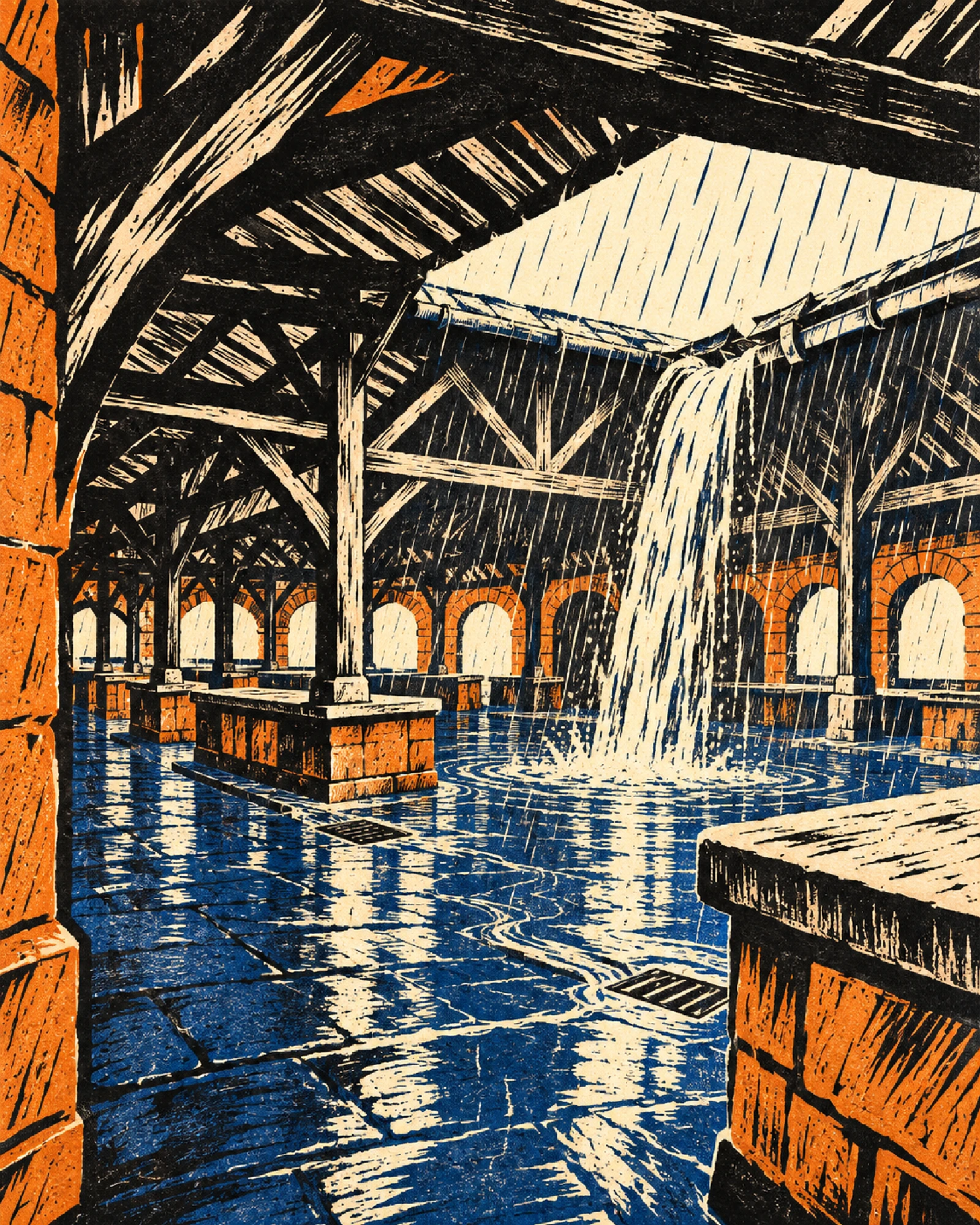
A cloudburst spills from a broken gutter inside an old covered market, sending water between empty stalls. Bold linocut masses and sweeping carved marks turn the architecture into an animated weather event.
Remix this referenceRain Through the Market Roof
- Form language
- Reduce complex forms into forceful interlocking wedges and broad bands; allow modest irregularity within a coherent print vocabulary.
- Contour
- Use thick, slightly bitten silhouettes interrupted by tapering carved notches; avoid mechanically uniform outlines.
- Mark-making
- Cut long sweeping gouges against shorter angular strokes; vary spacing and pressure so the carving has a strong handmade rhythm.
- Surface rendering
- Build tones from solid ink fields and open carved channels; preserve occasional roller skips and slight overprint offsets.
Priority
Keep bold linocut carving visibly responsible for both tonal structure and surface energy.
What to avoid & what to check
Exact prompt for this example
MODULE OWNERSHIP
subject: Subject count, type, stable proportions and landmarks, resting face geometry, hair shape, physical materials, garment construction and permanent marks. No emotion, movement, color assignment or rendering recipe.
expression: Facial soft-tissue displacement and pupil direction, muscle coordination, regional intensity, asymmetry and onset/peak/release. No head/body pose, stable appearance, skin color or rendering.
gesture: Head/neck/body/limb orientation, joint movement, support, contact and pose-caused occlusion using existing anatomy. No eye/pupil movement, emotion, identity, props inventory or camera.
props: Prop count, type, construction, physical material and scale relative to the subject. Holding/contact belongs to gesture, position to composition, color to palette.
scene: Environment elements, terrain, backdrop/floor presence and structural detail. No canvas positions, camera, lighting, assigned colors or render texture.
camera: Projection, focal-length impression, camera elevation/yaw/roll, viewing distance and crop. No actor pose, world placement, lighting or canvas aspect ratio.
composition: Normalized 0-100% canvas positions, scale in frame, depth/overlap, focal hierarchy and margins. No joint pose, camera projection, rendering, subject/prop inventory or emotion.
palette: Color anchors, hue/saturation/value ranges, colors assigned to parts and approximate color coverage. No illumination direction, shading algorithm, physical material or layout.
lighting: Light-source direction/softness/intensity, ambient illumination, physical shadow direction/length and highlight position. Absence of directional illumination is allowed. No shading technique, palette or material changes.
style: Reusable form abstraction, contour weight/taper/edge quality, medium and mark scale/density/direction, surface rendering and tonal transition technique. No fixed subject proportions, anatomy, identity, expression, pose, palette, light-source direction, camera or layout.
output: Image count, aspect ratio, size, file/alpha requirements and global lettering/logo/watermark restrictions. No background scenery, crop, style, identity or pose.

SUBJECT
inventory: No people or animals.
geometry: No character proportions or identifying landmarks apply.
resting-face: No faces are present.
appearance: No character appearance or garments apply.

PRIORITY


AVOID


CHECK


PROPS
inventory: No separate props.
construction: No prop construction applies.

PRIORITY


AVOID


CHECK


SCENE
inventory: A covered market with timber roof trusses, a central rain court, built-in stone counters, broken gutter, arches and wet paving.
structure: Roof bays surround the open court; water pours from the gutter break and spreads around raised counter bases into floor drains.

PRIORITY


AVOID


CHECK


CAMERA
projection: Use assertive perspective with a wide lens impression and readable architectural convergence.
viewpoint: View diagonally across the hall from standing height beside a stall entrance, with a level camera.
crop: Include roof structure and wet floor; crop the nearest counter and one overhead beam to convey enclosure.

PRIORITY


AVOID


CHECK


COMPOSITION
placement: Place the falling water near 65% of canvas width; let the open aisle sweep toward it from the lower left.
depth: Overlap foreground counter, middle trusses and distant arches; make the cascade primary and the receding hall secondary.
spacing: Compress the overhead overlaps while leaving a broad floor interval around the cascade for visual release.

PRIORITY


AVOID


CHECK


PALETTE
colors: Use ink black, deep cobalt, burnt orange and warm paper ivory.
assignment: Assign black to structural masses, cobalt to wet surfaces, burnt orange to dry masonry and ivory to water and open intervals.
balance: Let dark values carry most of the hall, with substantial ivory openings and selective orange warmth.

PRIORITY


AVOID


CHECK


LIGHTING
sources: Soft storm daylight descends through the open court; weak ambient light reaches the covered aisles.
shadows: Roof cover creates broad overhead shade; counter shadows remain short and diffuse beneath their bases.
highlights: Place broad highlights on the falling water and broken reflections across the wet paving.

PRIORITY


AVOID


CHECK


STYLE GUIDE
form-language: Reduce complex forms into forceful interlocking wedges and broad bands; allow modest irregularity within a coherent print vocabulary.
contour: Use thick, slightly bitten silhouettes interrupted by tapering carved notches; avoid mechanically uniform outlines.
mark-making: Cut long sweeping gouges against shorter angular strokes; vary spacing and pressure so the carving has a strong handmade rhythm.
surface-rendering: Build tones from solid ink fields and open carved channels; preserve occasional roller skips and slight overprint offsets.

PRIORITY
Keep bold linocut carving visibly responsible for both tonal structure and surface energy.

AVOID


CHECK


OUTPUT
format: Produce one finished image, 4:5 portrait, 1600 × 2000 pixels, opaque PNG.
restrictions: No lettering, logos or watermarks.

PRIORITY


AVOID


CHECK


FINAL INTEGRATION
composition + style: Let the carved rhythms reinforce the spatial overlaps while keeping the hall's depth readable.
Model information comes from image provenance. The same prompt may produce a different result.