Text to imageSpace & architectureStyle guide
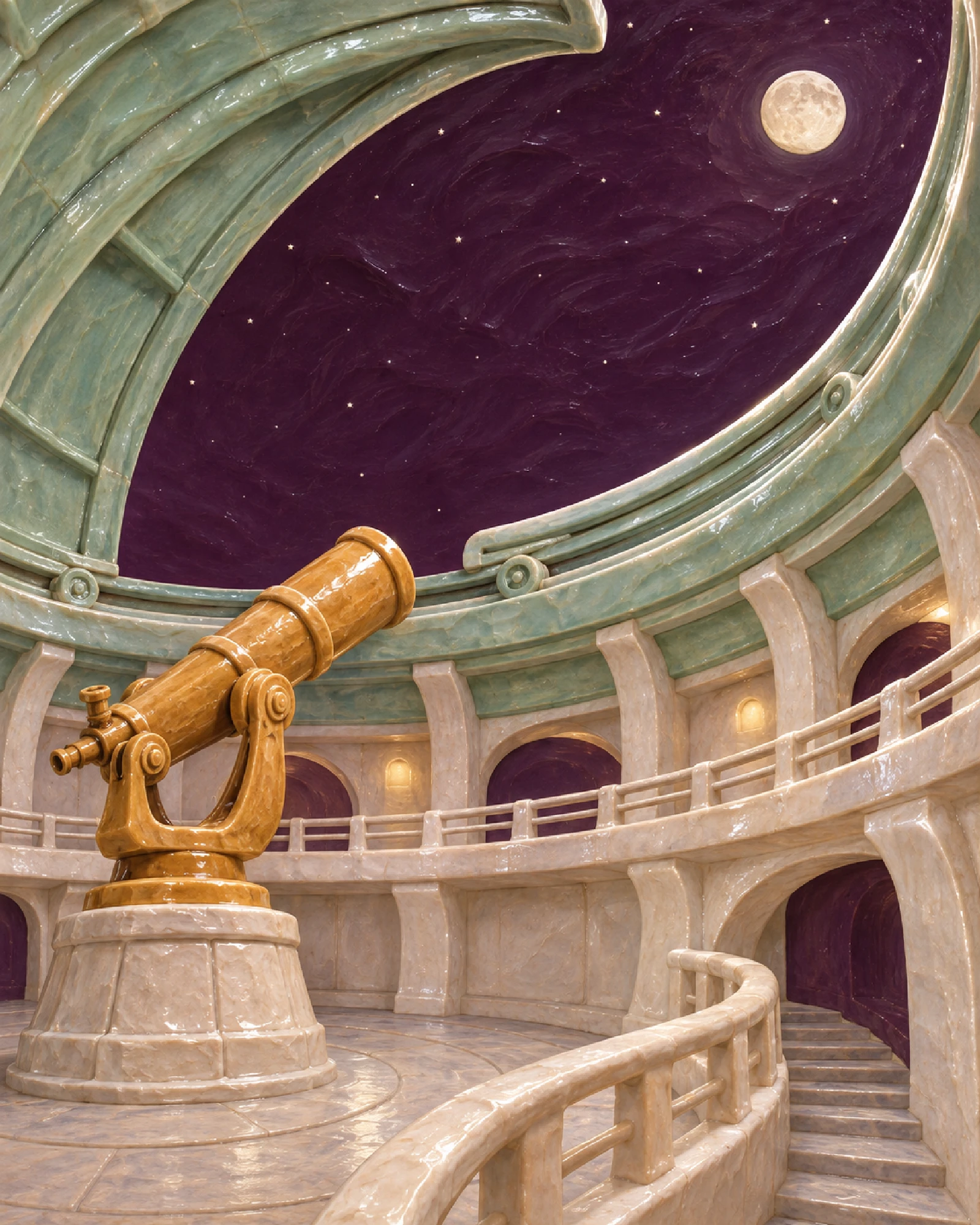
An Observatory with an Open Dome
An observation chamber and galleries unfold beneath an overlapping open dome. Rounded ceramic relief and glaze-filled recesses give the architecture a sweeping gesture of opening.
Remix this referenceAn Observatory with an Open Dome
- Form language
- Translate architecture into overlapping modeled relief bands with rounded shoulders and deeply scooped recesses.
- Contour
- Use thick, softly irregular silhouette edges and narrow incised internal boundaries instead of drawn outlines.
- Mark-making
- Leave occasional broad modeling-tool sweeps and uneven impressed grooves; vary their pressure without covering every surface.
- Surface rendering
- Model glossy glaze pooling in recesses, thinner translucent glaze over raised edges and softly mottled transitions across broad planes.
Priority
The finished illustration must visibly resemble a hand-modeled glazed ceramic relief.
What to avoid & what to check
Exact prompt for this example
MODULE OWNERSHIP
subject: Subject count, type, stable proportions and landmarks, resting face geometry, hair shape, physical materials, garment construction and permanent marks. No emotion, movement, color assignment or rendering recipe.
expression: Facial soft-tissue displacement and pupil direction, muscle coordination, regional intensity, asymmetry and onset/peak/release. No head/body pose, stable appearance, skin color or rendering.
gesture: Head/neck/body/limb orientation, joint movement, support, contact and pose-caused occlusion using existing anatomy. No eye/pupil movement, emotion, identity, props inventory or camera.
props: Prop count, type, construction, physical material and scale relative to the subject. Holding/contact belongs to gesture, position to composition, color to palette.
scene: Environment elements, terrain, backdrop/floor presence and structural detail. No canvas positions, camera, lighting, assigned colors or render texture.
camera: Projection, focal-length impression, camera elevation/yaw/roll, viewing distance and crop. No actor pose, world placement, lighting or canvas aspect ratio.
composition: Normalized 0-100% canvas positions, scale in frame, depth/overlap, focal hierarchy and margins. No joint pose, camera projection, rendering, subject/prop inventory or emotion.
palette: Color anchors, hue/saturation/value ranges, colors assigned to parts and approximate color coverage. No illumination direction, shading algorithm, physical material or layout.
lighting: Light-source direction/softness/intensity, ambient illumination, physical shadow direction/length and highlight position. Absence of directional illumination is allowed. No shading technique, palette or material changes.
style: Reusable form abstraction, contour weight/taper/edge quality, medium and mark scale/density/direction, surface rendering and tonal transition technique. No fixed subject proportions, anatomy, identity, expression, pose, palette, light-source direction, camera or layout.
output: Image count, aspect ratio, size, file/alpha requirements and global lettering/logo/watermark restrictions. No background scenery, crop, style, identity or pose.

SUBJECT
inventory: No characters or living subjects.
geometry: No separate subject geometry applies.
resting-face: No facial geometry applies.
appearance: No character appearance or garment construction applies.

PRIORITY


AVOID


CHECK


PROPS
inventory: One pedestal-mounted astronomical telescope, large enough to stand above an adult observer.
construction: A long metal optical tube sits in an open fork mount on a broad masonry pedestal, with a compact side eyepiece.

PRIORITY


AVOID


CHECK


SCENE
inventory: An observatory contains a circular chamber, a curved viewing gallery, recessed access passages and a partially open dome.
structure: Overlapping metal roof shells follow concentric tracks above concrete ribs; an exterior night sky appears through the broad opening.

PRIORITY


AVOID


CHECK


CAMERA
projection: Use immersive wide-angle perspective with gently emphasized convergence.
viewpoint: Look upward and diagonally across the chamber from the lower access landing, with a level roll.
crop: Include the telescope in full while allowing the nearest gallery and outer roof rim to extend beyond the frame.

PRIORITY


AVOID


CHECK


COMPOSITION
placement: The open dome sweeps from the upper left toward the right edge; the smaller telescope anchors the lower-left quarter.
depth: Layer the near gallery, telescope chamber and receding roof shells; let their overlaps frame the distant sky.
spacing: Make the opening the dominant focus, the telescope secondary, and preserve an uncluttered interval between them.

PRIORITY


AVOID


CHECK


PALETTE
colors: Use celadon, warm porcelain white, deep aubergine and a small honey-amber accent.
assignment: Give the roof shells celadon, ribs and galleries porcelain white, sky and recesses aubergine, and the telescope amber.
balance: Let pale architectural colors occupy most of the image, with a substantial dark opening and one compact warm accent.

PRIORITY


AVOID


CHECK


LIGHTING
sources: Soft moonlight enters from high right through the roof opening, supported by faint diffuse interior illumination.
shadows: Roof ribs cast soft shadows down and left; deeper passages retain broad, quiet shadow.
highlights: Place gentle highlights along upper-right rims, rounded ledges and the telescope tube.

PRIORITY


AVOID


CHECK


STYLE GUIDE
form-language: Translate architecture into overlapping modeled relief bands with rounded shoulders and deeply scooped recesses.
contour: Use thick, softly irregular silhouette edges and narrow incised internal boundaries instead of drawn outlines.
mark-making: Leave occasional broad modeling-tool sweeps and uneven impressed grooves; vary their pressure without covering every surface.
surface-rendering: Model glossy glaze pooling in recesses, thinner translucent glaze over raised edges and softly mottled transitions across broad planes.

PRIORITY
The finished illustration must visibly resemble a hand-modeled glazed ceramic relief.

AVOID


CHECK


OUTPUT
format: Deliver one finished image, 4:5 aspect ratio, 1600 × 2000 pixels, opaque PNG.
restrictions: No lettering, logos or watermarks.

PRIORITY


AVOID


CHECK


FINAL INTEGRATION
scene + composition + camera: The architectural opening and layered viewpoint cooperate to make the room feel expansive and inhabited by possibility.
style + lighting: Soft illumination reveals the modeled relief and changing glaze thickness without flattening the spatial depth.
Model information comes from image provenance. The same prompt may produce a different result.