Text to imageIllustrationStyle guide
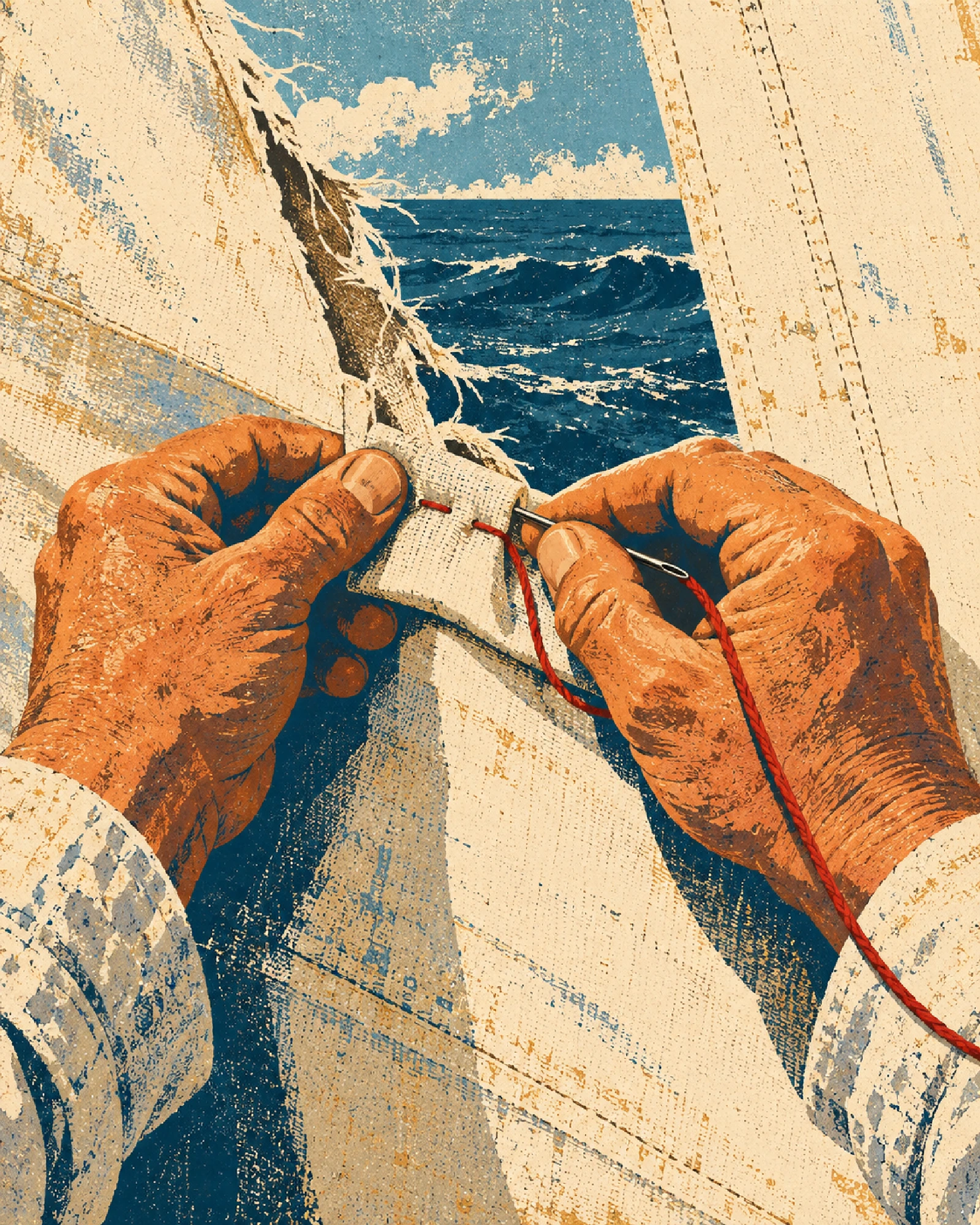
Hands Mending a Torn Sail
An intimate view of hands repairing a sail, with the sea still visible through its open tear. Decisive shape rhythms and uneven ink impressions give the screen print a tactile presence.
Remix this referenceHands Mending a Torn Sail
- Form language
- Reduce forms into interlocking broad wedges and supple curves; alternate long quiet shapes with compact angular interruptions.
- Contour
- Ink-field boundaries carry most contours; occasional blunt, tapered strokes retain slightly imperfect stencil edges.
- Mark-making
- Screen-printed deposits retain sparse squeegee streaks and broken ink passages, varying naturally rather than repeating a distress pattern.
- Surface rendering
- Opaque ink fields and selective translucent overlaps build stepped tones; slight registration slips and paper reserves keep the print tactile.
Priority
Decisive shape rhythms and visibly transferred ink define the graphic screen-print treatment.
What to avoid & what to check
Exact prompt for this example
MODULE OWNERSHIP
subject: Subject count, type, stable proportions and landmarks, resting face geometry, hair shape, physical materials, garment construction and permanent marks. No emotion, movement, color assignment or rendering recipe.
expression: Facial soft-tissue displacement and pupil direction, muscle coordination, regional intensity, asymmetry and onset/peak/release. No head/body pose, stable appearance, skin color or rendering.
gesture: Head/neck/body/limb orientation, joint movement, support, contact and pose-caused occlusion using existing anatomy. No eye/pupil movement, emotion, identity, props inventory or camera.
props: Prop count, type, construction, physical material and scale relative to the subject. Holding/contact belongs to gesture, position to composition, color to palette.
scene: Environment elements, terrain, backdrop/floor presence and structural detail. No canvas positions, camera, lighting, assigned colors or render texture.
camera: Projection, focal-length impression, camera elevation/yaw/roll, viewing distance and crop. No actor pose, world placement, lighting or canvas aspect ratio.
composition: Normalized 0-100% canvas positions, scale in frame, depth/overlap, focal hierarchy and margins. No joint pose, camera projection, rendering, subject/prop inventory or emotion.
palette: Color anchors, hue/saturation/value ranges, colors assigned to parts and approximate color coverage. No illumination direction, shading algorithm, physical material or layout.
lighting: Light-source direction/softness/intensity, ambient illumination, physical shadow direction/length and highlight position. Absence of directional illumination is allowed. No shading technique, palette or material changes.
style: Reusable form abstraction, contour weight/taper/edge quality, medium and mark scale/density/direction, surface rendering and tonal transition technique. No fixed subject proportions, anatomy, identity, expression, pose, palette, light-source direction, camera or layout.
output: Image count, aspect ratio, size, file/alpha requirements and global lettering/logo/watermark restrictions. No background scenery, crop, style, identity or pose.

SUBJECT
inventory: One adult human subject with two weathered hands.
geometry: Broad palms, sturdy fingers and prominent knuckles establish recognizable hand construction.
resting-face: No resting facial geometry is prescribed.
appearance: Short nails, dry skin and plain woven work-shirt cuffs; small wear details may vary naturally.

PRIORITY


AVOID


CHECK


GESTURE
head: Head and neck orientation remains unprescribed.
torso: No torso pose is prescribed.
limbs: The left thumb and fingers pinch the folded edge; the right fingers guide the needle with a flexed wrist.
contact: The left grip steadies the sail; the right grip partly hides the needle as its tip emerges and draws the thread taut.

PRIORITY


AVOID


CHECK


PROPS
inventory: One torn sail, one sailmaker's needle and one continuous length of heavy sewing thread.
construction: Heavy woven sailcloth has a ragged slit and folded repair edge; a palm-length metal needle carries thick thread through its eye.

PRIORITY


AVOID


CHECK


SCENE
inventory: Open seawater and sky form the surrounding environment; no floor or buildings are visible.
structure: A sea horizon and a few long swells provide sparse environmental structure.

PRIORITY


AVOID


CHECK


CAMERA
projection: Normal-lens perspective gives gentle foreshortening without wide-angle enlargement.
viewpoint: View closely from the mender's side, slightly above the hands and oblique to the sail surface, with no camera roll.
crop: Frame both hands, partial forearms and the tear tightly; exclude the face, head, neck and torso, with forearms and sail continuing beyond the image.

PRIORITY


AVOID


CHECK


COMPOSITION
placement: The tear sits above center; hands bracket its lower edge, and the thread extends toward the lower-right border.
depth: Hands overlap the sail in the foreground; distant sea and a narrow strip of sky appear through the opening.
spacing: The needle's exit leads the eye, followed by the sea reveal; broad uninterrupted sail areas balance the crowded repair passage.

PRIORITY


AVOID


CHECK


PALETTE
colors: Warm ivory, copper-orange, deep petrol blue and vermilion; subdued anchors support one saturated accent.
assignment: Ivory for sail and sky, copper-orange for hands, petrol blue for sea and dark accents, vermilion for thread.
balance: Ivory dominates, blue and copper-orange occupy substantial passages, and vermilion remains a narrow accent.

PRIORITY


AVOID


CHECK


LIGHTING
sources: Broad, soft daylight arrives from the upper left, supported by gentle ambient illumination.
shadows: Short shadows fall toward the lower right beneath fingers and folded cloth, deepening at contact.
highlights: Restrained highlights lie on upper-left knuckle surfaces and the exposed upper-left edge of the needle.

PRIORITY


AVOID


CHECK


STYLE GUIDE
form-language: Reduce forms into interlocking broad wedges and supple curves; alternate long quiet shapes with compact angular interruptions.
contour: Ink-field boundaries carry most contours; occasional blunt, tapered strokes retain slightly imperfect stencil edges.
mark-making: Screen-printed deposits retain sparse squeegee streaks and broken ink passages, varying naturally rather than repeating a distress pattern.
surface-rendering: Opaque ink fields and selective translucent overlaps build stepped tones; slight registration slips and paper reserves keep the print tactile.

PRIORITY
Decisive shape rhythms and visibly transferred ink define the graphic screen-print treatment.

AVOID


CHECK


OUTPUT
format: One finished image, 4:5 portrait aspect ratio, 1600 × 2000 pixels, opaque PNG.
restrictions: No lettering, logos or watermarks.

PRIORITY


AVOID


CHECK
Model information comes from image provenance. The same prompt may produce a different result.