Text to imageAnimationStyle guide
Stars Beneath the Station Floor
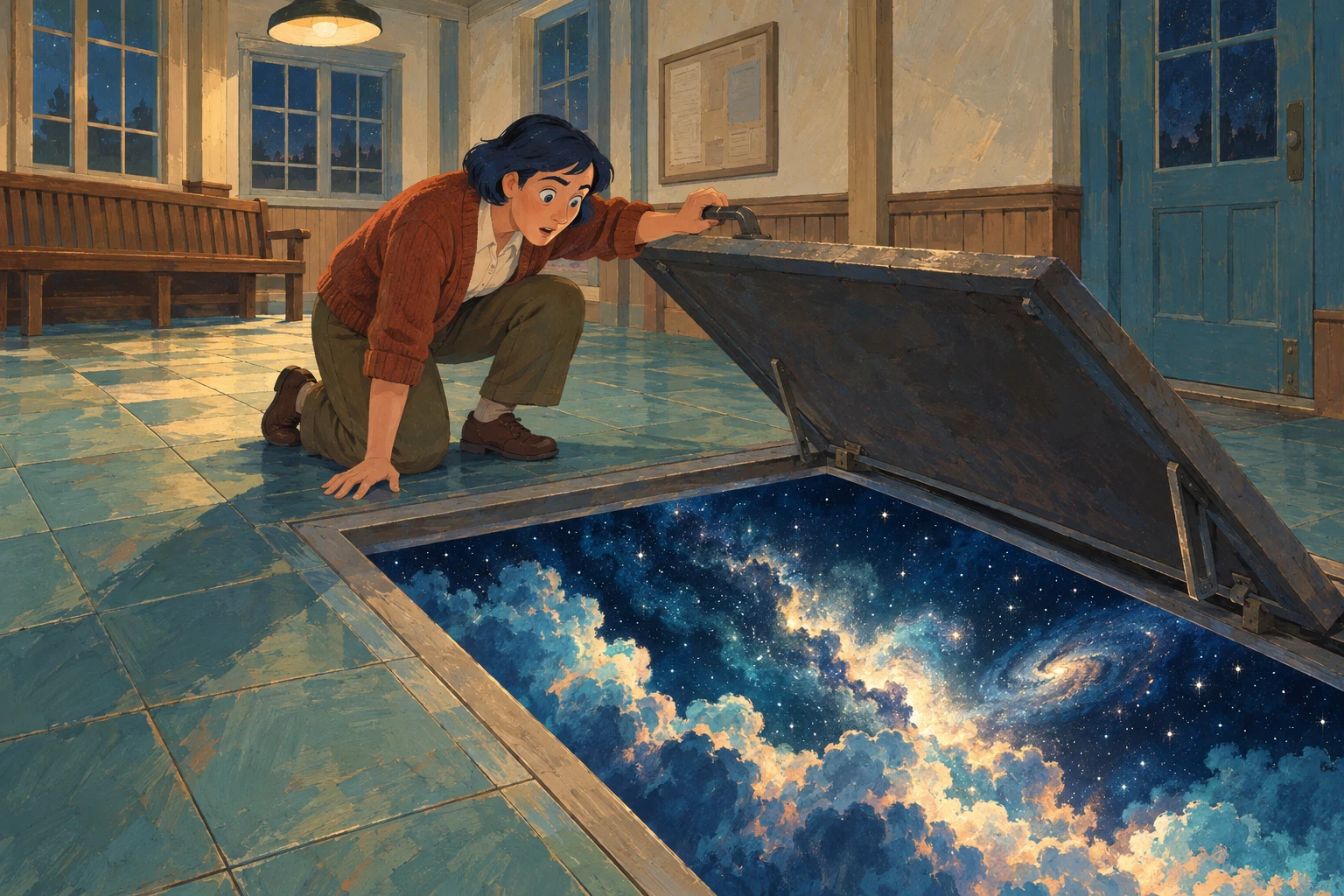
A station caretaker opens a maintenance hatch and discovers an endless night sky beneath the waiting room. Broad opaque gouache planes and broken painted edges connect the familiar interior with an astonishing celestial depth.
Remix this referenceStars Beneath the Station Floor
- Form language
- Build forms from broad planar masses, alternating simple curves with angular facets; simplify small details into suggestive shapes.
- Contour
- Let opaque painted boundaries separate forms; vary their firmness and occasionally break an edge instead of enclosing every shape.
- Mark-making
- Use broad brush traces inside planes and brief dry-brush skips along edges; allow natural variation in stroke width and pressure.
- Surface rendering
- Layer matte opaque gouache in a few stepped tonal levels, retaining shallow paper tooth and occasional imperfect paint overlaps.
Priority
Rendering medium: 2D opaque-gouache animated-film concept illustration; formal rendering reference: Walt Disney Studios · 1950s · Peter Pan concept art (1953)
What to avoid & what to check
Exact prompt for this example
MODULE OWNERSHIP
subject: Subject count, type, stable proportions and landmarks, resting face geometry, hair shape, physical materials, garment construction and permanent marks. No emotion, movement, color assignment or rendering recipe.
expression: Facial soft-tissue displacement and pupil direction, muscle coordination, regional intensity, asymmetry and onset/peak/release. No head/body pose, stable appearance, skin color or rendering.
gesture: Head/neck/body/limb orientation, joint movement, support, contact and pose-caused occlusion using existing anatomy. No eye/pupil movement, emotion, identity, props inventory or camera.
props: Prop count, type, construction, physical material and scale relative to the subject. Holding/contact belongs to gesture, position to composition, color to palette.
scene: Environment elements, terrain, backdrop/floor presence and structural detail. No canvas positions, camera, lighting, assigned colors or render texture.
camera: Projection, focal-length impression, camera elevation/yaw/roll, viewing distance and crop. No actor pose, world placement, lighting or canvas aspect ratio.
composition: Normalized 0-100% canvas positions, scale in frame, depth/overlap, focal hierarchy and margins. No joint pose, camera projection, rendering, subject/prop inventory or emotion.
palette: Color anchors, hue/saturation/value ranges, colors assigned to parts and approximate color coverage. No illumination direction, shading algorithm, physical material or layout.
lighting: Light-source direction/softness/intensity, ambient illumination, physical shadow direction/length and highlight position. Absence of directional illumination is allowed. No shading technique, palette or material changes.
style: Reusable form abstraction, contour weight/taper/edge quality, medium and mark scale/density/direction, surface rendering and tonal transition technique. No fixed subject proportions, anatomy, identity, expression, pose, palette, light-source direction, camera or layout.
output: Image count, aspect ratio, size, file/alpha requirements and global lettering/logo/watermark restrictions. No background scenery, crop, style, identity or pose.

SUBJECT
inventory: One original adult human woman, a station caretaker; no other figures.
geometry: A compact, broad torso, sturdy limbs and large practical hands; a square chin distinguishes her silhouette.
resting-face: Wide-set eyes beneath straight brows, a blunt nose and a broad mouth with a gently projecting lower lip.
appearance: A blunt bob tucked behind the ears, a knitted cardigan over a plain shirt, woven work trousers and leather shoes.

PRIORITY


AVOID


CHECK


EXPRESSION — ACTOR A
brows: Both brows rise, with one lifting slightly ahead of the other.
lids: Upper lids lift while the lower lids remain softly supported.
cheeks: Cheeks remain relaxed, without a smile-driven lift.
nose: Nostrils stay relaxed; the bridge remains unwrinkled.
mouth: Lips part into a small rounded opening, with neither corner pulled sideways.
jaw: The jaw releases slightly, leaving only a narrow opening.
gaze: Both pupils settle downward into the open hatch.
coordination: The eyes register discovery before the mouth fully responds; keep the reaction quiet.
timing: Capture the onset, just as an ordinary inspection becomes an impossible discovery.

PRIORITY


AVOID


CHECK


GESTURE
head: Her neck inclines toward the opening, with the head turned enough to leave the face visible.
torso: She kneels on one knee, her torso suspended halfway through a forward lean.
limbs: One arm holds the raised hatch; the other extends to the floor, with the free foot planted for balance.
contact: One hand grips the hatch handle; the opposite palm and kneeling knee bear weight on the tiled floor.

PRIORITY


AVOID


CHECK


PROPS
inventory: No separate props.
construction: No prop construction applies.

PRIORITY


AVOID


CHECK


SCENE
inventory: A modest station waiting room with a tiled floor, timber bench, tall windows, ceiling lamp and hinged maintenance hatch.
structure: The thick hatch rim opens directly onto a limitless starfield with immense cloud banks; no shaft or bottom intervenes.

PRIORITY


AVOID


CHECK


CAMERA
projection: Moderate wide-angle perspective with restrained convergence and no fisheye distortion.
viewpoint: An elevated three-quarter view from across the room, looking down obliquely with a level roll.
crop: A room-wide view includes the caretaker's entire figure and the complete hatch opening.

PRIORITY


AVOID


CHECK


COMPOSITION
placement: The caretaker occupies the left middle ground; the large opening spreads across the lower right beneath the raised lid.
depth: The face leads attention to the threshold, then into celestial depth; the bench remains subordinate in the rear.
spacing: Leave broad uninterrupted floor around the opening and quiet wall space above; keep the face clear of the lid.

PRIORITY


AVOID


CHECK


PALETTE
colors: Deep ultramarine, muted teal, chalk cream, warm apricot and subdued rust form the limited color family.
assignment: Ultramarine fills the sky and hair; teal defines the floor, cream the walls and stars, apricot the skin, rust the cardigan.
balance: Cool colors occupy most of the image; cream provides breathing room and the restrained warm colors gather on the figure.

PRIORITY


AVOID


CHECK


LIGHTING
sources: A broad ceiling light from the upper left provides the main illumination; the opening supplies faint upward ambient fill.
shadows: Soft, short shadows fall toward the lower right, with a deeper contact shadow beneath the hatch rim.
highlights: Broad highlights touch the upper-left cheek and knuckles; the hatch edge catches a narrow glint.

PRIORITY


AVOID


CHECK


STYLE GUIDE
form-language: Build forms from broad planar masses, alternating simple curves with angular facets; simplify small details into suggestive shapes.
contour: Let opaque painted boundaries separate forms; vary their firmness and occasionally break an edge instead of enclosing every shape.
mark-making: Use broad brush traces inside planes and brief dry-brush skips along edges; allow natural variation in stroke width and pressure.
surface-rendering: Layer matte opaque gouache in a few stepped tonal levels, retaining shallow paper tooth and occasional imperfect paint overlaps.

PRIORITY
Rendering medium: 2D opaque-gouache animated-film concept illustration; formal rendering reference: Walt Disney Studios · 1950s · Peter Pan concept art (1953)

AVOID


CHECK


OUTPUT
format: One finished image, landscape 3:2, 1536 × 1024 pixels, opaque PNG.
restrictions: No lettering, logos, signatures or watermarks.

PRIORITY


AVOID


CHECK


FINAL INTEGRATION
scene + composition + camera: Keep the architectural threshold legible so the transition between ordinary room scale and celestial scale reads immediately.
expression + gesture: Coordinate the interrupted action and emerging facial response as a single instant of discovery.
Art direction
디즈니 / Walt Disney Studios · 1950s · 피터 팬 콘셉트 아트(1953) / Peter Pan concept art (1953) ↗- Render forms as broad planar masses with simplified curved and angular facets
- Separate forms primarily through opaque painted boundaries rather than continuous outlines
- Broad brush traces within planes and small dry-brush interruptions at their edges
- Matte opaque gouache planes, shallow paper texture and a small set of tonal levels
Model information comes from image provenance. The same prompt may produce a different result.