Text to imageArt stylesStyle guide
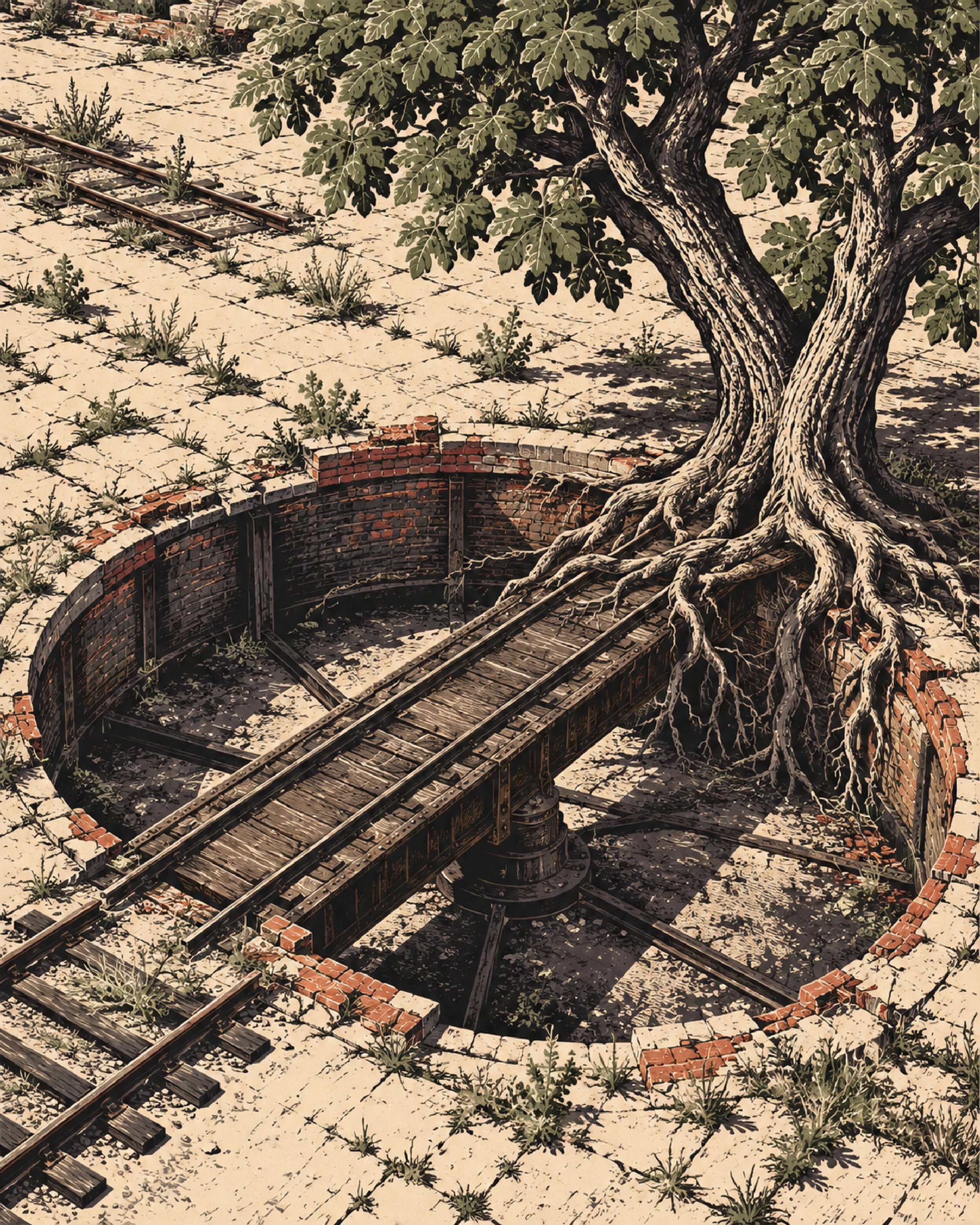
A Fig Tree Rooted in a Railway Turntable
Fig roots spread across an idle railway turntable. Bold linocut masses and rhythmic carved marks meet the spacious emptiness of its circular pit.
Remix this referenceA Fig Tree Rooted in a Railway Turntable
- Form language
- Reduce forms to interlocking wedges, arcs and blunt lobes; retain irregular gaps and let minor shapes vary within this robust vocabulary.
- Contour
- Build edges from thick ink shoulders interrupted by angular bites; taper selected ends through the widening or narrowing of carved channels.
- Mark-making
- Use rhythmic gouge strokes in uneven parallel runs, with occasional hooked cuts and blunt stops; vary their length and pressure naturally.
- Surface rendering
- Print dense ink masses with slightly broken transfer; create tonal steps through changing cut density, leaving broad untouched areas between worked passages.
Priority
The defining medium is bold linocut with visibly carved, rhythmic marks.
What to avoid & what to check
Exact prompt for this example
MODULE OWNERSHIP
subject: Subject count, type, stable proportions and landmarks, resting face geometry, hair shape, physical materials, garment construction and permanent marks. No emotion, movement, color assignment or rendering recipe.
expression: Facial soft-tissue displacement and pupil direction, muscle coordination, regional intensity, asymmetry and onset/peak/release. No head/body pose, stable appearance, skin color or rendering.
gesture: Head/neck/body/limb orientation, joint movement, support, contact and pose-caused occlusion using existing anatomy. No eye/pupil movement, emotion, identity, props inventory or camera.
props: Prop count, type, construction, physical material and scale relative to the subject. Holding/contact belongs to gesture, position to composition, color to palette.
scene: Environment elements, terrain, backdrop/floor presence and structural detail. No canvas positions, camera, lighting, assigned colors or render texture.
camera: Projection, focal-length impression, camera elevation/yaw/roll, viewing distance and crop. No actor pose, world placement, lighting or canvas aspect ratio.
composition: Normalized 0-100% canvas positions, scale in frame, depth/overlap, focal hierarchy and margins. No joint pose, camera projection, rendering, subject/prop inventory or emotion.
palette: Color anchors, hue/saturation/value ranges, colors assigned to parts and approximate color coverage. No illumination direction, shading algorithm, physical material or layout.
lighting: Light-source direction/softness/intensity, ambient illumination, physical shadow direction/length and highlight position. Absence of directional illumination is allowed. No shading technique, palette or material changes.
style: Reusable form abstraction, contour weight/taper/edge quality, medium and mark scale/density/direction, surface rendering and tonal transition technique. No fixed subject proportions, anatomy, identity, expression, pose, palette, light-source direction, camera or layout.
output: Image count, aspect ratio, size, file/alpha requirements and global lettering/logo/watermark restrictions. No background scenery, crop, style, identity or pose.

SUBJECT
inventory: One mature fig tree and one disused railway turntable form the principal subjects; no people or animals.
geometry: Give the fig a forked trunk, broad uneven crown and exposed branching roots; the turntable has a narrow bridge and circular rim.
resting-face: Neither subject has a face.
appearance: The fig has ridged bark and lobed leaves; the turntable uses weathered steel plates, paired rails and a central pivot.

PRIORITY


AVOID


CHECK


PROPS
inventory: No separate props.
construction: No prop construction applies.

PRIORITY


AVOID


CHECK


SCENE
inventory: An abandoned railway yard contains a circular inspection pit, short approach tracks and sparse weeds between paving stones.
structure: The brick-lined pit has a recessed floor and a broken lip; approach rails end at its rim, with no enclosing building.

PRIORITY


AVOID


CHECK


CAMERA
projection: Use an orthographic impression with parallel rails and restrained depth compression.
viewpoint: Look obliquely downward from above the pit rim, high enough to reveal its floor and the bridge surface.
crop: Use a broad environmental view containing the crown and pit; crop only the continuing approach tracks and paving.

PRIORITY


AVOID


CHECK


COMPOSITION
placement: Gather the tree in the right half; run the bridge diagonally from the lower left toward its trunk, leaving the upper left spacious.
depth: Roots overlap the bridge and broken rim before descending into the pit; the crown overlaps the farther rim.
spacing: Make the root crossing the first read, the circular pit the second; preserve a broad uninterrupted gap beside the root network.

PRIORITY


AVOID


CHECK


PALETTE
colors: Use near-black plum, warm limestone cream, dusty sage and a small amount of burnt vermilion.
assignment: Assign plum to bark, steel and pit recesses; cream to paving and exposed cuts, sage to leaves, vermilion to brick remnants.
balance: Plum and cream dominate; sage supports the tree mass, while vermilion remains a restrained accent.

PRIORITY


AVOID


CHECK


LIGHTING
sources: Broad, soft daylight arrives from the upper left, with moderate ambient light inside the pit.
shadows: Short, soft shadows fall toward the lower right; the bridge casts a broader shadow onto the recessed floor.
highlights: Keep highlights broad and subdued along upper root ridges and the exposed turntable rim.

PRIORITY


AVOID


CHECK


STYLE GUIDE
form-language: Reduce forms to interlocking wedges, arcs and blunt lobes; retain irregular gaps and let minor shapes vary within this robust vocabulary.
contour: Build edges from thick ink shoulders interrupted by angular bites; taper selected ends through the widening or narrowing of carved channels.
mark-making: Use rhythmic gouge strokes in uneven parallel runs, with occasional hooked cuts and blunt stops; vary their length and pressure naturally.
surface-rendering: Print dense ink masses with slightly broken transfer; create tonal steps through changing cut density, leaving broad untouched areas between worked passages.

PRIORITY
The defining medium is bold linocut with visibly carved, rhythmic marks.

AVOID


CHECK


OUTPUT
format: One finished image, portrait 4:5, 2400 × 3000 pixels, opaque PNG.
restrictions: No lettering, logos or watermarks.

PRIORITY


AVOID


CHECK
Model information comes from image provenance. The same prompt may produce a different result.