Text to imageCharacterStyle guide
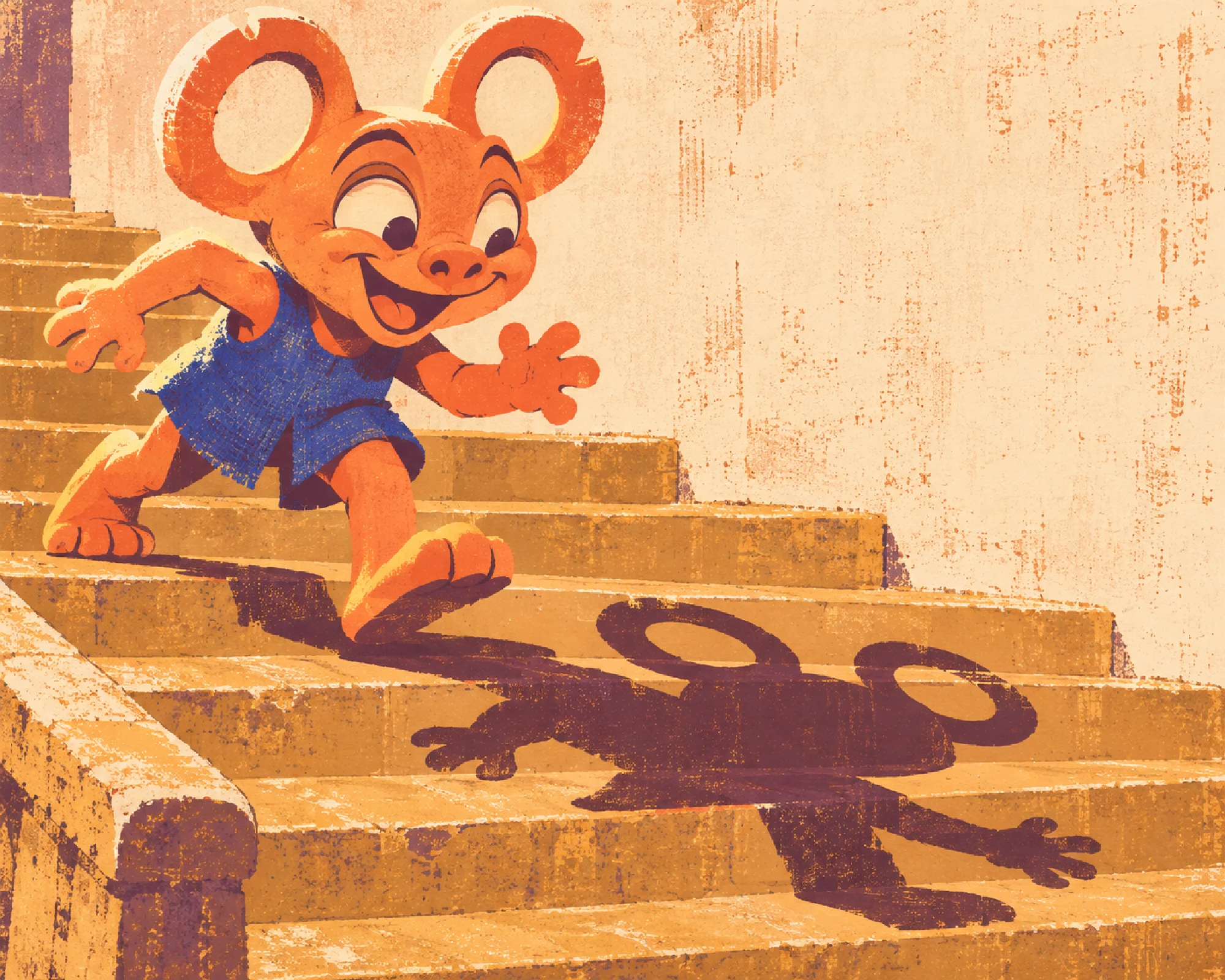
A Hoop-Eared Creature Racing Its Shadow
A small hoop-eared creature races its own shadow down a staircase. Overlapping silhouettes, decisive ink shapes, and an exuberant face turn the moment into a lively screen-printed character illustration.
Remix this referenceA Hoop-Eared Creature Racing Its Shadow
- Form language
- Build shapes from bold lobes and clipped wedges; alternate expansive curves with abrupt cuts to establish a decisive graphic rhythm.
- Contour
- Use mostly unoutlined silhouettes with blunt, slightly ragged stencil edges; reserve short heavy strokes for essential interior separations.
- Mark-making
- Broad screen-printed ink deposits carry occasional squeegee streaks and broken dry patches; let their size and spacing vary naturally.
- Surface rendering
- Use a few discrete tonal shapes and visibly overlapping ink layers; slight registration slips and paper show-through keep the print handmade.
Priority
Preserve graphic screen printing with decisive shape rhythms and visible ink behavior.
What to avoid & what to check
Exact prompt for this example
MODULE OWNERSHIP
subject: Subject count, type, stable proportions and landmarks, resting face geometry, hair shape, physical materials, garment construction and permanent marks. No emotion, movement, color assignment or rendering recipe.
expression: Facial soft-tissue displacement and pupil direction, muscle coordination, regional intensity, asymmetry and onset/peak/release. No head/body pose, stable appearance, skin color or rendering.
gesture: Head/neck/body/limb orientation, joint movement, support, contact and pose-caused occlusion using existing anatomy. No eye/pupil movement, emotion, identity, props inventory or camera.
props: Prop count, type, construction, physical material and scale relative to the subject. Holding/contact belongs to gesture, position to composition, color to palette.
scene: Environment elements, terrain, backdrop/floor presence and structural detail. No canvas positions, camera, lighting, assigned colors or render texture.
camera: Projection, focal-length impression, camera elevation/yaw/roll, viewing distance and crop. No actor pose, world placement, lighting or canvas aspect ratio.
composition: Normalized 0-100% canvas positions, scale in frame, depth/overlap, focal hierarchy and margins. No joint pose, camera projection, rendering, subject/prop inventory or emotion.
palette: Color anchors, hue/saturation/value ranges, colors assigned to parts and approximate color coverage. No illumination direction, shading algorithm, physical material or layout.
lighting: Light-source direction/softness/intensity, ambient illumination, physical shadow direction/length and highlight position. Absence of directional illumination is allowed. No shading technique, palette or material changes.
style: Reusable form abstraction, contour weight/taper/edge quality, medium and mark scale/density/direction, surface rendering and tonal transition technique. No fixed subject proportions, anatomy, identity, expression, pose, palette, light-source direction, camera or layout.
output: Image count, aspect ratio, size, file/alpha requirements and global lettering/logo/watermark restrictions. No background scenery, crop, style, identity or pose.

SUBJECT
inventory: A is one original, small bipedal creature with hollow hoop ears; there are no other figures.
geometry: A has a flattened pear-shaped head, squat torso, mitten hands, and broad three-toed feet beneath slender legs.
resting-face: Wide-set oval eye sockets sit above a low bulb nose, short muzzle, and naturally broad mouth.
appearance: A has supple smooth hide and a coarse woven sleeveless tabard with a split hem; the left ear ring has a small nick.

PRIORITY


AVOID


CHECK


EXPRESSION — ACTOR A
brows: Both brows lift, with the left outer end slightly higher.
lids: Upper lids stay open while the lower lids rise with the cheeks.
cheeks: Both cheeks bunch upward, with a deeper fold on the left.
nose: Nostrils widen slightly without wrinkling the nose bridge.
mouth: An open grin stretches both corners outward, the left corner higher.
jaw: The jaw drops loosely enough to keep the grin open.
gaze: Pupils look down and right toward the leading edge of A's shadow.
coordination: Raised cheeks and lower lids support the open grin; keep the brow lift buoyant.
timing: Capture delight at its apex, with the grin fully formed and the cheeks still lifted.

PRIORITY


AVOID


CHECK


GESTURE
head: A extends the neck slightly forward and turns the head down toward the stairway ahead.
torso: The torso pitches forward in a descending run, with a small countertwist through the shoulders.
limbs: One knee drives forward as the trailing leg extends; opposing arms swing with relaxed, open hands.
contact: The trailing forefoot pushes off an upper tread while the leading foot reaches over the next step.

PRIORITY


AVOID


CHECK


PROPS
inventory: No separate props.
construction: No prop construction applies.

PRIORITY


AVOID


CHECK


SCENE
inventory: A broad outdoor masonry staircase, a low side parapet, and an uninterrupted wall define the setting.
structure: Generous stair treads descend between the wall and parapet; worn edges soften the otherwise simple construction.

PRIORITY


AVOID


CHECK


CAMERA
projection: Use a mild wide-angle perspective that keeps the staircase legible without extreme convergence.
viewpoint: View from an elevated front three-quarter position, with a level horizon and no camera roll.
crop: Show A's complete figure and the cast shadow; let the surrounding architecture continue beyond the crop.

PRIORITY


AVOID


CHECK


COMPOSITION
placement: A occupies the upper-left half; the shadow reaches across the lower-right half, forming a descending diagonal pair.
depth: A's silhouette overlaps the stair bands; the tabard and shadow form spatially separate accents.
spacing: The face leads attention, followed by the shadow; leave an open wall area at upper right and breathing room around the ears.

PRIORITY


AVOID
No borders or character-sheet panels.

CHECK


PALETTE
colors: Use warm apricot, ultramarine, muted ochre, deep plum, and paper cream.
assignment: A's hide is apricot, the tabard ultramarine, the stairs ochre, the shadow plum, and the wall cream.
balance: Warm architecture occupies the broadest color areas; ultramarine and plum provide smaller dark accents.

PRIORITY


AVOID


CHECK


LIGHTING
sources: Strong low sunlight arrives from behind A at upper left, supported by soft ambient illumination.
shadows: A casts a long, clearly edged shadow down and right, connected across successive treads and risers with readable ear openings.
highlights: Light catches the upper-left edges of ears and shoulders, with restrained highlights on the face.

PRIORITY


AVOID


CHECK


STYLE GUIDE
form-language: Build shapes from bold lobes and clipped wedges; alternate expansive curves with abrupt cuts to establish a decisive graphic rhythm.
contour: Use mostly unoutlined silhouettes with blunt, slightly ragged stencil edges; reserve short heavy strokes for essential interior separations.
mark-making: Broad screen-printed ink deposits carry occasional squeegee streaks and broken dry patches; let their size and spacing vary naturally.
surface-rendering: Use a few discrete tonal shapes and visibly overlapping ink layers; slight registration slips and paper show-through keep the print handmade.

PRIORITY
Preserve graphic screen printing with decisive shape rhythms and visible ink behavior.

AVOID


CHECK


OUTPUT
format: One finished image, landscape 5:4, 2000 × 1600 pixels, opaque PNG.
restrictions: No lettering, logos, or watermarks.

PRIORITY


AVOID


CHECK


FINAL INTEGRATION
expression + gesture: The facial performance and running action cooperate to make the solitary game feel exuberant.
composition + lighting + style: The cast shadow becomes a graphic partner through the arrangement and print treatment while retaining its connection to A.
Model information comes from image provenance. The same prompt may produce a different result.