Text to imageAnimationStyle guide
Grass in the Open Planetarium
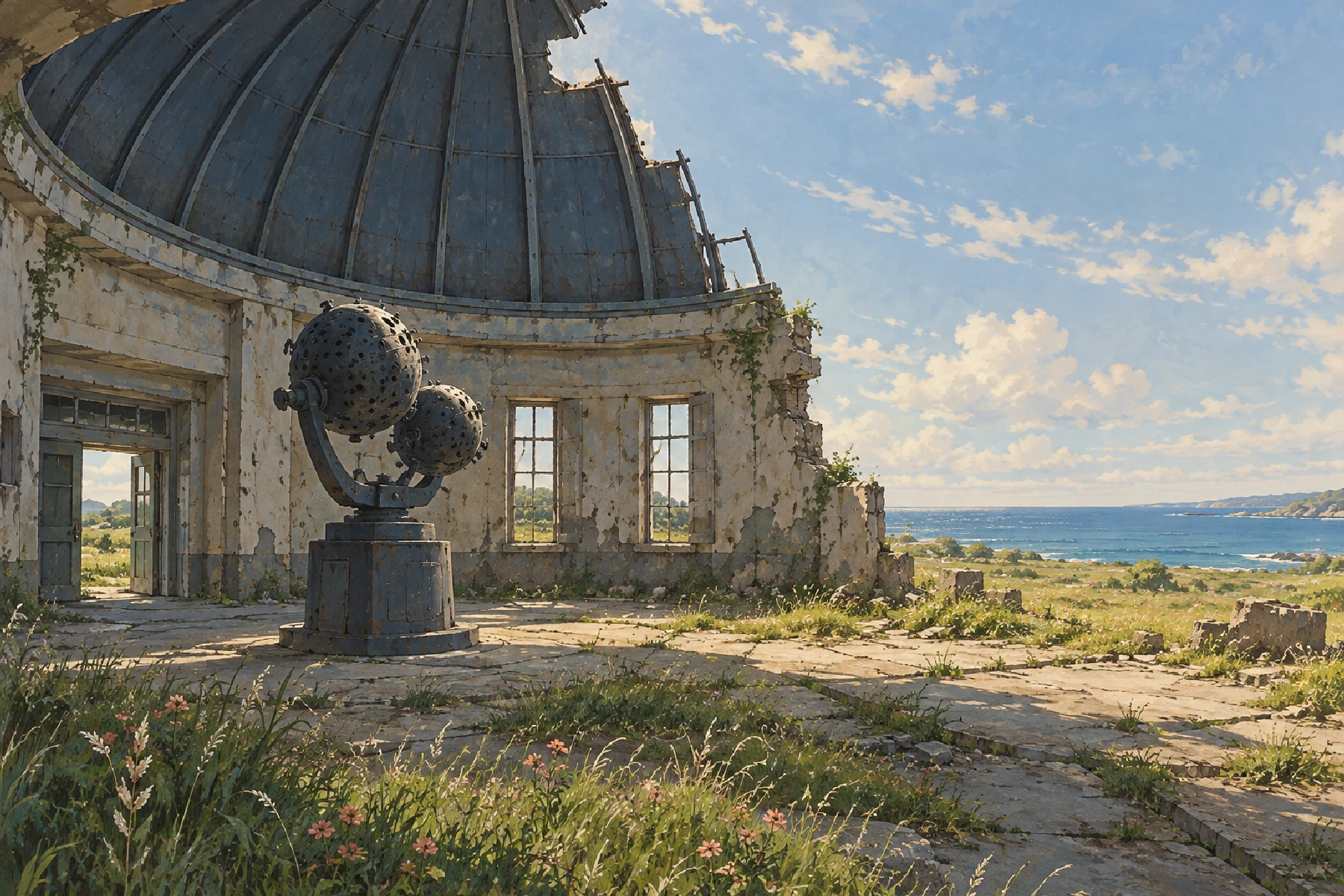
The sea appears beyond a broken dome, and meadow grasses surround a silent star projector. The roof forms a dark crescent around an expansive pale sky, creating a quiet moment of discovery.
Remix this referenceGrass in the Open Planetarium
- Form language
- Establish broad interlocking painted planes, then add selective surface patches; simplify small detail into irregular grouped shapes.
- Contour
- Let hard and soft painted boundaries alternate; use occasional thin broken accents instead of continuous heavy outlines.
- Mark-making
- Overlap broad brush traces along surface planes, with sparse dry-brush catches and freely varied finer strokes for small forms.
- Surface rendering
- Build opaque paint over shallow paper grain; blend neighboring tones unevenly, retaining pigment flecks and a few visible repaint edges.
Priority
Rendering medium: 2D hand-painted animated-film background illustration; formal rendering reference: Studio Ghibli · 2020s · The Boy and the Heron (2023), background art
What to avoid & what to check
Exact prompt for this example
MODULE OWNERSHIP
subject: Subject count, type, stable proportions and landmarks, resting face geometry, hair shape, physical materials, garment construction and permanent marks. No emotion, movement, color assignment or rendering recipe.
expression: Facial soft-tissue displacement and pupil direction, muscle coordination, regional intensity, asymmetry and onset/peak/release. No head/body pose, stable appearance, skin color or rendering.
gesture: Head/neck/body/limb orientation, joint movement, support, contact and pose-caused occlusion using existing anatomy. No eye/pupil movement, emotion, identity, props inventory or camera.
props: Prop count, type, construction, physical material and scale relative to the subject. Holding/contact belongs to gesture, position to composition, color to palette.
scene: Environment elements, terrain, backdrop/floor presence and structural detail. No canvas positions, camera, lighting, assigned colors or render texture.
camera: Projection, focal-length impression, camera elevation/yaw/roll, viewing distance and crop. No actor pose, world placement, lighting or canvas aspect ratio.
composition: Normalized 0-100% canvas positions, scale in frame, depth/overlap, focal hierarchy and margins. No joint pose, camera projection, rendering, subject/prop inventory or emotion.
palette: Color anchors, hue/saturation/value ranges, colors assigned to parts and approximate color coverage. No illumination direction, shading algorithm, physical material or layout.
lighting: Light-source direction/softness/intensity, ambient illumination, physical shadow direction/length and highlight position. Absence of directional illumination is allowed. No shading technique, palette or material changes.
style: Reusable form abstraction, contour weight/taper/edge quality, medium and mark scale/density/direction, surface rendering and tonal transition technique. No fixed subject proportions, anatomy, identity, expression, pose, palette, light-source direction, camera or layout.
output: Image count, aspect ratio, size, file/alpha requirements and global lettering/logo/watermark restrictions. No background scenery, crop, style, identity or pose.

SUBJECT
inventory: One original abandoned planetarium building; no people or animals.
geometry: A broad, low circular hall carries a ribbed dome with a large missing wedge and a short rectangular entrance wing; an outer-wall breach opens the hall to the exterior.
resting-face: No facial geometry applies.
appearance: Plastered masonry walls, a sheet-metal dome and stone thresholds show weathered fractures; minor damage may vary naturally.

PRIORITY


AVOID


CHECK


PROPS
inventory: One old star projector, approximately waist-high relative to the entrance doorway.
construction: Two perforated metal globes share a forked iron support above a squat pedestal; small fittings may vary.

PRIORITY


AVOID


CHECK


SCENE
inventory: A coastal heath, a distant sea horizon, thin clouds and meadow grasses with a few small flowers surround the site.
structure: Concrete flooring remains inside; grass grows through broken floor joints.

PRIORITY


AVOID


CHECK


CAMERA
projection: Natural perspective with a moderately wide lens impression and restrained edge distortion.
viewpoint: View from just above standing eye level, obliquely across the interior, with a level camera.
crop: Use an environmental wide shot; crop part of the near dome rim and foreground floor while keeping the projector complete.

PRIORITY


AVOID


CHECK


COMPOSITION
placement: The shell occupies the left half and curls across the top; place the projector near 35% width and 70% height.
depth: Foreground grass overlaps the floor, the projector anchors the middle distance, and the wall opening reveals the sea beyond.
spacing: Make the dome opening the dominant shape and the projector a secondary discovery; reserve broad quiet sky across the right half.

PRIORITY


AVOID


CHECK


PALETTE
colors: Use warm ivory, slate blue, muted sage and dry ochre, with a tiny dusty-coral accent.
assignment: Assign ivory to sky and plaster, slate to dome and projector, sage to grass, ochre to bare ground and coral to flowers.
balance: Pale ivory dominates, slate forms a substantial dark counterweight, and subdued vegetation carries the remaining color.

PRIORITY


AVOID


CHECK


LIGHTING
sources: Broad soft morning sunlight enters from the upper left; open-sky ambient light gently reaches the interior.
shadows: The shell casts a broad softened shadow toward the lower right; the projector adds a shorter shadow in the same direction.
highlights: Gentle highlights catch upper-left dome edges, globe shoulders and exposed grass tips.

PRIORITY


AVOID


CHECK


STYLE GUIDE
form-language: Establish broad interlocking painted planes, then add selective surface patches; simplify small detail into irregular grouped shapes.
contour: Let hard and soft painted boundaries alternate; use occasional thin broken accents instead of continuous heavy outlines.
mark-making: Overlap broad brush traces along surface planes, with sparse dry-brush catches and freely varied finer strokes for small forms.
surface-rendering: Build opaque paint over shallow paper grain; blend neighboring tones unevenly, retaining pigment flecks and a few visible repaint edges.

PRIORITY
Rendering medium: 2D hand-painted animated-film background illustration; formal rendering reference: Studio Ghibli · 2020s · The Boy and the Heron (2023), background art

AVOID


CHECK


OUTPUT
format: Deliver one finished image as an opaque PNG, 1800 × 1200 pixels, with a 3:2 aspect ratio.
restrictions: No lettering, logos, signatures or watermarks.

PRIORITY


AVOID


CHECK


FINAL INTEGRATION
subject + composition + style: Let painted edge variation reinforce the spatial hierarchy while preserving the architectural construction.
Art direction
스튜디오 지브리 / Studio Ghibli · 2020s · 그대들은 어떻게 살 것인가(2023)의 배경 미술 / The Boy and the Heron (2023), background art ↗- Establish broad form planes before describing smaller surface variations with painted patches
- Use hard and soft painted boundaries rather than strong continuous outlines
- Overlapping brush traces following the plane direction with sparse dry-brush marks
- Shallow paper-and-pigment texture, uneven painted planes and blended tonal transitions
Model information comes from image provenance. The same prompt may produce a different result.